Provence: Outdoor Cafes

Lunch time in L'Isle-sur-la-Sorgue With New Friend

Outdoor cafes and restaurants are virtually a way of life and extremely important for socializing with friends and beasts. Some friends are invited and some just make their way to your table. You hardly can go wrong, taking in a moment to yourself, a refreshment, a possible bite to eat, and a chance to catch up with your day.

Cafe Time in Aix-en-Provence

Take a beautiful outdoor cafe, mix in a bit of sunshine and fresh air, add a steaming cup of espresso, and viola, your day is made.

One of the most beautiful and impressive places to sit in a cafe and experience the "cafe life" is on Cours Mirabeau in Aix-en-Provence. It is often called the Avenue des Champs-Elysees of the south. This grand boulevard with its massive plane trees and ancient moss-covered trickling fountains was first laid out in 1651. Nearly 400 years later, it still is a wonderful boulevard to sit at an outdoor cafe, and just experience life. I suggest the famous cafe, Le Deux Garcons towards the top of the grand boulevard.

Provence Markets "Spice Up Your Life"

Spice Vendor, Lourmarin Friday Market, Provence

The photo above is of the lively Friday morning market in Lourmarin, also the village where famed English author, Peter Mayle, who wrote A Year in Provence and other novels, calls home.

One of my very favorite things to do when traveling is to frequent the local markets. As a matter of fact, I plan my itinerary around the flea markets, antique markets, fresh produce markets, bird markets, flower markets, etc. Markets are so colorful, and give you a real slice of local people, life, culture, and ambience. Markets are very lively and the vendors often very outgoing and playful types.

Markets are a way of life, especially in Provence, France. Locals shop frequently for fresh ingredients and produce, rather then once a week or every two weeks. The markets are held different days in different villages, and often specialize in certain items. Usually a guidebook, or articles on a particular market will divulge which "must have" items to seek out. Also, the month you are traveling may determine what is in season, and what to purchase. In Provence, cherries are a delectable treat in May, and lavender is in full bloom in July.

One of the "must have" items for me, are spices. I love to collect and buy spices whenever I travel. Each country has their cuisine and flavors, and what better way to relive your trip and experiences then making their local dishes and recipes, with local spices you have purchased there. Spices are easy to pack, and usually have a long shelf life. Spices are a small splurge, and a small effort to take home for memorable times long after your trip. They also make wonderful, reasonable gifts for loved ones, and especially for those who like to cook.

Produce Is Elevated To Art Form

In Provence, its wonderful markets are brimming with Provence cheese, black olive tapenades, lavender honey, flowers, olive oils, wonderful hand-made sausage, local crafts, colorful Provence linens, hand-made pottery, delightful breads, and seasonal fresh fruit and vegetables. When you are here, take advantage of these incredible foods and flavors and experience Provence. You must pick up some famous "Herbes de Provence" which usually consists of dried thyme, basil, savory, fennel, and lavender.

Provence outdoor markets are a treat for all of your senses with colors, aromas, tastes, and people-watching. Some of my favorite markets in Provence are the Tuesday: Vaison-la Romaine, Thursday: Nyons, Saturday: Apt, Sunday: L'Isle-sur-la-Sorgue.

"Postcards From Provence"

Magic of Provence, Red Poppies Blooming in May

I am not an expert on Provence, France, but I have studied, researched, and created two wonderful 2007 and 2008 spring itineraries that my husband, John, and I followed to experience the heart and soul of Provence. There is something so magical about Provence, it reaches to my very core. I snapped the above photo, roadside on an early Sunday morning, heading to the famous and fabulous L'lsle-sur-la-Sorgue antique market.

It is hard to pinpoint why Provence is so special. Is it the light that Van Gough would talk about and try and capture in his paintings? Is it the Roman influence of ancient engineering masterpieces, roads, and villages that survive to tell their story? Is it the legendary "mistral wind" that bellows through the famous Cote du Rhone valley? Is it the unspoiled rural countryside beauty? Is it the absolutely charming people full of rich tradition and culture? Is it the incredibly fresh and mouth-watering seasonal foods and time-proven wines? Is it the fact that you never know who you will run into at a cafe, or bump elbows with at an outdoor market? Ah, you will just have to go sometime and ponder these questions yourself. If you have been to Provence, and have some wonderful stories, please share.

Writing about a few things that makes Provence so magical a place is difficult. I could jot down a long detailed list, but prefer instead to share with you a few snapshots, that those fortunate to call Provence their home experience on a regular basis, if not daily.

Generally, my itineraries are "off the tourist beaten path", preferring to visit the lesser known special places, such as Edith Mezard's tiny linen and embroidery shop in Lumieres, the Abbaye St. Andre gardens across the river from the popular city, Avignon, or the little cheese shop, Lou Canesteou, in Vaison-la-Romaine, to name a few. Rick Steves' Provence and The French Riviera 2009 is a good guidebook for general information, tips, and proven itineraries for those wanting a starting point.

Some of my favorite books written about Provence, were the catalyst to visit this special part of France, and experience it first hand. If you can't get to Provence in the near future, perhaps you would like to begin by reading some of these wonderful books. For more information on these books, just "click" on their titles. A Good Year. A Pig in Provence: Good Food and Simple Pleasures in the South of France.A Year in Provence.Words in a French Life: Lessons in Love and Language from the South of France.

Please follow along with me for more snapshots of Provence.

Bake With Bloom, Bite-Size Desserts

Carole Bloom's Latest Book, Bite-Size Desserts If you or any of your loved ones has a sweet tooth, you must know about my long time dear friend and baking expert, Carole Bloom. Carole is a European-trained pastry chef, confectioner, chocolatier, and best selling author of nine cookbooks.

Her latest cookbook, just released from Wiley in April 2009, is Bite-Size Desserts. Carole is riding the wave of one of the hottest food trends in this country today, small desserts that deliver big delectable flavors. Bite-Size Desserts, has a lively and lovely format, beautiful mouth-watering photos, and a total of 87 tantalizing recipes.

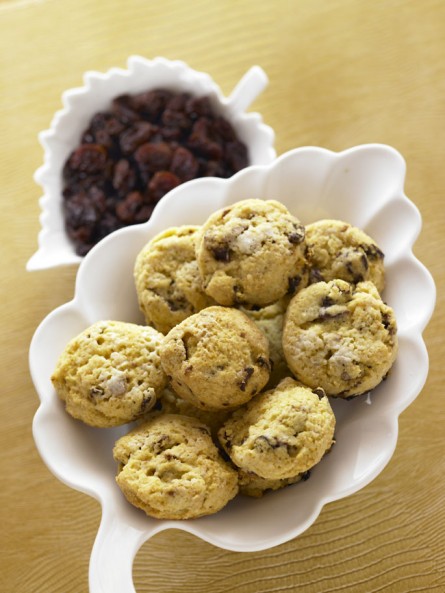
I had her book one week, and had already gleefully made "cornmeal-dried cherry scones", "wicked brownie bites", and "raspberry-blueberry crisps".  Below is a special treat for all of you,  Carole Bloom's "Cornmeal-Dried Cherry Scones" recipe. Enjoy. For book and purchase information, click on, Bite-Size Desserts: Creating Mini Sweet Treats, from Cupcakes and Cobblers to Custards and Cookies

Carole Bloom's "Cornmeal-Dried Cherry Scones"

"I love to use cornmeal in baking because it provides lots of texture. It works deliciously with the dried tart cherries in these scones. These are lovely for breakfast, afternoon tea, and as a snack. They taste best when warm and can be reheated in a 350 degree oven for 7-9 minutes."

MAKES 2 dozen 2-inch round scones.

Ingredients: 3/4 cup (3-1/4 ounces) all purpose flour 2/3 cup (4 ounces) fine yellow cornmeal 1 tablespoon (1/4 ounce) plus 1 teaspoon granulated sugar 1-1/2 teaspoons baking powder 1/8 teaspoon kosher or fine-grained sea salt 2 ounces (4 tablespoons, 1/2 stick) unsalted butter, chilled 2/3 cup (3-1/2 ounces) dried tart cherries 1/3 cup plus 2 teaspoons heavy whipping cream 1 extra-large egg, at room temperature 1/2 teaspoon pure vanilla extract

Adjust the oven racks to the upper and lower thirds and preheat the oven to 350 degrees F. Line 2 baking sheets with parchment paper or nonstick liners.

*** Pulse together the flour, cornmeal, 1 tablespoon of sugar, baking powder, and salt in the work bowl of a food processor fitted with a steel blade.

*** Cut the butter into small pieces and add it to the four mixture. Pulse until the butter is cut into very tiny pieces, about 30 seconds. The texture should be sandy with very tiny lumps throughout. Add the dried cherries and pulse a few times to mix.

*** Use a fork to lightly beat 1/3 cup of cream with the egg and vanilla in a liquid measuring cup. With the food processor running, pour this mixture through the feed tube and process until the dough forms itself into a ball, about 30 seconds.

*** Dust a large piece of waxed or parchment paper with flour and turn the dough out onto it. Knead the dough briefly and form it into a round about 3/4 inch thick. Dip a 1-1/2 inch round plain-edge biscuit cutter in flour and use it to cut straight down through the dough and lift straight up, without twisting, to form the scones. Twisting seals the edges of the dough and keeps the the scones from rising well as they bake. Gather the scraps together, knead briefly, and roll and cut the remaining dough into scones. Transfer the scones to the lined baking sheets, leaving at least 1 inch of space between them so they have room to expand as they bake.

*** GARNISH

Brush the tops of the scones with the remaining 2 teaspoons of cream, taking care that it doesn't run down the sides and under the scones. If it does, wipe it up because it can cause the bottoms of the scones to burn. Lightly sprinkle the tops of the scones with the remaining 1 teaspoon sugar.

*** Bake for 9 minutes. Switch the baking sheets and bake another 9 minutes until the scones are light golden. Remove the baking sheets from the oven and cool the scones completely on the baking sheets on racks.

*** KEEPING Store the scones in an airtight plastic container between layers of waxed paper at room temperature up to 4 days. To freeze up to 4 months, wrap the container tightly in several layers of plastic wrap and aluminum foil. Use a large piece of masking tape and an indelible marker to label and date the contents. If frozen, defrost the scones overnight in the refrigerator and bring to room temperature before serving.

MAKING A CHANGE Add 1/3 cup of coarsely chopped toasted walnuts or pecans with the cherries. Replace the dried tart cherries with dried cranberries or dried blueberries.

Congratulations Carole, on your new Bite-Size Desserts cookbook! It is such a delightful cookbook to read, as well as bake with. Your flavor combinations are genius. Please visit www.carolebloom.com for more information on her cookbooks, classes, and schedule.

How To Compost In Your Backyard

Compost Bin And Ready Compost

Would you like to do something great for your garden, rewarding for you, and green for planet earth? It is called composting. It is very easy to get started. One, you save money on conserving water and not having to buy commercial fertilizers and soil amendments. Two, you enhance your soil health, fertility, and inhibit weed growth. Three, your gardens will require less water because the soil is able to retain water moisture more efficiently. Four, by composting and recycling, less of all of this is going into land fills, and the organic humus material is going back into your gardens for your benefit. Does your city have a "Compost Bin Subsidy Program"? See below.

Everyday I add to my compost, by following my kitchen- to chicken coop- to compost bin routine. First, by my kitchen sink corner, I keep a little open triangle plastic container with drain holes. In it goes my brewed coffee grains and filter, fruit and vegetable clippings, etc. Each morning when I open up my chicken coop for the day, I skim my chicken manure box, adding chicken manure and some pine shaving bedding to the mix. I put all of that in my compost, and layer it with grass clippings, which we heap in a pile outside of our compost bins, after mowing our lawn.

I layer my compost bin with my kitchen additions, chicken manure, leaves from the yard, and grass clippings. The smaller the pieces you add to your compost, the quicker your added materials will break down into compost. I make sure my compost bin mixture is moist. Continue to add water if your compost bin mixture is dry, and rotate it every few weeks with a pitch fork to aerate it. In a matter of 6-12 weeks, especially if you keep your compost bin in a partly shady area and moist, microorganisms break down these materials and create an extremely rich-nutrient dark organic mixture.

The formula for composting is to use about 50% greens, which is the nitrogen or the fire, and 50% browns, which is the carbon or the fuel. This formula does not have to be exact. With the addition of water and oxygen these two elements begin to breakdown and create heat. You might want to splurge and buy a compost thermometer which has a long stem to poke down into the heart of your compost bin, and read the temperature. You want your compost pile up around 120-150 degrees F, to start the decomposition process and kill any weed seeds, etc. Eventually your compost will stop heating up, after it has been turned. This means your compost is nearly ready, and it will benefit by leaving it be, for a few weeks more.

Greens are fruit and vegetable clippings, fresh grass clippings, yard trimmings, egg shells, tea bags, coffee grinds and filters, and breads. Manure is nitrogen, and also considered greens, which is an extra bonus to your compost, but you must add other green to your mixture other than manure. Horse, cow, sheep, and chicken manure are wonderful to use. Be mindful that manure can be "hot", as in potential to burn your plants, if not composted adequately and given time to break down.

Browns are dried leaves, wood materials, ground up branches and twigs, bark, straw, hay, pine shavings, sawdust, shredded paper, and wood ashes. Some browns take a long time to break down such as pine needles, so I do not include them.

What does not go into your compost bin. Think of your compost as vegetarian, therefore no meat, fish, poultry, bones, oils, lard, grease, dairy products. No dog or cat manure, or your cat litter box fill. No treated wood products, charcoal or pressed-log ashes. If you are unsure of something, leave it out.

Space required for composting is about a 3' square area. I have three bins going at one time, so I have more area devoted to composting. Don't forget about the potential for composting at school, or work, too. You want an area which is partially shady spot, and one which is easy to maneuver around in. Locate your compost bin in a "tucked away" but convenient area.

Compost bins can be home-made with simple materials such as stacked pallets, or quarter inch wire mesh 12' long, wrapped in a circle, and held together with a hook and eye at the top and bottom. There are also plans available on the Internet to make them, or manufactured bins available for sale at nurseries, and mail-order.

If you want to start backyard composting, check with your city first to see if they subsidize a "compost bin program". For instance, my city, Encinitas, has been quite proactive in recyling, compost workshops, and encourages residents to compost by subsidizing "Smith & Hawken" compost bins, http://www.smithandhawken.com/catalog/product.jsp?productId=prod21199&categoryId=cat240046p&sku=21199 that normally retail for $129, for only $35 each, limit two per year/per Encinitas household. These compost bins are available for non-Encinitas residents too, for a special non-profit reduced price, price and availability is subject to change. For further information visit, www.solanacenter.org or call, (760) 436-7986, x222.

The City of Encinitas has set aside funds for this program, and has had this program in place for many years now. If your city does not have a "Compost Bin Subsidy Program" like Encinitas, contact your city and ask for one. Make your voice heard. Start with the "Recycling Department" within your city. Does your city have a great "green" program in place, that you would like to share? Do you know of other benefits of composting that haven't been mentioned? Please share your comments.

Composting has made gardening easier for me. It is so delightful to see my gardens flourishing, and every time I dig into my soil, there is another good sign, an abundance of worms.

Repetition Is Design

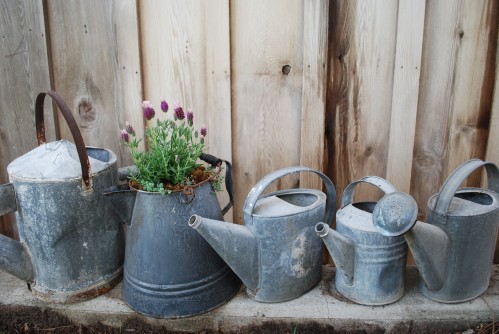
Vintage Watering Cans Make A Statement Have you ever walked into some one's home or garden for the first time, and immediately felt at ease, comfortable, with your senses confirming that this room or space is working in unison? Most likely your host or hostess has beautifully incorporated the basic design principles on purpose or unknowingly by instinct. Generally speaking, the best designed and pleasing spaces, rooms, and gardens, are the ones that have evolved over time, adding a little bit at a time. Remember to adhere to the five basic principles of design as you create your space. They are scale and proportion, balance, rhythm, emphasis, and harmony.

Within the rhythm design principle is repetition. Repetition is created by repeating color, pattern, test, light, or form in your space. Do you notice how much better plants look if they are grouped in mass plantings or at least three's or five's? Have you stopped buying singles of this and that unless for a focal setting? Same principle goes for incorporating your personal style into your garden, home, and personal space. Repetition is design.

Repetition is a very easy way to emphasize your style and with elements important to you in your garden. These beautiful time-worn watering cans would not have half as much "punch" dispersed throughout a garden, as they do punctuated spout to spout.

It can be something as simple as watering cans, container pots, vintage garden tools, rocks, Adirondack chairs, birdhouses, bird feeders, sculpture, antique fencing, glass pieces, and collections. Have you ever seen photos of potting tables with all sorts of terracotta pots in various sizes, stacked and piled together? What a fabulous look, "design by default". I spoke earlier this past fall about "what is your garden style". What kinds of things emphasize your garden style? What do you collect, enjoy, and can be repeated?

What have you repeated in your garden, by design or happenstance that works brilliantly? Repeating favorite things in your garden, home, and space, morphs into design and your style.

Borage Is Bold

Blue Borage Next To Santa Barbara Daisy There is nothing boring about Borage, Borago officinalis. It is the epitome of why herbs are so great, and how you can enjoy them in your garden as well as their many versatile uses.
"Borage is Bold", and has been associated with courage literally, since medieval times by its ability, to make people happy, dispel their melancholy, and comfort the heart.

Borage is an annual garden herb often seen in cottage gardens. It is a culinary herb traditionally, which also has the good fortune of attracting bees with its beautiful vibrant "periwinkle blue" flowers. There is also a white-flowered borage, which is not as common. Borage prefers full sun, little water, and tolerates poor soil. It is a tall plant in the garden, reaching at maturity 2-3' high and and 1-2' wide. Its leaves are hairy and somewhat prickly. It easily self sows in your garden, but does not transplant well.

Borage is a great companion plant for strawberry plants, actually enhancing their fruit flavor and yield. Also, tomato growers will be happy to know that borage enhances tomato vine growth and disease resistance when planted near by. Borage plants are an excellent source of calcium and potassium, so be sure and compost your spent plants.

Blue Borage Flower Ice Cubes

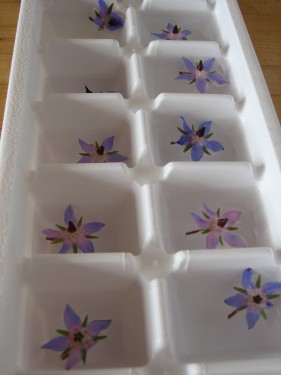
Borage flowers are terrific used as a garnish, decorating, and styling. When my borage is blooming I harvest the "periwinkle blue" flowers and make "borage ice cubes". Imagine "borage ice cubes" bobbing in a refreshing homemade lavender-steeped lemonade this summer.

Borage flowers are one of the best edible flowers to use in your home-grown mixed green salad. Sprinkle your spring and summer salads with edible borage flowers, and your salads will "wow".

Candy your borage flowers for decorating and garnish, by crystallizing them for your special occasion cakes, cookies, and tea breads. Harvest and pick off your borage flower heads by gripping the black stamen tips and gently separate the flower from its green back. Rinse and dry edible borage flowers, holding one flower by a petal in your hand, dip a small unused artist paintbrush into a slightly beaten egg white at room temperature, and cover your entire borage flower. Dust your borage flower entirely with a superfine sugar. Let each flower dry completely on a waxed paper surface till free of moisture. This could be a number of days depending on your humidity. Store your dried, crystallized borage flowers in an airtight container. You probably will want to use them right away, but you could potentially keep them as long as a year. Garnish your desired sweet.

Besides borage flowers, young borage leaves have a slight cucumber flavor, and can be used in many types of recipes, too, such as chopped in fresh salads, added to cheeses, with pastas, and as a substitute for spinach.

My enamor with borage is for its beauty and benefit in the garden, and its fabulous attribute as a styling and decorating garnish. Its many additional uses include cosmetic, medicinal, and further culinary uses such as drinks, sauces, jelly, syrups, and more. Be bold with borage, and add some to your life.

Ten Years Of Coffee Cup Thoughts

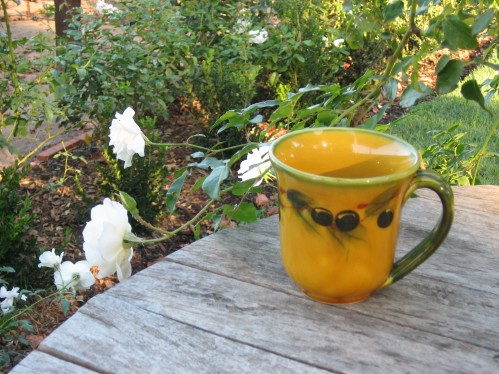
Coffee Cup Thoughts Each morning I start my day in our gardens and opening up our chicken coop for the day. It's early morning, and I am scurrying around to see if any new seeds have sprouted in our kitchen garden, what needs water, what is about to bloom, how my new roses are doing, if what I transplanted recently is doing well, and what chore or project needs to be done. It is also a time I reflect on my gratitude, my blessings, and my bliss. I call these "coffee cup thoughts".

My husband, John, and I have lived here on our cherished property ten years this month. What an adventure it has been and so important a journey in our lives. We feel at one with the massive pine trees so deeply rooted and grounded here. Today is a simple celebration of our time here, and the joy, living here has meant to us. I wanted to reflect on ten special happenings or experiences, one for each year, that have touched our lives, and share them with you.

* Out of nowhere came a first-sighting of a stunning male and female bluebird in our vineyard, curious visitors and eager to follow us aound. It had been almost seven years and nary a sighting of any bluebirds before. Why were they here now?

* Collecting "still warm in your hands" just laid eggs from our happy hens. The indescribable golden goodness and taste of fresh organic eggs, and our sweet "Hollywood Girls" who laid them.

* A stunning perfect rainbow over our vineyard, and the Pacific Ocean to our west. Was the "pot of gold" here? It has happened just once.

* The excitement of our first vineyard harvest, so many years down the road from when it first was just an idea. All the time, classes, care, management, and devotion to our vines, culminating in the beautiful ink-black elongated syrah clusters gloriously dangling from our vines. The grapes were ripe, the brix (sugar %) was right, and each grape was so tasty, sweet, and juicy. Will these grapes transform into great wine?

* Last year's first bite into a delicious ripe fuji apple off of our espaliered tree. Our fuji apple trees had just limped along for years, and then last year, they produced the most "mouth-watering" sweet and crunchy fresh-freckled apples I have ever tasted. Will this year repeat?

* Hearing the first incredibly romantic banter of a pair of equally-matched barn owls. It sent tingling goosebumps up my spine. Will they be back this winter?

* The first sweet wafting scent from my spring blooming patch of sweet peas, so beautiful a natural perfume, and unexpected as I innocently walked by. It totally stopped me in my tracks. Could there by anything more divine at that moment?

*Finding my first hummingbird nest, so very tiny, and intricately engineered. We have some many wonderful and curious hummingbirds that greet and visit with us each and every day. It is reassuring that they make our gardens, their home, too.

*Watching the sun traverse the horizon in ever so gradual increments, day by day, month by month, moving north in the spring/summer, and south in the fall/winter, always setting perfectly into the Pacific Ocean, and reminding us to be grateful for every single day. We had been here several years before, right before our eyes, we saw two looming islands off our horizon. Dry and clear conditions have to be so perfect, we are lucky to see the islands once or twice a year.

*Understanding the art of growing an abundance of home grown vine-ripened heirloom tomatoes. Making our first summer-grilled pizza with fresh oregano pesto, aged gouda cheese, and sliced absolute-perfection "Jubilee" tomatoes.

I have not even mentioned our family and friends that have been so much a part of our time here, too, and shared in the many great times, celebrations, and experiences. Please know who you are, and how grateful, you are in our lives. I would have to write a "book" to cover it all.

These are only ten "firsts", and I could have mentioned so many, many more. Remember to embrace the simple joys and pleasures in your world and garden, as they are gifts for you.