Make Mom Happy With A Rose Plant

Double Delight's First Spring Bloom Does your mom live a "stone's throw" away from you? Are you able to make her and all of your loved ones a delightful Mother's Day Brunch celebrating "her day" with your fresh eggs, delicately poached over heart-shaped polenta, melon-drizzled vinaigrette over arugula greens, blue cheese, and proscuitto, and gloriously ending with fresh berries and sour cream coffeecake? No, does she live out-of-state like my mom? Well, here is a great suggestion.

Stumped what to get your mom for Mother's Day? Say you "love her" with a symbol of love, a beautiful new rose plant for her garden. If you're a gardener, chances are you got your love of "digging in the dirt" from her.

If you haven't heard of Edmund's Roses before, you are in for a treat. Edmunds' Roses has an extensive selection of all kinds of bareroot roses, such as antique roses, floribundas, climbers, tree roses, hybrid tea roses and more. Once ordered, Edmunds' Roses sends out bare root roses, time-appropriate according to your plant zone you live in, so you receive your roses at their optimal time for planting. Prices and shipping are reasonable.

Edmunds' Roses is open year round for orders, and customer service, but actually ship their bare root roses from December through May each year. With Mother's Day less than a week away, you might consider sending your mom a gift certificate from Edmunds' Roses. Your mom can choose what type of rose she would like, what color, and when she would like it to redeem it. Gift certificates never expire and are available by phone only at, Edmunds' Roses, 1-888-481-7673, Monday-Friday, 8am-4:30pm CST.

A rose plant is something living, and keeps on giving year after year. It is a plant of beauty and emotion. Your mom will enjoy her rose and think of you, in her garden for many years.

Edmunds' Roses is a wonderful idea for other occasions besides "Mother's Day", such as the holidays, birthdays, anniversaries, new home, new baby, and thank you.

Please go to Edmunds' Roses for more information and online ordering.

Chickens & Chicken Coop FAQ

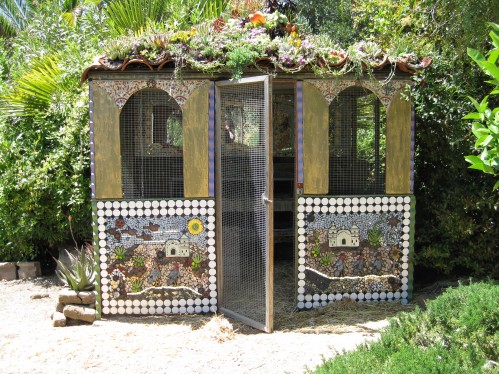
Kathy Lafleur's Amazing Chicken CoopMy dear friend, fellow gardener, and incredible ceramic and mosaic artist, Kathy LaFleur, would only have a chicken coop as befitting as the one in the above photo for her lucky chickens.

Kathy has transformed this aviary into a "palais de poulet" for her hens. On the top of her roof she added roof tiles, and planted beautiful thriving blooming succulents. On the front of her chicken coop she has painstakingly created two unique mosaics. There are more colorful mosaics and mirrors adorning the inside. Notice the two rows of vintage hen nesting boxes in the chicken coop background, and that she uses hay as her preferred bedding material. Hats off to you, Kathy, your creative chicken coop is so inspiring and amazing!

Here are a few FAQ questions from the previous "Backyard Chicken Coop" Series:

What are the best chicken breeds for a backyard chicken coop? It really is your preference, and what your purpose is for having chickens.

My preference for backyard "homesteaders" is the heavy-breed chickens that generally lay brown eggs. Some of my favorites are the Buff Orpingtons, Rhode Island Reds, Barred Rocks, Silver-Laced Wyndottes, and the Black Australorps. The heavy-breed chickens are more docile, friendly, approachable, and are great layers. Ameraucanas lay a pretty blue-green egg, and are a nice choice, too.

If you are pinched for space overall, you might consider the Bantam chicken varieties. They are a smaller chicken that lay large eggs relative to their size. Their space requirements are 1 sq ft/bird inside coop and 4 sq ft/bird outside chicken coop, quite a bit less than the heavy breed chickens at 1.5-2 sq ft/bird inside chicken coop, and 8-10 sq ft/bird for outside pen. Silkies, with their head plumes, and Cochins with their heavily feathered legs are Bantams. I call them designer chickens, pretty and showy, but can be skittish and a bit aloof. You might want to get an assortment of breeds for your backyard flock for variety and fun, but preferably all about the same age.

What is the best floor for chicken coops? Chickens require dry, draft free housing with good ventilation. Ideally you want your chicken coop, raised off of the ground, with sunlight able to access underneath. However, this is not always possible, especially if you have a modified structure or building.

A concrete floor is acceptable, but you must provide ample bedding and make sure it is not damp. A dry, wood floor is acceptable, again with ample bedding. If you are using plywood or wood in general, make sure it is untreated, no chemicals used in manufacturing it. My preference for bedding is pine litter, available at feed stores, because it is manageable and easy to compost with. Hay is another nice choice of bedding. Sometimes your chicken coop design lends itself better to one kind of bedding over another.

An entire wire floor is not ideal, because it can be hard on hen's legs and feet, and manure is dropping where? Wire mesh over the top of your chicken manure box is fine, but not for an entire floor. It also leaves your hen house rather exposed to rodents and varmints.

Where do I position my chicken coop in my backyard? Ideally, you want a quiet corner or spot on your property that is away from your house. It needs to be preferably on a high, well-drained area. You want ample air movement without a draft. Fresh air means fresh oxygen and movement to remove excess moisture, ammonia, and carbon dioxide which hens naturally give off.

It should be an area where the south sun reaches the chicken coop, and the outside pen for a large portion of the day. We have our chicken coop nestled by our orchard, and generally close to our storage shed, and composting area. It is an area slightly removed, but accessible. Fun with landscaping helps muffle sounds from your chickens, and integrates your chicken coop with the rest of your garden.

Chickens are active, and can be remain in their outside pen all day. Remember, if they are laying hens, they will need access to their chicken coop and nesting boxes during the daytime, too. At night time, it is best to tuck your chickens in, by bringing their feed bucket inside the chicken coop, and closing up their outside pen, doors, and windows till morning. Make sure your chickens have adequate ventilation with their chicken coop closed for the night.

When I let my chickens out in my yard, they like to wallow in the dirt. What are they doing? I call it a "dirt bath". They enjoy creating a little basin and laying down in the dirt, flinging dirt over themselves and their feathers. It is a way of cleaning themselves, cooling themselves, and relaxing.

I have a hen who insists on sitting on a "clutch" of eggs for long periods of time. What is she doing? She is brooding, or sitting on her eggs to hatch them. If you have a rooster in your flock, most likely you want fertilized eggs and/or chicks. If your hens sit on fertilized eggs for 21 days, embryos will develop and eventually hatch as chicks.

Even if you don't have a rooster in your flock, some hens will naturally sit or "brood" on their eggs, usually in the spring time. You have a choice to let your hen brood, or collect your eggs as usual. I usually collect my eggs so I know they have recently been laid, and because a hen can actually become emaciated by not moving, eating, or following her regular routine for days and sometimes weeks. Just because you remove all the eggs a hen is sitting on, does not necessarily mean she will stop brooding, too.

I have a neighbor or friend who wants to give me one of her hens that is being picked on in her own flock. Is that okay to do? I have generally had good experience in adopting hens into my flock. I would encourage you to adopt a hen, if the circumstance is right for you, and the hen is generally healthy and in good condition. There is a difference in a hen being pecked at, and a hen that is sick. Introducing an older hen into a younger hen flock usually works well. The adopted hen, can become the "mother hen", and show the others "the ropes".

Why are certain hens being picked on in my flock, and how can I prevent it, stop it? Hens naturally have a pecking order they establish within a flock. Sometimes a hen is perceived as weak, or picked on for no reason at all. If you introduce younger hens into your flock this can be a problem because they are smaller and younger, and unable to defend themselves. Generally speaking, if your flock of hens are the same age, you will have less of a "pecking order" problem. This can be hard as your flock size shifts and you might want to add new hens. Hens like routine, and when new hens are frequently introduced, it shifts the flock dynamics. Also, make sure you are not overcrowding your hens, check your sq ft/bird to chicken coop and sq ft/bird to outdoor pen ratio.

Sometimes it takes just a few days for all of the hens to settle in, and adjust. Sometimes they never adjust, and you might have to separate them in another pen or coop, or isolate them for a period of time, or ask a friend about adopting your hen.

Do you have more questions, comments, stories to share about your chickens and chicken coop?

Orchid Rockrose Shrub

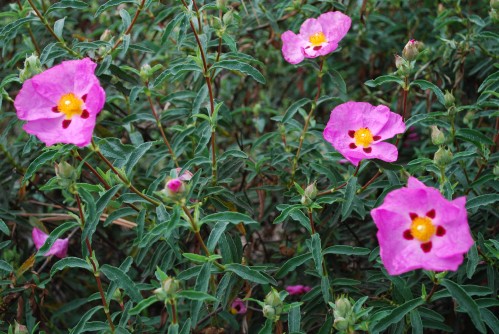
Close Up of Blooming Orchid Rockrose This is another spring blooming delight, Orchid Rockrose, Cistus x purpureus. Although this is a native Mediterranean drought tolerant shrub, something about it reminds me of an English country garden.
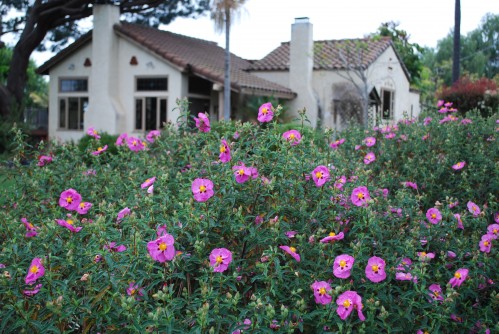
Former neighbors of mine had several one gallon Orchid Rockrose shrubs left over from a landscape installation, and asked me if I would like them. Not familiar with the Orchid Rockrose at the time, I boldly mass planted them in an informal hedge, in a sunny dry spot on our property. Besides a beautiful informal hedge, this shrub is suitable for rock gardens, fire-prone areas, erosion-control, and natural settings.

The hedge has grown to about 4' high x 4' wide. It blooms in the spring for about a month with 3" deep pink "happy face" flowers. Each flower has a deep burgundy spot at the base of each petal, with a yellow-orange yolk center. Their flower is very distinctive, and friends always ask me the name of this shrub.

When Orchid Rockrose is not demonstrating its showy bloom, its dark green evergreen foliage continues to please. It is an easy shrub to care for, thrives in full sun, requires little water, and grows quickly in poor soil and adverse conditions such as high heat, winds, and ocean salt air. It does not like a lot of pruning as a mature shrub, but can be top-tipped for fullness, and pruned easily as a young shrub.

  Orchid Rockrose Hedge

It grows well in zones 6-9, and 14-24. There are a number of different species within the Cistus family, with different flower colors, and characteristics in appearance. You can find the Orchid Rockrose shrub in local Southern California nurseries, and online, too. Be sure and start with a small container size, and adequate spacing, as it grows quickly.

If you are looking for a low maintenance, drought tolerant shrub, you might consider the versatile and showy, Orchid Rockrose.

Succulent-Potted Vintage Hen Planter

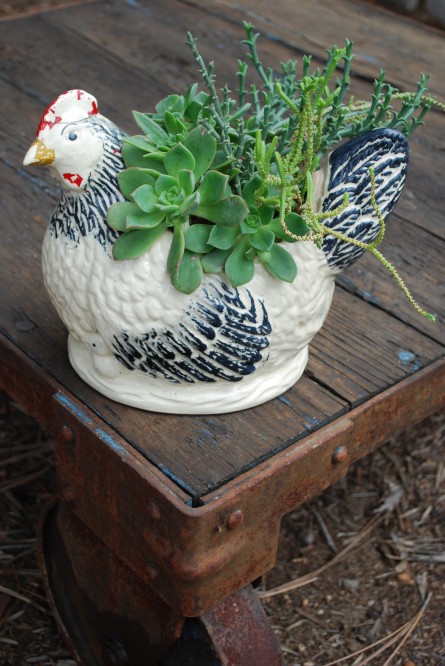
Succulent-Potted Vintage Hen Vintage chicken planter cackles with character, and begs to be potted with succulent plumage. Round and rosette-like, I use my perennial favorite succulent, echeveria, planted at my hen's shoulder and back. Similiar to a perfectly shaped fleur-de-lis, is the handsome green, slightly uncommon ice plant relative, Smicrostigma viride. The chartreuse green notched strands, with a mind of their own, are Crassula mucosa, or Watch Chain succulent (formerly Crassula lycopoidioides). One couldn't ask for better plumage, that keeps on growing.
I love the "thrill of the hunt" at wonderful off-beat flea markets. You never know what you might find, and what treasure you were meant to take home. This is an unmarked vintage hen planter, probably anywhere from the 1930's to 1950's. I rescued her from a flea market existence, out of the midwest heartland. Her comb was broken, yet someone cared and patiently repaired.

In searching for treasures and beauties to re-purpose, don't overlook the wonderful vintage planters. You know the ones, the darling vintage "baby" planters, the mid-century 1950's "greenish" planters, the simple McCoy or Bauer pieces. These type of planters, even though they might have a chip or crack, work beautifully with the colors, textures, and look of succulents.

Clean up your newly acquired vintage planter. Remember a chip or crack just adds to the character of a piece, and chances are when potted with succulents will not even be noticeable. Put a few pebbles and potting charcoal in the bottom for drainage, fill with cactus potting soil, plant and design with succulents that extend the charm and look of the planter. Mist or spray with water sparingly, and your succulents will be happy. Place your newly potted vintage planter in a sunny window, an outdoor sunlit porch, or in other words, a protected spot with sun.

Succulents have become so popular today because they are drought tolerant, low maintenance, abundant in many colors and textures, and plain fun! Chances are you have one or more retail locations in your area that specialize in succulents. If you live in the San Diego area and love succulents, you must visit Solana Succulents.

Grey Honey Myrtle Tree

Close-Up of Blooming Grey Honey Myrtle Tree I wanted to write about the Grey Honey Myrtle tree, because it is one of my stellar nursery choices, of the last two years. You know the ones. They catch your eye in their generic container. You have an inkling they could look nice in your garden or yard. You take them home, plant them, and you all settle in. Presto, you wonder how you ever lived without them. They do something incredible and unknown to you, such as a totally unanticipated explosion of color. Yes, it is a big deal, because there are many more lackluster nursery choices that seem to fizzle, and all with good intentions. Has this happened to you?
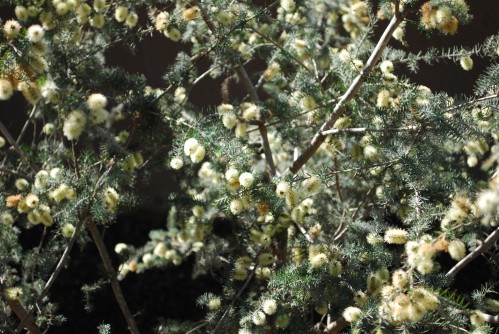
One of my favorite trees, and stellar nursery choice, is the petite but ever so charming, Grey Honey Mrytle tree, Melaleuca incana. This little darling can actually be grown as a shrub up to 9' tall and wide, or shaped into a small graceful tree. It has a very appealing weeping and lacy branch structure with blue-slate needlelike foliage. In early spring, it blooms profusely in a plethora of tiny "cream puff" flowers that beckon birds and bees.

The Grey Honey Myrtle Tree is a native of Australia, and part of the mammoth melaleucas family which has over 140 species. Optimum climate zones vary by species. It is safe to say that this melaleuca does well in zones 8,9, and 12-24. It will thrive in full sun to partial shade, and is drought tolerant when established. It is an easy tree to care for, and can endure poor soil, wind, heat, and low moisture conditions. In my opinion, the Grey Honey Myrtle tree is a moderate to slow grower, although melaleucas are generally thought of as fast growers. Lace pruning is a good idea to enhance its weeping style, and keep it off of the ground.

My Grey Honey Myrtle tree was planted as a screen, close to my fawn-colored brown stucco fence. Its contrasting grey foliage against this backdrop, and backlit with southern sunlight is stunning. This is a beautiful, very striking ornamental tree for your yard or garden. It too, could be a stellar nursery choice for you.

If you live in a Mediterranean climate, these trees (shrubs) should be available at your local nurseries. In the San Diego area, I have seen them for sale at a few places, but most recently at Buena Creek Gardens. They are also available online through various websites.

Meet A Magnificent Mustard

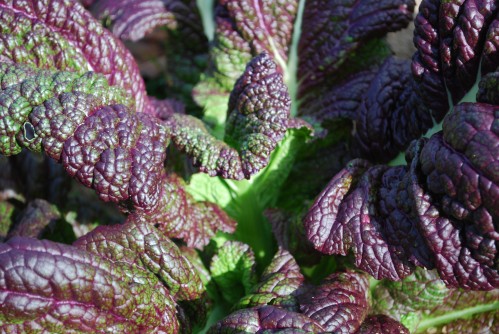
Close Up of Asian Mustard, Red Giant If you like spring greens, you will love to grow and cook with the asian mustard, Red Giant, Brassica juncea. Easily started by seed, it is a cool season annual which is slightly peppery in taste with magnificent green to dark purple textured leaves. Although it is "cold and bolt" tolerant, if allowed to flower, it has incredible yellow flowers that emerge as a tall spike out of its center, as a final encore.
I have to admit I was first drawn to Red Giant mustard for its magnificent beauty. At different times of the day, it even appears to have a copper glow about it. I bought seeds to make a winter to spring border in my kitchen garden, or potager. It is equally striking in a landscape planting, or even paired with the wonderful ornamental cabbage and kale in a cool-weather container design.

A part of the Mustard family, and thought to be originally from India, the asian mustard, Red Giant, is one of the most popular asian mustards. It is quite different in taste and texture from American mustards, you might have grown. It is extremely versatile, when it is harvested, how it is harvested, and how it is prepared. Do you like spring greens, harvest the young whole plants early, at 20 days for your spring lettuce and mesclun mix. Do you like Asian stir fry, take one or two mature leaves at a time for your recipe, and the plant will continue to grow. Try it as a replacement for chard in your bean soups, julienned, or a substitute for spinach in your quiche. It is nutritionally packed with abundant amounts of vitamin A, C, B vitamins, calcium, and more.

Depending on your climate, you can plant it in the fall, spring, or late winter. It prefers full sun, and light moist fertile-mulched soils. Seeds germinate in 1-2 weeks, young plants can be harvested at 20 days, mature plants at 40 days. For a continuous crop, you might want to sow seeds every three weeks in the spring. I find that it "volunteers" easily for me, and my chickens reap those tasty benefits.

At nurseries, I often see asian mustard, Red Giant, in mesclun mixes, rather than sold by itself. There are many seed companies who have it available online. I first purchased my asian mustard, Red Giant, from the fabulous seed company, Botanical Interests, located in Broomfield, Colorado. Their website is www.botanicalinterests.com.

Do you normally grow mustard in your vegetable garden? What is your favorite way of preparing it? Please share your comments.

Grapevines Awakening to Spring

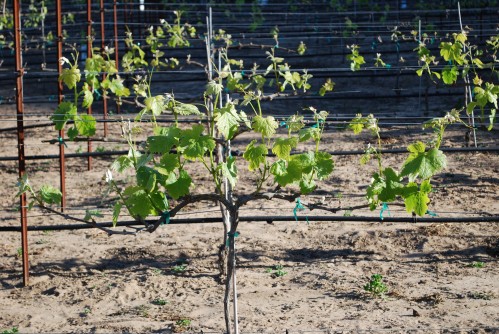
Spring in Our Vineyard Here at Domaine de Manion (DDM), in our backyard vineyard, we finished our spur pruning in February, and knocked down most of the winter weeds. Spur pruning is cutting last year's grapevine canes down to two nodes or buds at each spur, off of the cordons. It is an individual management practice how many spurs you keep on each arm or cordon, but usually you have at least 5-6 spurs, a fist length apart on each cordon. Please note there are different types of pruning techniques used in vineyards throughout the world. We prefer the spur pruning method in our "syrah" vineyard.

In our Southern California climate, at the 33rd parallel, bud burst is usually around the beginning of March. Bud burst is the awakening of the grapevines in spring, marking the end of their winter dormancy. Bud burst usually occurs when mean daily temperatures are 50 degrees F (10 degrees C). Beautiful chartreuse shoots slowly emerge from the tiny buds on the spurs.

Ideally you want shoots from the cordons, growing upward and as vertical as possible, to reach the two sets of upper double wires, which will hold them in place. This is the very popular and common Vertical Shoot Positioning (VSP) System. This VSP trellis system helps with important air flow between the vines and rows, and proper sunlight exposure. There are many other types of trellis systems used in vineyards throughout the world, and in some cases a trellis system is not used at all. Often times, vineyard management is dictated by your geography location and grape varietal you grow.

At DDM we are just starting our "fourth leaf" or fourth season of the vineyard. Our grapevines and cordons are well established. As shoots emerge that are not in a desirable spot, such as on the trunk of a grapevine, shoots pointing down or sideways off of their cordon, are easily "nipped off" with your fingers.

The canopy is the leaf cover above the grapevine and ultimately the green vegetation above each grapevine that the trellis holds in place. Grapevines, shoots, and leaves through careful manipulation, can be managed for the best balance between shoot and fruit growth. Careful pruning, thinning, shoot positioning, and leaf removal are all parts of canopy management used throughout the year to optimize your grapes.

The warmer, longer days of spring urge the grapevine shoots to grow quickly. Soon the directed shoots are swaying in the soft breeze, and the vineyard has undeniably come alive again.

Everyone Loves a "Garden Baby"

Vintage Garden Baby Fountain

I absolutely adore my "garden baby" fountain. Before an estate sale, it had been cherished in someone else's garden for a very long time. In a way, when I purchased my "garden baby", I felt like I was taking guardianship of this precious little concrete soul. To me, a "garden baby" exudes the spirit of a garden in another form other than plants. It captures a kaleidoscope of emotions such as love, purity, bliss, innocence, oneness, and peace.

I started researching "garden babies", and found very little, which added even more to their mystery. Usually found in a statuary or fountain form, why were they so popular at one time? What do they symbolize? What is their meaning in our gardens?

So, I asked two friends who are experts on the subject, and I share with you their insight on "garden babies".

Pat Welsh, an incredible gardener and garden writer for over fifty years in the San Diego area. She writes about "garden babies" from a historical European perspective.

"Statues of babies and children in gardens go back to ancient times. In England, especially, they sometimes have a sorrowful meaning. Since the 19th century, and probably long before that, people made little gardens in memory of babies that had died or were miscarried. Creating such a garden was a way to deal with grief. Sitting in such a garden gave one a place to mourn surrounded by statues of babies and it provided a special place to pray for a baby who had died. People still make these gardens today in memory of babies who died or miscarried.

In the Renaissance plump little boy angels, called putti, became popular. These also were often seen in gardens or as carved decorations on buildings, sometimes just for fun and other times to assuage grief. It made people feel better to think of their own little angel flying around happily in Heaven.

Statues of Greek and Roman gods lend romance to gardens and make us remember the deep mythological roots of garden-design and garden creation. Statues of deer, birds, turtles, rabbits, and other animals bring life to gardens and symbolize closeness to nature. Statues of children in gardens make us think of happy, carefree childhood out in nature. Statues of babies symbolize innocence, joy, and protective love. The mythic idea of a naked baby in a grassy glade or laughing in a fountain makes one think of one's own soft naked skin against the leaves, grass, cooling water on a hot day, and all the other textures in nature. The contrast in textures must have been particularly pleasing during eras, such as the Victorian era or the Elizabethan era, when the upper classes, the people who had gardens, were so covered with many layers of clothing they could never feel the sensual pleasures of being lightly clad or naked out in nature."

Pat Welsh, "The Resident Gardener"-Author-Public Speaker-Garden Consultant, Pat Welsh's Southern California Gardening, A Month-by-Month Guide.

Beau and Nancy Kimball, own the highly respected, Kimball & Bean Architectural & Garden Antiques business, situated on a historic 1830's farm homestead, fifty miles northwest of Chicago, Illinois. Beau writes about "garden babies" from an American architectural perspective.

"I believe that the "garden baby", although born in Europe, is more of an American creation than a European one. Prior to the turn of the 19th century almost all garden sculpture was of a classical Greek or Roman form. Starting with the Columbian Exposition in Chicago 1893 and continuing through the Paris Worlds Fair of 1900, a whole new form of humanistic, less severe sculpture began to take hold in the Paris ateliers of American sculptors like Lorado Taft and Frederick MacMonnies.

Several of their students including Janet Scudder (the "Frog Fountain"), Edith Parsons (the "Frog Baby") and Sylvia Shaw Judson ("Bird Girl" and the "Naughty Faun") became famous by supplying Gatsby age society clients and their estates with fountains and statuary made from carved stone, lead and bronze in this new friendlier form that included pixies, fairies and children.

Unlike the earlier classical sculpture, this humbler form also turned out to be the perfect style for the hundreds of thousands of newly minted suburban gardens of the post WWII building boom - especially when created in the more egalitarian concrete. Almost all of what we see today was produced in the last forty years. I often see it as being described as "1940's", but, it in my experience, it can almost always be documented as post 1960's at the oldest."

Kimball & Bean Architectural and Garden Antiques 3606 South Country Club Road Woodstock, IL 60098 Phone 815-444-9000 Fax 815-444-9002 www.kimballandbean.com

Many thanks to Pat Welsh and Beau Kimball for sharing their expertise and perspectives. "Garden babies" is a fascinating subject. If you have a "garden baby" in your garden, or have additional information to comment about them, please feel free to share.