
Blueberries for Breakfast

Blueberries are one of the easiest and rewarding fruits to grow in your garden. Blueberry bushes look great in your landscape. Blueberries are so good for you, and tasty. In a previous post, Feed Your Blueberry Bushes Coffee Grinds I write about my blueberry bushes.

A recap on blueberry basics. Blueberries like sun, water, and good drainage. They do best with two different varieties planted near each other. Grow blueberries that are best for your climate. Some of the varieties that do well in Southern California are O'Neal, Misty, and Sunshine. They are acid-loving plants that thrive with added cottonseed meal, or like I do, coffee grinds to their soil at regular intervals. It is easier in Southern California to grow blueberry bushes in wine half barrels. Grow varieties with different harvests times for a longer blueberry season. Harvest your blueberries when they turn blue, and are sweet to your taste. Blueberries are so good for you, full of antioxidants. Blueberries can be used in sweets and savories.

I have the biggest thrill harvesting my blueberries from "bush to table." My blueberries are such a treat. I use them in many ways, but one of my favorites is to make weekend Blueberry Buttermilk Pancakes. I found Martha Stewart's recipe years ago, and it is hard to beat, Blueberry Buttermilk Pancakes. Enjoy!

Please share if you grow blueberries. Please share your favorite recipe using your home-grown blueberries.


VintageGardenGal Tidbit Thyme...

Attention Chicken Lovers! Spruce up your chicken coop for VintageGardenGal's Annual Chicken Coop Photo Contest. Send in your photos this coming May!
Encinitas Garden Festival is Saturday, April 30, 2011. For more detailed information and tickets, please visit Encinitas Garden Festival.
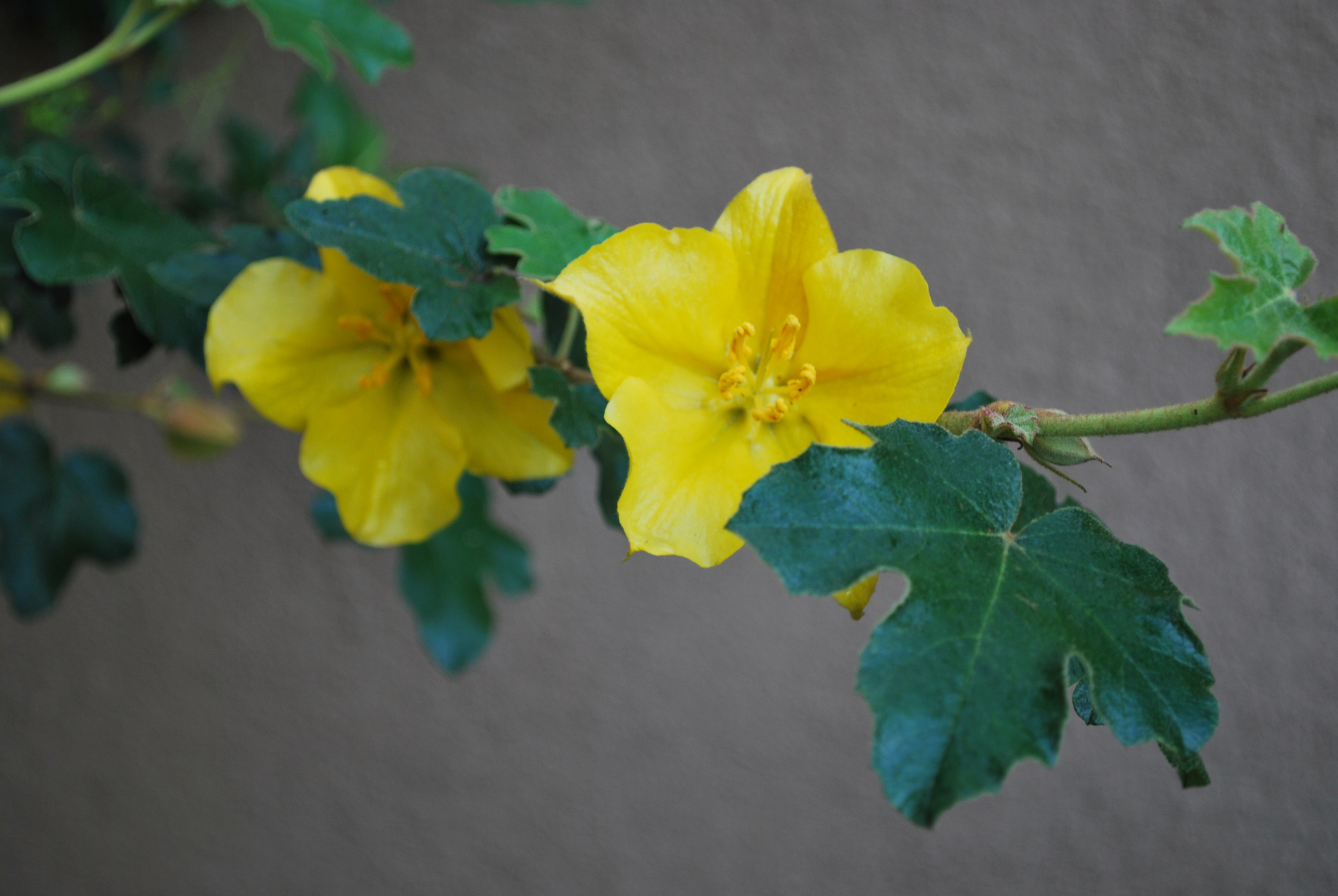


Flashy Flannel Bush

A friend of mine gave me a cutting of what I know now is Fremontodendron, Fremontia, or Flannel Bush. I planted it in a corner of my garden against my brown woodland stucco wall, and basically forgotten about it until now. However, this spring-blooming evergreen shrub with its brilliant yellow starfish-shaped flowers, won't allow this plant to be a wallflower anymore.

The Flannel Bush is a native shrub to California and some parts of Arizona, within optimum Zones 4-24. It is a shrub, but can be shaped into a small tree by pruning its lower branches. It is a fast-growing plant, which can reach up to 20' tall and 12' wide. It naturally has an irregular shape, so it benefits by pinching young growth to encourage new branching and shaping by pruning unruly long shoots.

The Flannel Bush likes full sun, and no additional water. It thrives with the average annual rainfall it receives in its native habitat. It is extremely drought tolerant. It has shallow roots, which means young plants may need to be staked. It can be a short lived shrub, and some fellow gardeners consider it a bit finicky to grow. It is a low maintenance shrub.

If you have yellow in your garden color palette, or need a spark of yellow at times in your garden, you might want to plant a Flannel Bush. Plant it, leave it be, and wait for its wonderful spring awakening with its dark green foliage and rich lemon yellow flowers. This is what is blooming in my garden right now.

Please share if you have a Flannel Bush in your garden. Please comment on your experience growing a Flannel Bush.

VintageGardenGal Tidbit Thyme...

Attention Chicken Lovers! Spruce up your chicken coop for VintageGardenGal's Annual Chicken Coop Photo Contest. Send in your photos this coming May!

Encinitas Garden Festival is Saturday, April 30, 2011. For more detailed information and tickets, please visit Encinitas Garden Festival.


April's Seasonal Edibles

Whether you frequent farmer's markets, or you are lucky enough to pick your own edibles out of your kitchen garden, why not try and eat what is fresh and in season. Let the seasonal fruits and vegetable dictate your diet and recipe selections. Try creating your Easter Sunday menu from an abundance of these "in season" edibles.

For those of us in Southern California, here is a general list of what is splendid and in season for the month of April. This is a general recommendation, and is not all inclusive. It is a great guide for your trips to the market, farmer's markets, or visualizing what you could be reaping from your kitchen garden this month.

Asparagus, Avocados, Basil, Green Beans, Beets, Broccoli, Cabbage, Carrots, Cauliflower, Celery, Chard, Cherries, Citrus: (Grapefruit, Kumquats, Lemons, Navel Oranges, Tangelos, Tangerines), Collards, Cucumbers, Medjool Dates, Kale, Kohlrabi, Lettuce, Mushrooms, Mustard, Nectarines, Green Onions, Passion Fruit, Green Peas, Raspberries, Spinach, Strawberries, Tomatoes, and Turnips.

This photo was taken at the Vista Farmer's Market, one of my favorite North County Farmer's Markets, and one of my "Places to Know." Sunset Magazine describes it as "One of the best in Southern California." Saturdays, 8am - 12 noon. Worth a visit, and a treat to find local seasonal edibles.

Please share if Farmer's Markets are part of your shopping and menus. Please comment on your favorite farmer's market.

VintageGardenGal Tidbit Thyme...

Attention Chicken Lovers! Spruce up your chicken coop for VintageGardenGal's Annual Chicken Coop Photo Contest. Send in your photos this coming May!

Encinitas Garden Festival is Saturday, April 30, 2011. For more detailed information and tickets, please visit Encinitas Garden Festival.


The Romance of Sweet Peas

Sweet peas flowers are usually trimmed at their stem base for a tight bouquet of elegant color and perfume. This style can loosely be described as the "Biedermeier" style, a European hand-tied style tightly structured flower arrangement in a circular pattern. See my recent post, First Bouquet of Sweet Peas.  Author, Debra Lee Baldwin, graciously commented from that post, "Did you know that the fragrance of sweet peas has never been duplicated chemically?" Something that I did not know, and makes sweet peas all that special.

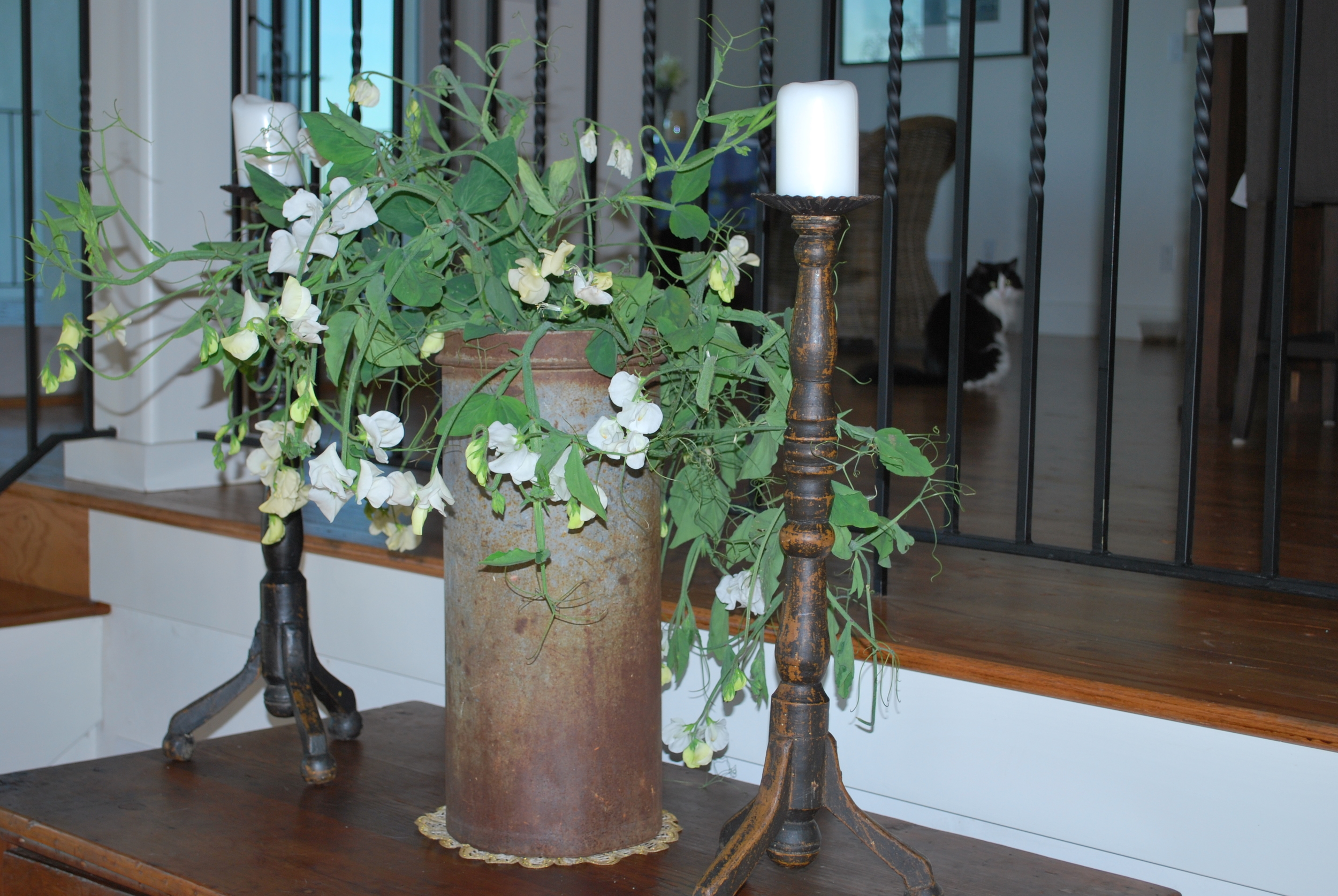
For another style using sweet peas, try cutting your sweet peas in long boughs, in other words try cutting and using your entire sweet pea vine. It is an entirely different look for sweet peas, similar to a dramatic "tossle" of some one's beautiful long mane. Cutting sweet peas in this manner, you have a larger bouquet, whimsical sweet pea tendrils, the fragrance and color of romantic sweet pea flowers, and the wonderful texture and color of the sweet pea vine itself.

In the above photo, I have used a mid-century flower stand rusted container with height, and character. These un-named sweet peas, their seeds a gift from a garden club sharing table, are a combination of white and ivory sweet peas, elegant and romantic. This type of cut arrangement will last and provide enjoyment for at least a week.

Please comment if you have made flower arrangements using sweet peas in this style. Please share your favorite sweet pea to grow.


VintageGardenGal Tidbit Thyme...

Attention Chicken Lovers! Spruce up your chicken coop for VintageGardenGal's Annual Chicken Coop Photo Contest. Send in your photos this coming May!

Encinitas Garden Festival is Saturday, April 30, 2011. For more detailed information and tickets, please visit Encinitas Garden Festival.


Children's Garden Books

Gardening books for children can be the seeds that start your children or grandchildren thinking about nature, wildlife, gardening, our mother earth, and so much more. If you are a gardener, most likely your children or grandchildren observe you in your garden and share in your garden pleasure. Kathyrn O. Galbraith has written over a dozen children's books for ages 4-8, which include valuable life lessons.

Kathryn O. Galbraith has a wonderful new children's book out now called, Planting the Wild Garden It is beautifully illustrated by talented artist, Wendy Anderson Halperin. I particularly like her whimsical raccoons.

A farmer and her boy, plant seeds in their garden, but in the wild garden many seeds are planted haphazardly by many kinds of creatures, elements of weather, and mother nature in general. Galbraith teaches us we are all connected to each other. We must respect mother nature and her creatures who are part of  the circle of life, too.

Last year Kathryn O. Galbraith wrote the children's book Arbor Day Square, illustrated by another talented artist, Cyd Moore. It is a touching children's story about the beginnings of Arbor Day, and the importance of planting trees. Kathryn O. Galbraith's Arbor Day Square won her a 2010 Parents' Choice Award.
Arbor Day Square has many life lessons to share with children, too.  A dusty prairie with no trees in the beginning, translates into it is up to you to make your own life and environment. You can make a difference in your community, and world. How planting the trees each year was a celebration and became a tradition. Cherish your family traditions, and community. Small trees, over time become large massive trees reaching towards the sky. One must have patience. The benefits of trees are many, and can be enjoyed and preserved for generations.

Kathryn O. Galbraith author's note at the back of her book is fascinating. The first Arbor Day was "first celebrated" in what is now the state of Nebraska on April 10, 1872. Over a million trees were planted that day. Arbor Day is now celebrated in all fifty states, and is even celebrated in many other countries around the world. For more information please visit, Arbor Day. This year's Arbor Day is Friday, April 29, 2011. Let us teach all of our children the importance of trees and our environment through special days like Arbor Day and Earth Day.


Encinitas Garden Festival is Saturday, April 30, 2011. For more information, please visit Encinitas Garden Festival

Lavender Twist Redbud Tree

Lavender Twist Redbud Tree in Spring Time Look at this beauty. Last fall I purchased this redbud tree, grown by Monrovia at a local nursery sale. I had a perfect spot for it in my garden, close to a guest bedroom window. A quiet garden spot where it can take center stage. Now, in early spring it is coming to life and blooming in weeping branches of pink showy flowers.

It's official name is Cercis canadensis "Covey." It is a smaller deciduous evergreen species which reaches 6' tall and 6-8' wide. It has an enticing weeping branch structure which slightly twist, adding more to it's drama. A spring burst of lavender pink blooms follows the outline of its branches.

The Lavender Twist Redbud tree is hardy in zones 7-9. It likes full sun, and moderate regular water. Once its spring fashion show ebbs, deep green heart-shaped leaves emerge. Select pruning should be done after it blooms.

The Lavender Twist Redbud is a North American native. Besides the attraction of this tree's appearance, it is also used in landscapes for fire-scaping purposes. There are many varieties of redbud trees, which cover a multiple of zones, for those of you not in zones 7-9. This is a great tree to have in your garden for four season interest.

Please share if you have a redbud tree in your garden. Please comment on what you like about your redbud tree.


VintageGardenGal Tidbit Thyme...

Attention Chicken Lovers! Spruce up your chicken coop for VintageGardenGal's Annual Chicken Coop Photo Contest. Send in your photos this coming May!


  The Encinitas Garden Festival is Saturday, April 30, 2011. For more information, go to Encintas Garden Festival.

Succulents, Front and Center

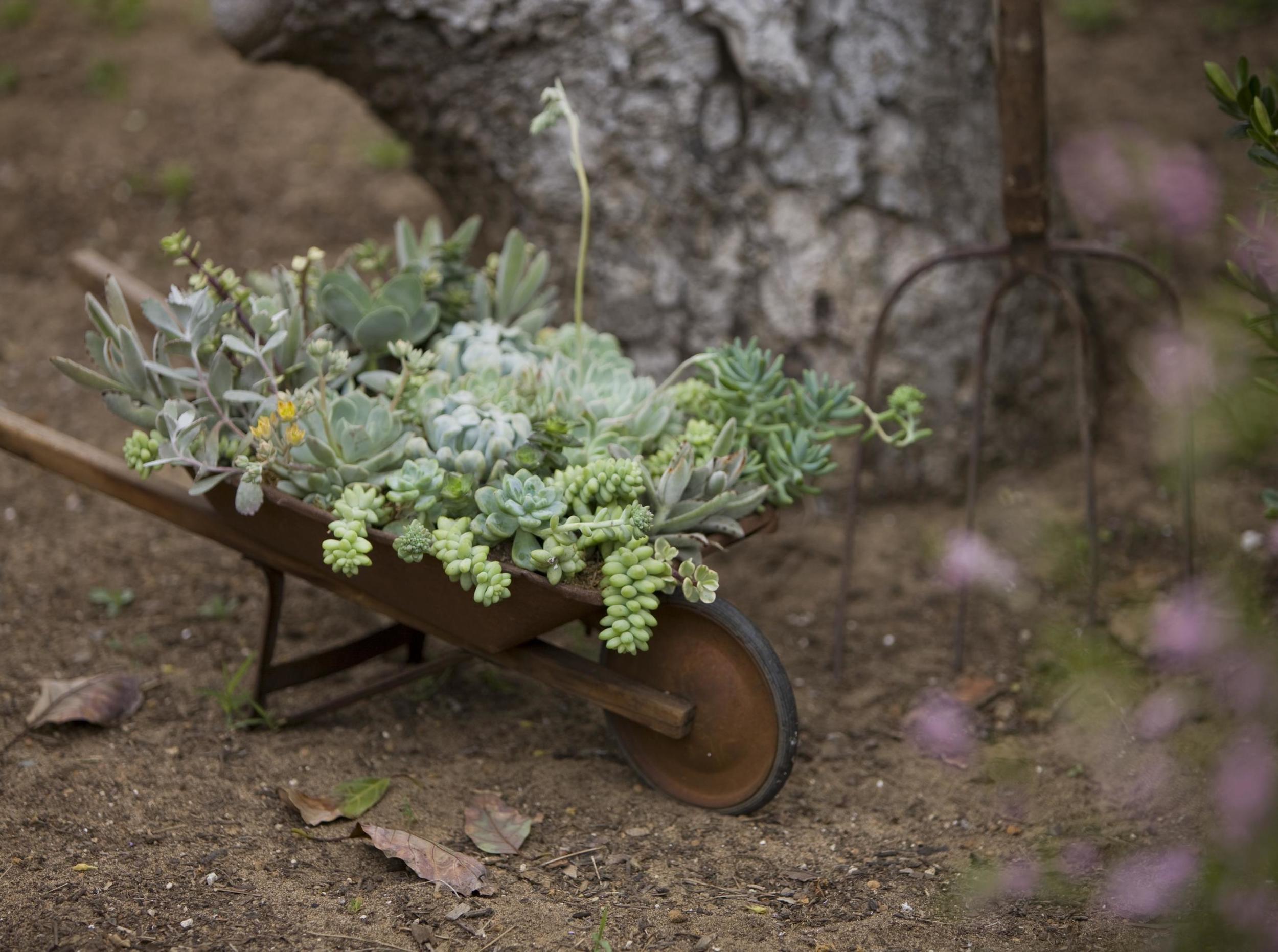
Country Gardens Magazine, Photo by Ed Gohlich Country Gardens magazine Spring 2011, features VintageGardenGal's fun combination of vintage containers and succulent design in their article, "Show Off Succulents." Country Gardens Magazine, Spring 2011.

Many thanks to Country Gardens magazine, and James A. Baggett, Editor, for their interest in my vintage container and succulent designs. This article was produced by Andrea Caughey, and photographed by Ed Gohlich.

My Bullet Tips on Designing with Vintage Containers: -One of a kind, unique -Surprise element, usually through repurposing -Look for them at flea markets, garage sales, antique shops, online -Buckets, pails, chicken feeders, nests, vintage sewing drawers, oil cans, strainers -Vintage containers dictate your design by color, shape, character, and style -Allow for ample drainage, either with gravel or shells -Add gravel, then your potting soil; next place your bulbs, plants -Wood containers need to be lined with a heavy plastic first -Bulbs and succulents require little water, moist not wet, can use spray bottle

My Bullet Tips on Designing with Vintage Containers & Succulents -Design and plant tight areas using chop stick or knitting needle -Succulent designs lend themselves to small space requirements -Dense planting of succulents is best, less growth, and maintenance -Design ideas tips: 1) single color or tone but different form, 2) group with same shape, or 3) repeat same color tones

Please share if you have ever designed with vintage containers. Please comment on your favorite succulents.

Blue in the Garden

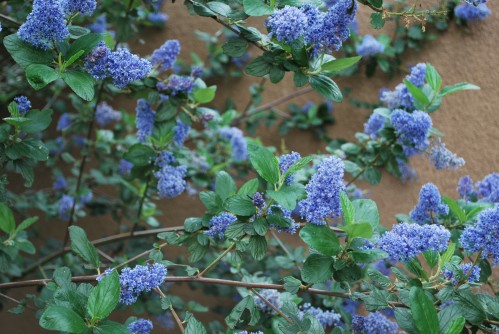
Profusion of Bloom What is blooming in my garden now. My Ceanothus, or California's wild lilac. Sometimes it is hard to find pretty  shades of blue colors for your garden. Usually blooming in late winter or early spring, the Ceanothus heralds "spring is coming."  This drought tolerant California native is delightful. I always look forward to its profuse blue blooms in my garden each year.

Ceanothus, an evergreen shrub, comes in many varieties, shapes, and blue color flower spikes. Some Ceanothus varieties are low and spreading, others are shrubby and bushy, and like my Ceanothus Ray Hartman, some have a tendency to grow upright and can be groomed into small trees. Flower colors range from pale blues to deep dark violet blues. There is even a Ceanothus with white blooms. Each variety has its own unique color. Their spike-blooms are showy and long-lived.

Ceanothus are very easy to care for and generally low maintenance shrubs. Ceanothus like full sun, and very little water. Avoid when planting Ceanothus, drip irrigation, summer water, and soil amendments. As a California native they prefer to be dry, and rely on our natural rainfall. Prune discreetly after their bloom time.

Don't be afraid to get "Blue in the Garden," think of  the dramatic Ceanothus. They thrive in zones 5-9, 14-24. You won't be disappointed. Please share if you have Ceanothus in your garden. Please comment on your favorite Ceanothus.


VintageGardenGal Tidbit Thyme....

On Friday, March 18 at 4:00 p.m., national partners (Plant A Row for the Hungry, Garden Writers Association, The Scotts Miracle-Gro Company, Keep America Beautiful, National Gardening Association and Franklin Park Conservatory) will join Los Angeles Mayor Antonio Villaraigosa in the dedication of a series of reading, learning and community gardens in East Los Angeles. The installation event is part of the recently launched GRO1000 gardening and green spaces initiative and helps to kick off Keep Los Angeles Beautiful's Great American Cleanup.

This garden event will be held at the Proyecto Pastoral Community Center in the Boyle Heights neighborhood of East Los Angeles, 135 North Mission Road, Los Angeles. Approximately 200 area students, as well as members of the Guadalupe Homeless Project, will join Mayor Villaraigosa and GRO1000 national and local partners in the garden installation and dedication. One deserving student at the event will also be presented with the national Give Back To Gro Youth Gardener Award.

GRO1000 is a partnership committed to the establishment of 1,000 community gardens and green spaces over the next seven years throughout the United States and abroad. The initiative seeks to broaden the opportunities for individuals and communities to experience the benefits of community gardening and access to green spaces.

Additionally, community organizations interested in participating in GRO1000, by installing their own community garden, edible garden or green space, are able to apply for a GRO1000 Grassroots Grant by visiting http://www.thescottsmiraclegrocompany.com/GRO1000. Projects should include the involvement of neighborhood residents and foster a sense of community spirit. Interested organizations have until March 31, at midnight EST, to apply.