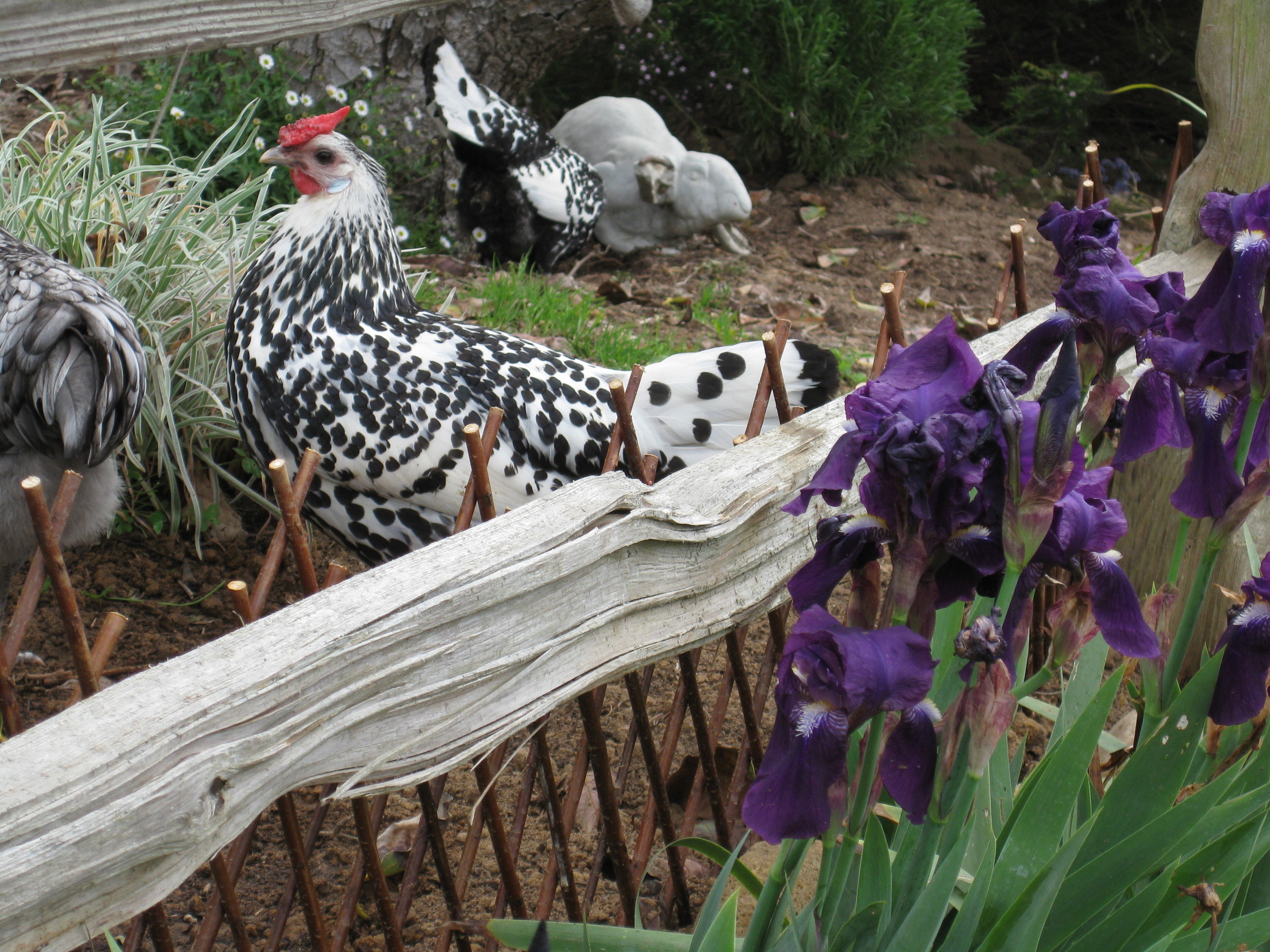
New Hens at "Coop de Manion"

Dolly, Dahlia, and a Tail of Charley My dear friend, Poultry Princess Kathy Lafleur, so aptly penned by panache garden writer Debra Prinzing, gave me three young hens a few months ago from her billowing flock. All three young hens, Kathy raised from day-old chicks, from a baker's dozen purchased from My Pet Chicken, five months earlier.  All of the chicks turned out to be hens, to My Pet Chicken's credit. It is not easy to sex day-old chicks. It is an art. With that said, Kathy's coop "runneth" over as the chicks matured into young pullets (hens) and I was happy to adopt three of her beauties.

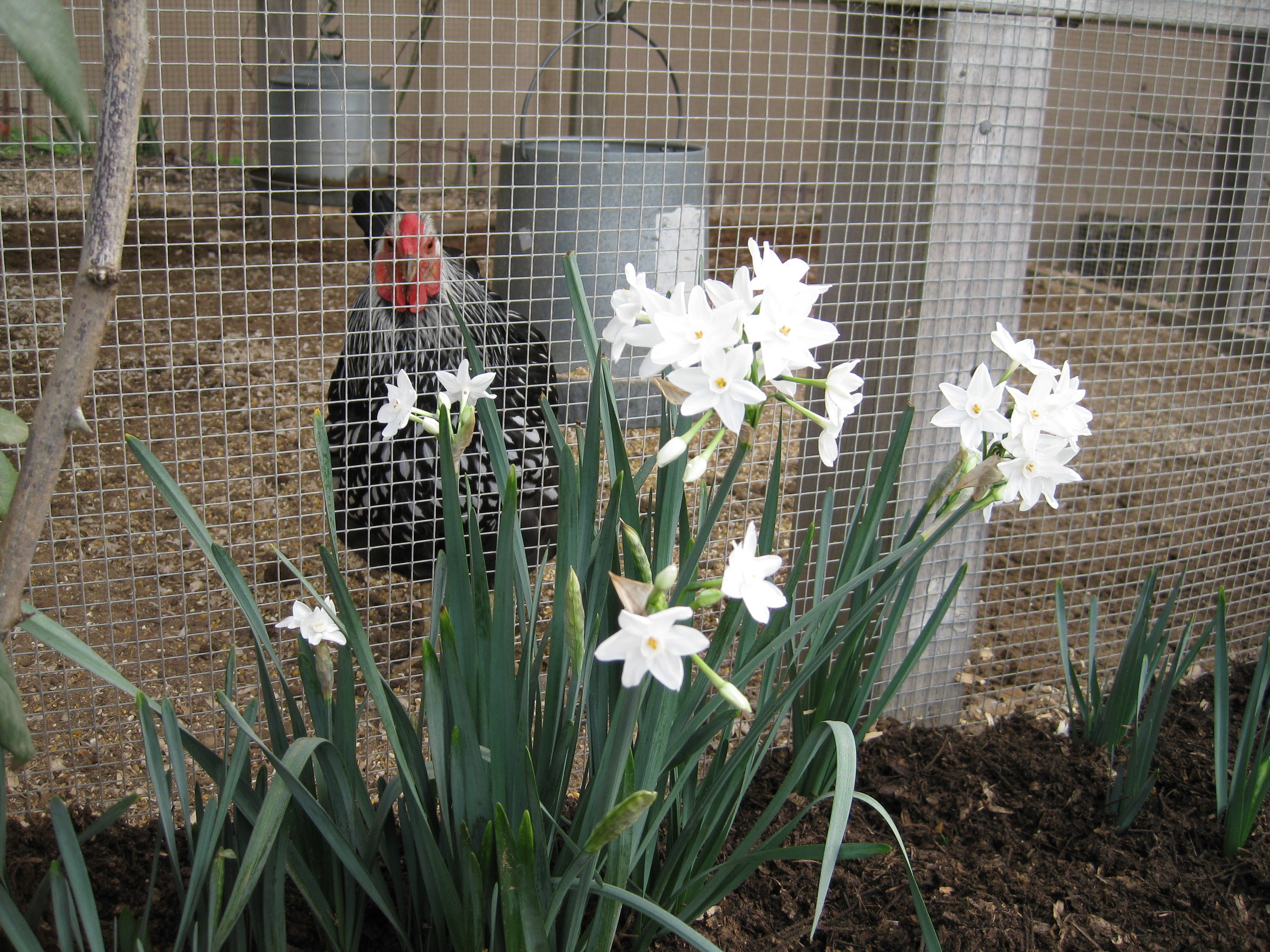
Two of my new hens are Silver Spangled Hamburgs, gorgeous, elegant black and white hens, that I named Dolly and Dahlia. The third is Charley, a White-Crested Blue Polish hen, whom you might have seen in her debut appearance, Chickens Dig Dirt Baths.

I was a little reluctant to blend these beautiful young hens in with my existing flock, for fear of not knowing the outcome.  I must confess, all went well, and introducing these young hens proved to be easy, nary a peck or a drawing of blood ocurred. Thank goodness, my elder hens, were on their best behavior.

Silver Spangled Hamburgs are small, almost bantam size, and very lively. In fact, after three months, I'm still trying to capture them together in a photo-worthy moment to no avail. I have noticed that when Silver Spangled Hamburgs are excited, they tend to fan their tail feathers, somewhat resembling a peacock.

Silver Spangled Hamburgs are an old traditional breed, whose origins date back hundreds of years to England and Holland. These hens exude elegance with their striking white feathers against black polka dot markings. Other stand-out features include a beautiful red rose-shaped comb, white ear lobes, and bluish legs. They are very quick, somewhat flighty, and not your "cuddly-lap" chickens for children. This breed is known for laying abundant ivory-colored dainty eggs, and a nice choice for "show competition."

Thank you, Kathy, for your lovely young hens. They are a joy, and a wonderful addition to our "Coop de Manion" flock.

Please share what factors have determined your personal chicken breed choices? Please share your motive for having, or wanting backyard chickens?

Thank You for Supporting VGG Sponsors!

Five Space-Saving Fruit Tree Techniques

Ein Shemer Apple Tree At the risk of going out on a limb, no pun intended, general trends today indicate that we have smaller spaces to garden in, converging with more desire to grow our own food. It is also the age- old adage, "less is more." Here are five space-saving fruit tree techniques to help you maximize growing your own desired fruit.

1) Espalier Fruit Trees on a two-dimensional plane in a pattern on a supporting wall, side of building, or fence. South and west facing direction are best for this. Espaliered fruit trees is one of my favorite styles as well as shapes for my fruit trees. You can either espalier them yourself, or buy them already pattern-established from a nursery or on online.

2) Multi-Variety Fruit Trees are available also from your favorite nursery.  Meaning these fruit trees are already grafted and established with different varieties on one tree. I have a pear tree that has  comice pear, d'anjou pear, and red bartlett pear harmoniously growing together in one tree. This winter, I got  a "4 in 1", which has two types of nectarines and two types of  peach. You  have one tree, but multiple varieties in one tree.

3) High-Density Planting of Fruit Trees. Planting of similar or dissimilar varieties of fruit trees closely together.  For instance, planting four fruit trees 18" to 24" apart in a square shape, in a 10' x 10' area. Requires summer pruning, but gives you the advantage of a possible long and varied fruit season, easy cross-pollination, natural restriction of fruit tree size, and a great appearance. With high-density planting you can create free-form shapes such as gazebos, circles, or as a hedge in a straight line.  Dave Wilson Nursery calls it Backyard Orchard Culture.

4) Limit Your Fruit Tree Size. After purchasing your bare root tree and planting it in your chosen location, cut the top 1/3 of your tree off at a 45 degree angle above a bud. Further trim any side branches or shoots to 6" to encourage new growth. Limiting your fruit tree size initially when planted, will keep your fruit tree small and manageable for maintenance and harvest size.

5) Plant Fruit Trees In Containers. Fruit trees in containers are beautiful, space-saving, and practical for small areas. Use on patios, entrances, and where ever you want to make a statement. Research what fruit trees do best in containers. Citrus trees are a good choice, if you have the climate.

Please share what is your favorite fruit tree in your yard or garden? Please comment if you think about space to harvest ratio in your yard and garden?

Thank you for supporting VGG sponsors!

Dwarf Sweet Pea Bush

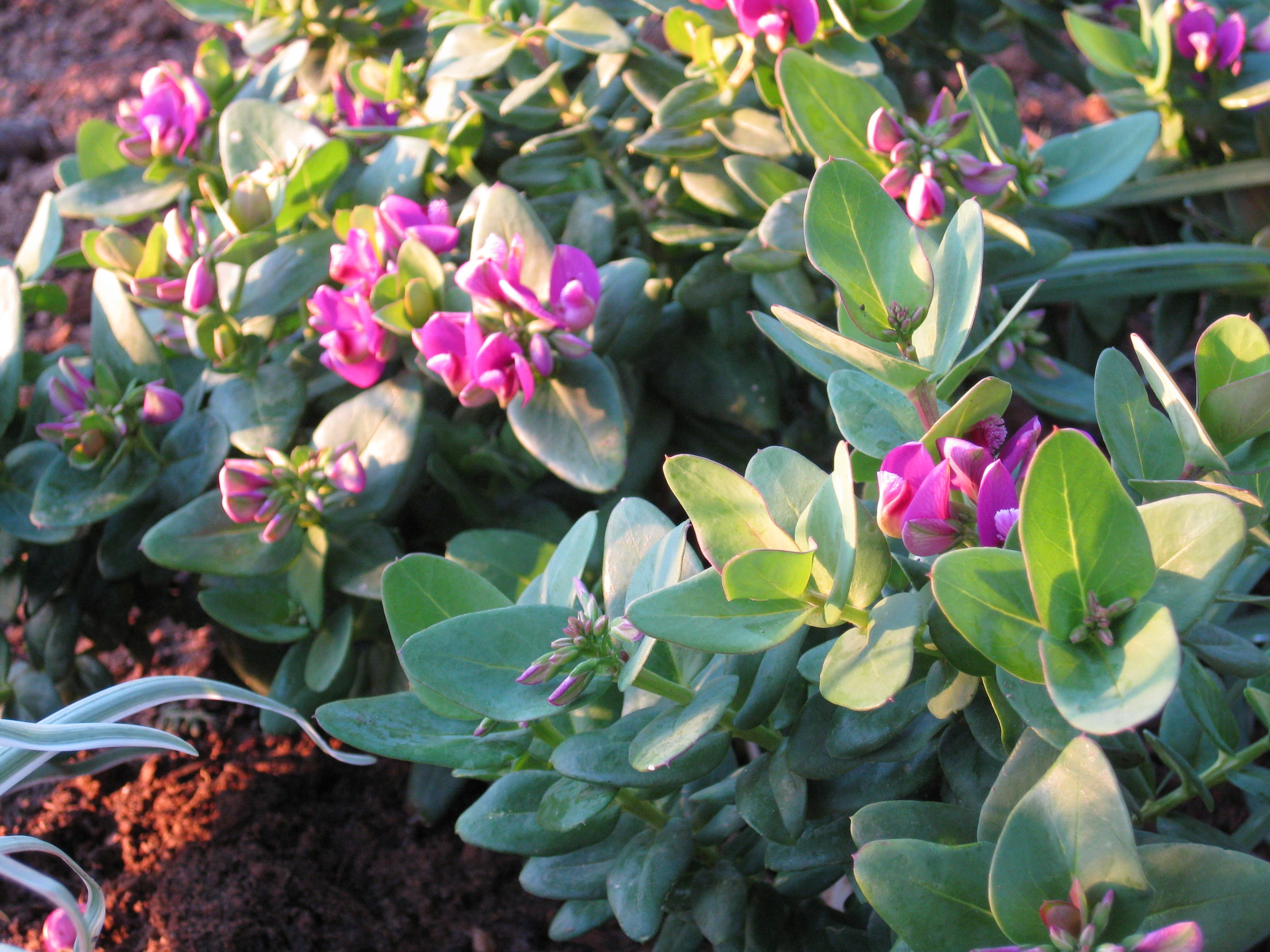
Dwarf Sweet Pea Bush at Sunset If your plant palette colors are pinks and purples, the perennial Dwarf Sweet Pea Bush, Polygala fruticosa, is a nice evergreen shrub to have in your garden. Just like its name, its pink-purple flowers resemble blooming sweet peas with pleasing grey-green foliage. Dwarf Sweet Pea Bush like sun, and moderate water. I consider it a low maintenance shrub with a long bloom time of several months.

At maturity, the Dwarf Sweet Pea Bush is generally a mounding shape 2' tall x 2' wide. Not to be confused with the standard size Sweet Pea Bush, Polygala dalmaisiana, which is very similar in appearance to the Dwarf Sweet Pea Bush, except that it can be a little more leggy, reach 3' to 5' in size, and is bare at its base. I personally prefer Dwarf Sweet Pea Bush in my garden.

Originally from South Africa, and in its native habitat grows close to the coast. It tolerates temperatures to 15-20F degrees. Dwarf Sweet Pea Bush, also goes by the names, Petite Butterfly and Butterfly Pea Shrub.

The Dwarf Sweet Pea Bush can be used as a charming cutting flower, as well as a perennial pleaser in the garden. Dwarf Sweet Pea can be found most likely, at your favorite local nursery, and also on the Internet.

Please share if you grow Dwarf Sweet Pea Bush in your garden.

Ode to 'Lo

Precious J.Lo For those of you who are faithful readers of VintageGardenGal, I must pause and tell you that my precious J.Lo passed away last week. She had a very long life in chicken years, approaching 8 years old this May. There are many reasons why I want to share this with you, and you might be thinking I've gone off of the deep end. But, no it is simply a small loving tribute to our wonderful hen, J.Lo.

I want you to know that your chickens can live a long healthy life. I want you to know that your chickens can become part of your family, just like your dog or cat. I want you to know that you can have a friend in the garden, with feathers and wattles. I want you to know that chickens have personalities, spirit, and character. I want you to know that chickens can give back, in intangible joy.

J.Lo was a Silver-laced Wyndotte, one of five hen in our original "Hollywood Girls" flock. Initially she was a bit of a runt, at the bottom of the pecking order in the flock. She was a good egg-layer, laying beautiful cream-colored eggs. She was always a talker, peeping over this and that. Over time she rose to the top like cream in the pecking order, fueled by her independence and sense of adventure.

She loved to be out in the garden, and loved to be a part of our social activities. She was never afraid of new people, or the number of people in the garden. She just felt at home, and was very sociable. In fact, I think she rather enjoyed being the life of the party.

Last year I wrote about my "coffee cup" thoughts reflecting on our first ten years on our property. J.Lo, and our "Hollywood Girls" were a cornerstone of our journey, and a part of the catalyst for writing VintageGardenGal. Somehow I can't stop thinking, that J.Lo will always live on with us in the garden, and she will. Ode to you, J.Lo.

Please feel free to comment.

Ceanothus Ray Hartman

Close Up of Ceanothus Ray Hartman Ceanothus are California's wild lilac. A native evergreen shrub which is drought tolerant and spring time showy with lavender-blue 6" spikes. Belonging to the Rhamnaceae (Buckhorns) family, Ceanothus shrubs, in general are drought tolerant once established and are found frequently growing in California's native chaparral. There are many different varieties of Ceanothus in form and blooming lavender-blue colors. Ceanothus bloom winter to spring and are simply stunning. Three of my favorite Ceanothus are Ceanothus concha, Ceanothus dark star, and Ceanothus Ray Hartman.

Officially a shrub, Ceanothus Ray Harman variety has an upright tendency. It is one of the Ceanothus varieties that can be trained into a mature small tree, sometimes reaching up to 15' high and 10'-15" across. It does best in Zones 8-9.

In the above photo, my Ceanothus Ray Hartman is planted close to my soft-hued brown stucco wall for a pleasing backdrop. I planted four Ceanothus Ray Hartman in my garden a few years ago, and they grow quickly.

A few tips to share with you in creating a Ceanothus Ray Hartman tree in your garden. I purchased one-gallon size plants from the extraordinary California native nursery, Tree of Life Nursery. Tree of Life Nursery is located about 7 miles east of San Juan Capistrano on Ortega Highway. If you are serious about introducing more California natives in your yard and garden, Tree of Life Nursery is the place to go. Tree of Life Nursery offers over 20 varieties of ceanothus, as well as many other popular natives, and lesser known natives.

If your intention is to shape your Ceanothus Ray Hartman upright into a small tree, purchase Ceanothus Ray Hartman plants that have a nice single stem. Plant in a sunny spot with ample room. Water regularly to give it a good start, and then taper off once established. Prepare to support your Ceanothus Ray Hartman with stakes as it begins to grow and fill out.

Let your Ceanothus Ray Hartman grow and establish itself for a few years.  After the second year, begin to trim bottom branches off of its main trunk slowly, at three month intervals. Nip or prune 6' off of the tips of some of your top branches and start shaping your tree. Trim as necessary to shape your tree into a nice upright tree form. This type of pruning encourages your Ceanothus Ray Hartman to grow upward and fill out into a beautiful wild lilac tree.

Please share if you are familar with the beauty of the Ceanothus varieties. Please comment if you have started introducing native plants into your garden.

Thank You for Visiting VGG Sponsors!

San Diego Horticultural Society announces its Spring Garden Tour, Saturday March 13, 2010. Tickets are $15/members, $20/non-members. To purchase tickets and more detailed information, please go to www.SanDiegoHorticulturalSociety.org

Pat Welsh Paints Our Vineyard

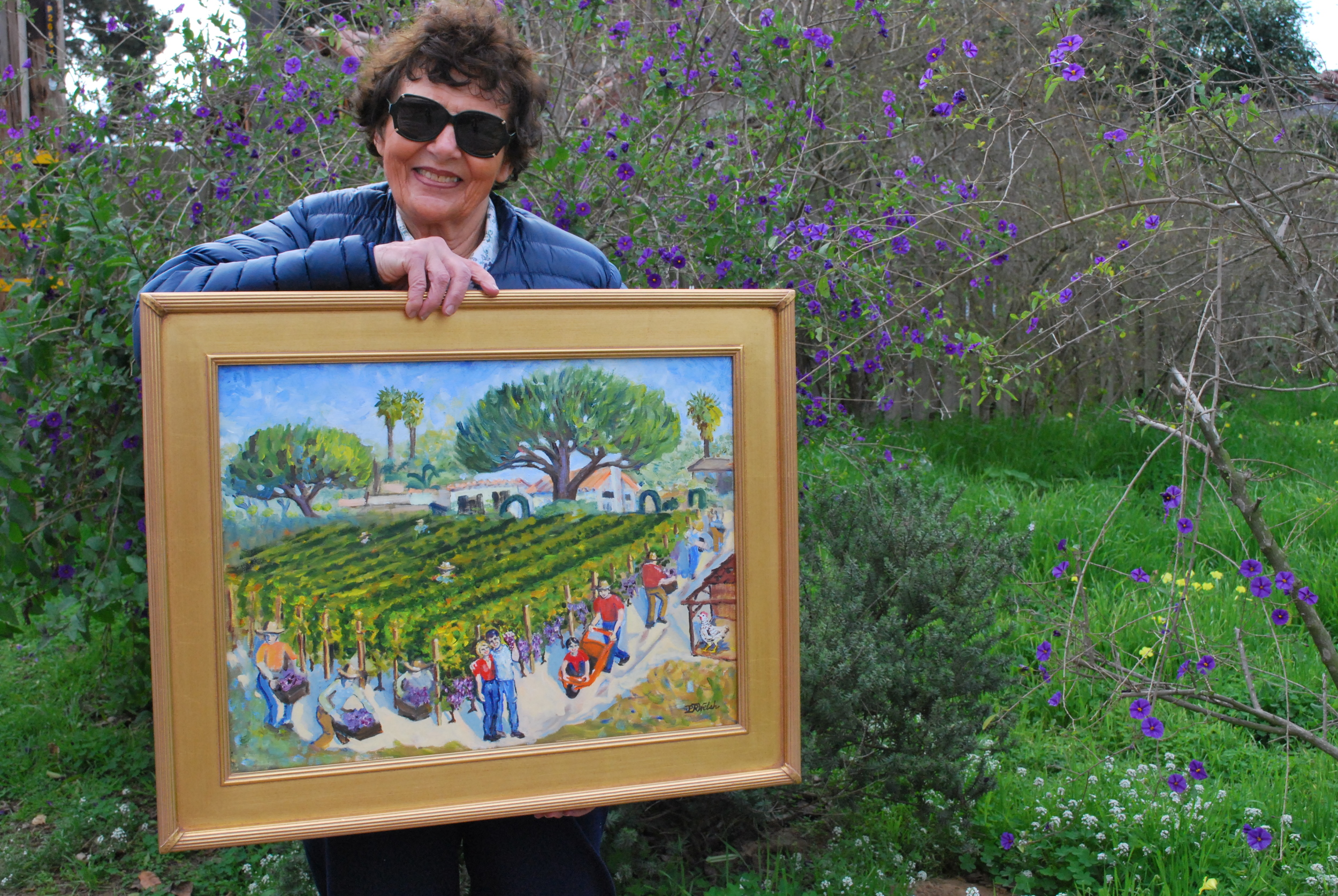
Pat Welsh Delivering Our Painting Most of you know Pat Welsh for her incredibly well-written garden books, and the fact that she is a writer, speaker, and garden guru. Did you know, however, she is also a very gifted and talented painter. Her painting is a passion. My husband and I absolutely adore Pat, and adore her painting style.

A few years back we approached Pat about painting "our little hamlet" here at Domaine de Manion, our home and backyard vineyard. Fortunately, she was very interested in our proposed subject, and soon Pat's painting of our home and vineyard took on a life of its own. Pat did on site visits, sketches, and borrowed photos we had taken to begin her vision of the painting. Despite her very busy schedule, she persevered and enjoyed time for painting.

Her proposed composition was exactly what we were hoping for, a beautiful, yet simple depiction of our first grape harvest in 2008. Pat focused her painting of our vineyard from our lower south west corner of our property. Her painting sweeps upward over our beautiful syrah vineyard to our home on top of the hill.  She was able to capture our enthusiastic friends helping in the harvest, J.Lo our beloved chicken and chicken coop, and the whole essence and excitement of our first harvest. My husband, John, and I, are depicted center-front, holding on to this moment.

We wanted something very special to remember and commemorate our first harvest, and all of our hard work which brought us to this point in time. We feel so fortunate and honored to have Pat Welsh's beautiful painting to capture our memories. Many thanks Pat, your painting is incredible.

Please comment on little celebrations in your life that have big meaning. Please share  if you have had a chance to delve into Pat Welsh's new book.

Thank You for Visiting VGG Sponsors!

San Diego Horticultural Society announces its Spring Garden Tour, Saturday March 13, 2010. Tickets are $15/members, $20/non-members. To purchase tickets and more detailed information, please go to www.SanDiegoHorticulturalSociety.org

Harvest Delight with Grocery Gardening

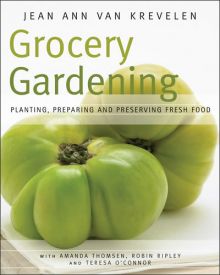
Grocery Gardening Book If you are as passionate about growing your own sustainable organic food as I am, you must buy the newly released book,  Grocery Gardening: Planting, Preparing and Preserving Fresh Food by Jean Ann Van Krevelen, with co-authors Amanda Thomsen, Robin Ripley, and Teresa O'Connor. Grocery Gardening is paperback, lists for $19.95, and is published by Cool Springs Press.

I have been looking for this type of book for a long time. One that takes me from vegetable garden to kitchen to cellar pantry. It is a little bit garden-growing guide, a little bit "fab" cookbook, and and a little bit good ol' homestead manual all rolled into one.

Grocery Gardening acquaints you with a nice detailed selection of herbs, fruit, and vegetable edibles. For each edible, you are given key steps for planting and growing, different varieties available, proper harvest time, and preserving methods for extra bounty. In addition, there are focused chapters on the basics of gardening, how to buy quality produce, preserving methods, and organic pest management.

Each colorful edible is presented in a unique Grocery Gardening format, simple yet comprehensive with added nutritional tidbits, edible trivia, accompanying mouth-watering recipes, specific pests to watch out for, and preferential preserving methods. If you need more reasons to buy Grocery Gardening, how about these recipes. Rhubarb Cake with Citrus Glaze. Rock Star Salsa. Fig and Arugula Composed Salad. Shepherd's Pie with Carrot and Sweet Potato Topping.

It is evident that author Jean Ann Van Krevelen, and co-authors Amanda Thomsen, Robin Ripley, and Teresa O'Connor of Grocery Gardening are quite talented and gifted in their own garden expertise and garden communications. In fact, I call them pioneers in "garden social media." You might be interested to know that they all met on Twitter, have never met each other in person, and their garden passion fueled them to write this book together in sixty days.

Whether you are a veteran or a "newbie" vegetable gardener, you will want to have Grocery Gardening: Planting, Preparing and Preserving Fresh Food by your side.

Please share if you plan on growing edibles this year. Please comment on your experience eating edibles straight out of your garden. Is it the satisfaction of connecting with the land? The incredible difference in taste? The convenience of walking to your garden, rather than hopping in your car?

Thank You for Visiting VGG Sponsors!

San Diego Horticultural Society announces its Spring Garden Tour, Saturday March 13, 2010. Tickets are $15/members, $20/non-members. To purchase tickets and more detailed information, please go to www.SanDiegoHorticulturalSociety.org

Spring Blooming Gravetye Giant

Dainty Gravetye Giant Blooming There are certain pockets of my garden which ground me with normalcy and the beckoning of spring, despite our ongoing home remodel. With all of the mess, upheaval, and chaos, my "Gravetye Giant" have managed to come up and bloom in dainty spring glory, reassuring me that all is well, and everything will once again be fine in the garden.

Maybe our persistent intervals of somewhat light rains, have stoked the feverish blooming of these beauties this year. I had half forgotten about them until their dainty white bells caught my eye one day. I can almost imagine "Tinkerbell" from Peter Pan, magically dancing amongst these blooms. Perhaps, that is why my favorite gnome is not too far away.

A sure sign of spring, Leucojum aestivum Gravetye Giant, also known as Giant Snowflake and Summer Snowflake, is a winter-to-spring blooming bulb. When blooming, Gravetye Giant can reach 2' -3' tall. They have a clump-forming habit, with vivid green foliage and delicate pendulous white bell flowers punctuated with an emerald green dot at the tip of each petal.

It is best to plant Gravetye Giant bulbs initially in the fall, in a part-shade to sunny location. Gravetye Giant are ideal for flower beds, borders, naturalizing, woodland shade gardens, and even water features. They are extremely showy and elegant in mass plantings. You can enjoy them inside as beautiful cutting flowers.

Gravetye Giant is a very forgiving bulb, with the ability to tolerate extremes like frost, and excess moisture. They require little maintenance by dead-heading blooms when finished, and cutting back foliage only when it yellows. Clumps can be divided, if necessary. They are relatively pest free, even rodent and deer resistant.

Gravetye Giant bulbs can be found through most bulb companies. My friends at Easy To Grow Bulbs offer reasonable Gravetye Giant 25, 50, and 100 bulk bulb pricing, shipping these bulbs August through December.

Please share if you have Gravetye Giant in your garden? Please comment on what in your garden is first to bloom, and suggests your spring is here.

Thank You for Visiting VGG Sponsors!

San Diego Horticultural Society announces its Spring Garden Tour, Saturday March 13, 2010. Tickets are $15/members, $20/non-members. To purchase tickets and more detailed information, please go to www.SanDiegoHorticulturalSociety.org