
Chickens Dig Dirt Baths

Charley Diggin' Dirt Meet Charley, short for Charlotte, she is a White-Crested Blue Polish hen, one of three new bantam hens I have added to my blended flock at "Coop de Manion" recently. More on this to follow.

Isn't Charley beautiful. She is as soft and fluffy to the touch as she looks. Her floppy white crest exaggerates her movement and personality. Honestly, I have had my beloved hens for about eight years, and Charley is special, she doesn't even act like a chicken. If I am crouching near the ground, she practically jumps in my lap, like a giddy teenager. With that said, she loves to be out in our garden, and loves to burrow in our soft sandy soil and create a dirt bath for herself.

In the above photo, Charley is demonstrating the fine art of a chicken "dirt bath." Don't ask me how they know how to do it, or where they learn it, they just know. Maybe they learn from their elders. If you have a prize-winning garden, this is about the most destructive a chicken will be. Chickens pride themselves in burrowing in the soil, making an indentation, and flicking dirt over themselves. If you have an exposed vegetable garden, this is another story because chickens love to help themselves to the latest gourmet treat emerging in your garden.

Charley is demonstrating her "dirt bath," in this sunny, sandy corridor where I have planted herbs along this pathway. All of my hens love to gravitate to this area, and wallow deep in the sandy soil. It is their favorite spot in the garden.

I have mentioned before when speaking of chickens in the garden, chickens love dirt baths to cleanse their feathers, cool themselves, and for general relaxation. It is sometimes hard to move a relaxed hen from her sunny dirt bath spot.

Now that you know the finer points of the chicken "dirt bath," I hope to put your mind at ease, and not be too concerned if you see your chickens doing the same in your garden. Rest assured, it is one of their little life pleasures.

Please share if your chickens like "dirt baths." Please share with us a little about your favorite chickens and their personalities.

Thank you for supporting VintageGardenGal's sponsors!
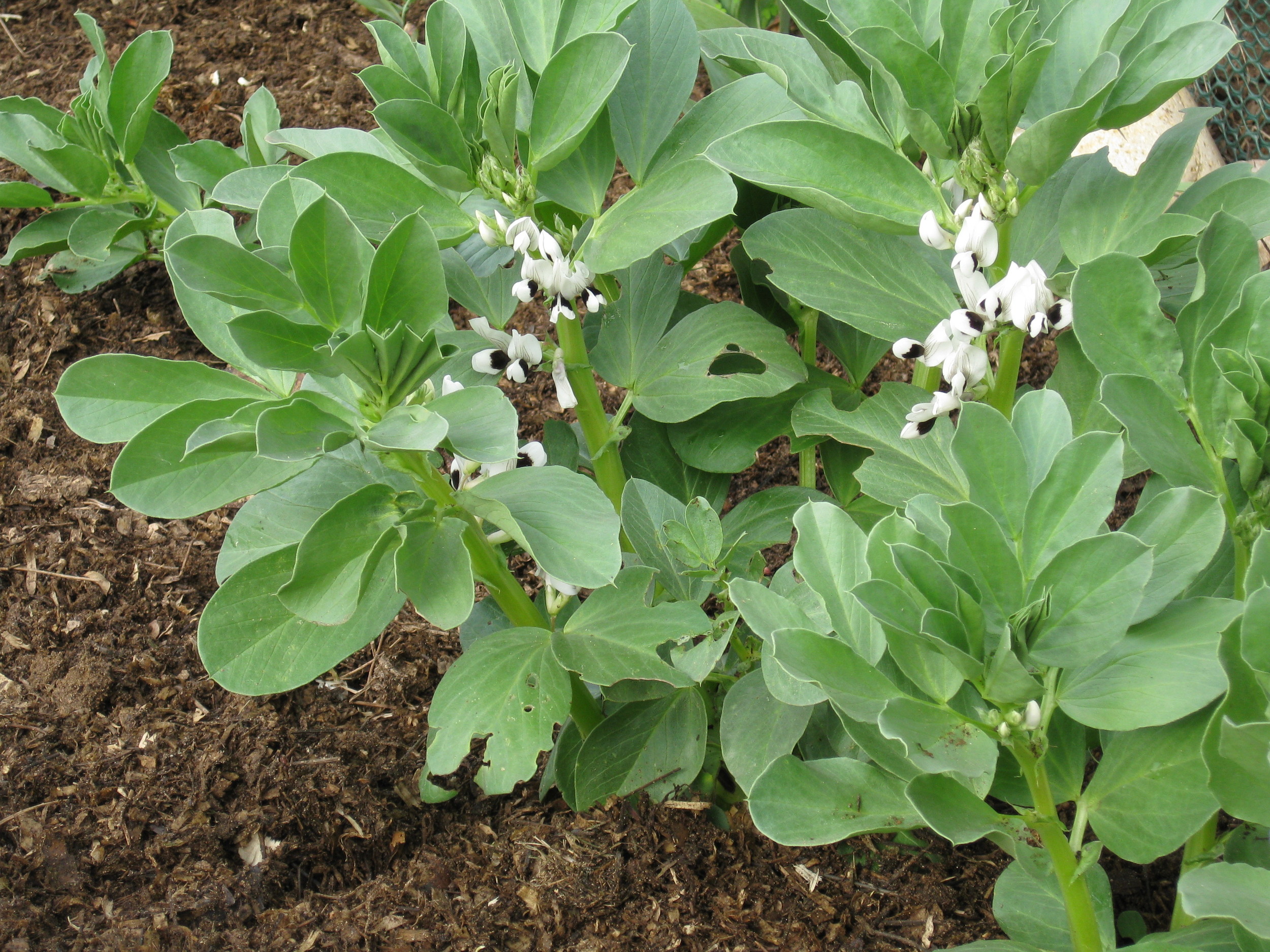
Do You Grow Fava Beans?

Colorful Fava Beans I generally plant fava beans in my potager every year. I think it is because they remind me of Europe. Fava beans were a staple in northern Europe before the introduction and popularity of the potato. When I'm in Europe, I see fava beans for sale at outdoor markets, and mentioned often on restaurant menus. While fava beans have been cultivated in Europe for centuries, fava beans are relatively new to the American farm, market, and garden.

I absolutely adore their catchy black and white flowers which remind me of black-eyed peas. Oh yes, and I love their slightly nutty buttery taste, too. Fava beans are also known by the names; Broad beans, Windsor beans, English beans, and a few others. (Please note, in some cases, a few people can be allergic to, or have an enzyme deficiency to fava beans. I have never experienced this or heard of this personally before, but have seen it in my reading).

In mild climates such as Southern California, I sow my fava beans in the fall, and patiently wait 150-180 days later, for harvest in spring. Fava beans are a legume, and require a long, cool growing season. Fava beans are also considered a beneficial cover crop, because they are high in nitrogen, and return nitrogen back, enriching the soil where they are grown.

I plant my fava bean seeds in a large full sun plot in my potager, where their height won't affect my other growing vegetables. Seeds need to be planted about 2" deep, and 6" apart. Allow for about 24" between your rows. Mature fava bean plants, do not require staking or support, and can reach 4' to 5' high yielding apple green pods, 6" to 8" inches long, with 5 to 7 beans in each pod.

The best reason for growing fresh fava beans is their wonderful taste and versatility. You can utilize young tender fava bean pods whole, or shelled when mature. Fava beans can be used in light spring pastas, hearty soups, pureed as a dip, sauteed as a vegetable, or used as a substitute for lima beans. It seems like every year, I see yet another creative way to use fava beans in spring recipes.

If you are not familiar with fava beans, I whole-heartedly recommend growing them sometime. Fava bean seeds are easy to find through your favorite seed catalogs. Territorial Seed and Botanical Interests both carry fava beans. In the garden, fava beans are quite striking in appearance, easy to grow and cultivate, add nitrogen back to your soil, and reap a tasty spring legume.

Please share if you  are familiar with, and grow fava beans in your garden? Please comment on your favorite way to enjoy fava beans.

Thank you for supporting VintageGardenGal's sponsors!

Heart of the Home

Emerging New Kitchen What once was basically unusable space in our home is emerging as "the heart of our home" and our new kitchen, thanks to our remodel. Custom-made shaker style cabinets in a warm, livable gray color echo the simple and rustic kitchen. A 30" white farmhouse sink, made by Whitehaus, waits to be installed. We are planning on white counters, and white top for the kitchen island, material to be determined.

I found our farmhouse sink and faucet at Vintage Tub and Bath. Vintage Tub and Bath is a mail order company back east, with a wonderful selection of new, but vintage-looking pieces for your kitchen and bath. Prices are reasonable, and there are no sales tax or shipping charges.

Our kitchen has two wall sides and two open sides. The north side, you can see in the above photo, is cabinets and kitchen sink.The east and adjoining side will be the appliance wall where our refrigerator, ovens, microwave, and pantry will be located. A large kitchen island 5' x 8', will be strategically situated across from our farmhouse sink, and where our cook top will be situated.

Our two opens sides of our kitchen face south and west. Our kitchen is on an elevated level above, by a height of 5 steps, and overlooks a huge great room facing south. This is where our dining and living room will be situated. Looking west from the kitchen, will be an adjoining cozy breakfast nook, and views of our garden and vineyard beyond.

For those that are in the throes of remodeling now, too, a great website to have at your fingertips is Remodelista. It is full of inspiring ideas, incredible resources, and overall "over the top" tips to get your through your remodel.

Please share if you are remodeling your home or kitchen now. Please share what prompted you to remodel.

Vintage Container Design With Spring Bulbs

Bucket of Spring Bulbs With Easter in early April this year, you have time to create a special spring bulb arrangement in a great vintage container for your front door or patio. In the photo to the left, I created my spring bulb arrangement in a vintage wooden bucket. A simple container that lets its contents have the attention.

You can either start with various dormant bulbs, or if pressed for time you can purchase from nurseries ready-to-bloom spring tulips, daffodils, hyacinth, freesias, amaryllis, lilies, and more. Try mixing in ferns for softness, or perhaps some dainty violas. Remember, spring is just around the corner.

A few tips to help you plant a fabulous spring bulb arrangement: 1) Select your container, preferably one with a nice wide mouth or planting area. Let your container size, color, and shape dictate what bulbs and plants would look best.

2) Be aware of your "plant-to-bloom" time frame, so that you coincide your arrangement in full bloom to your time frame needed. Perhaps, you might even want to stagger different bulbs to bloom at various times, for a longer lasting arrangement.

3) Dormant bulbs are awakened by the sun. Once your arrangement is planted, keep your arrangement in a sunny spot. Bulbs like to be on the dry side or moist, but not wet. Plant your bulbs root-side down. Arrange your bulbs in a good all-purpose potting soil, and allow for proper drainage. If you do not have drainage holes, line your container with heavy black plastic, and water sparingly. Save your spent bulbs from your arrangement, and plant in your garden.

4) Forced branches from your garden or market are beautiful this time of year, too, and are excellent companions to spring bulbs. Have fun with these beautiful pliable branches by shaping them, creating forms for support, and using them as structure.

Please share how you announce and herald spring at your home? Please comment on your favorite spring bulbs? Is it daffodils? hyacinth?

Gear Up for Heirloom Tomatoes

The Best Treat of Summer VintageGardenGal Notable: Last month I mentioned getting a jump start on purchasing your heirloom tomato seeds, and starting them for spring. I'm not the only one with tomatoes on my mind.

In the March 2010, "Special Gardening Issue" of Martha Stewart Living magazine, Martha features an article on "Winners From Our Tomato Tasting". Martha and a panel of "Heirloom Tomato Experts" weigh in on their heirloom tomato favorites from last summer.

VintageGardenGal's heirloom tomato seed sponsor, TomatoFest, happens to carry three favorites: Big Rainbow, Black Cherry Tomato, and Green Zebra, mentioned from Martha's article, and about 600 more varieties to choose from.

If you want to have beautiful mouth-watering delicious tomatoes this summer, and maybe your own "tomato tasting party", click on TomatoFest, or their ad on the right-hand side bar and order your heirloom tomatoes seeds for this year. You're in for a treat.

Please share an heirloom tomato story with us. Please comment if you grow heirloom tomatoes every year.

Newly Released Succulent Container Book

61ofOX5Fd2L__BO2,204,203,200_PIsitb-sticker-arrow-click,TopRight,35,-76_AA240_SH20_OU01_ Debra Lee Baldwin's recently released book, Succulent Container Gardens: Design Eye-Catching Displays with 350 Easy-Care Plants, is a terrific follow up book to her wildly successful book, Designing with Succulents.

Debra Lee Baldwin's new book Succulent Container Gardens, focuses on the infinite possibilities and versatility of succulents in containers. Her new book is armed with over 300 succulent-rich photos that Debra Lee Baldwin photographed in Southern California, and beyond. She visited talented designers, nursery owners, home owners, and folks who every day design with succulents, sell succulents, and in general appreciate the beauty and textural elements of succulents.

Succulent Container Gardens is organized into four chapters of pairing plants, designing with succulents, plant palettes, and all of the necessary basics in starting, maintaining, and caring for succulents in containers. As an extra bonus, she gives us detailed design lists of succulents by color, size, and function.

VintageGardenGal, caught Debra Lee Baldwin's attention, and has two cameos in her book, the first is a succulent-potted vintage chicken container, and the second, is a succulent-planted table top wreath adorned with a crimson candle for the holidays. Many thanks.

If you are not on the succulent bandwagon yet, Debra Lee Baldwin's new book, Succulent Container Gardens, will inspire you through the many possibilities of succulents in containers. Please share if you have been bitten by the succulent bug. Please comment on what attracts you to succulents, and how you design with them in your garden and in containers.

Chickens in the Garden

Julia, J.Lo, Fanny, and Coco at Home in the Garden Even if you provide your chickens with a chicken coop "extroadinaire" and an adjoining spacious outside pen, their preference will always be out roaming free in your yard and garden. So much garden to explore, bugs and worms to forage, dirt baths to indulge in, and plain ol' sunshine and breeze to enjoy.

I encourage you to let your chickens out to roam and free-range in your yard and garden, mind you with a watchful eye. It is important that you protect your chickens while they are outside of their pen, and on the "flip side," you are aware of the necessity of protecting your flower and vegetable gardens from your chickens, too.

If you let your chickens out in your yard and garden, be aware of possible predators such as dogs, coyotes, raccoons. Never let your chickens out to roam at night, only day time. Make sure your yard and garden is free of any glass, nails, and sharp objects which could possibly cut or puncture a chicken's foot. Punctures in a chicken's foot, has enormous consequences, and can lead to infection and bumblefoot. Use common sense to eliminate anything in your yard and garden which could potentially harm your chickens.

If you have a prize-winning garden, or an incredible green thumb growing organic vegetables, you should take precautions to keep them protected from your chickens. Chickens love home-grown vegetables, and will be in your vegetable garden, if not protected with a surrounding fence or netting. Our beloved hens will jump a foot or so to eat a lush cluster of grapes in our vineyard. We net our vineyard to dissuade wild birds, as well as own chickens. Chickens know where the good eats are, rest assured.

In your flower gardens, chickens are more likely to wallow in dirt baths at the base of shrubs, rather than eat actual plants. They are foraging for bugs, worm, small lizards more so than your flowers. Dirt baths for chickens are a form of cleansing their feathers, cooling themselves in the moist soil, and general relaxation.

Chickens if roaming outside, naturally head for their coop at dusk to perch on their roost at night. If it is not dusk, and you need to coax your chickens back into their coop and outside pen, try training them to herd.

Herding works with a small flock of chickens, not usually a large one. Herding chickens is a bit like "herding cats." When you first get your chickens, start training them at a young age to herd as soon as possible, especially if you are going to let them out to roam. I have never had a rooster, so I don't know if this method works for them, too.

My technique for herding chickens, is to gently walk behind them, patting or clapping my hands together, using my left or right arm out to steer them. It works. If you have a small flock, once you get the leaders heading towards your coop, the others fall into place. Gently clap walking slowly behind them, and they will march back to the coop.

Chickens love to be in your yard and garden. They love to have the freedom to roam and explore, but don't have to be out in your yard and garden all the time. Let them out, when you have time to keep an eye on them, and when you have time to be in your yard and garden.

Please share if you let your chickens out in your yard and garden at times. Please comment on any method you use to herd your chickens.

Garden Circle of Sweet Peas

Garden Circle of Sweet Peas Nothing says "spring" like a dainty bouquet of fragrant ruffled sweet peas. There are so many colors to choose from like elegant whites, soft pastels, and even vibrant reds to purples. You might just have to grow several varieties.

Many types of sweet peas are the old-fashion kind, which need a fence or some type of support to encourage them upward. There are some new types of "bush" sweet peas which don't require any support and are equally attractive planted as a border in your garden, or in a circle around the base of a birdbath. There are also new "container" sweet pea varieties available for another very different effect. Place them on an outdoor table or on your patio for a splash of color.

If you are planting sweet peas which need a support to climb, why not get a little creative with your support fencing. Try a "garden circle of sweet peas" in your garden. Plant your sweet peas in some form like a circle, maze, square, or in parallel rows before an arbor. In other words, try some non-traditional form plantings. In the above photo, I used a perfect circle of wire reinforced with chicken wire and open at the bottom, from a load of river rock I bought last summer.

Renee Shepard of, Renee's Garden seeds, has a true love for sweet peas, and might just be responsible for a "modern day one-woman renaissance of sweet peas." She offers over 20 different delightful sweet pea seed varieties, and several articles on ensuring "sweet peas success" in your garden, Renee's Garden Sweet Pea Seeds and information.

If you love sweet peas, and can't get enough of them in your own garden, it is worth a visit to Summers Past Farms Sweet Pea Day, east of San Diego, for a life-size sweet pea maze at their annual "Sweet Pea Day" each April. Proprietors Marshall and Sheryl Lozier, encourage you to pack a picnic and bring the kids, or make it a special "garden gal" day with friends. Mark your calendar.

Welcome "spring into your garden" with romantic sweet peas, in your favorite colors, and grown in your favorite way. Please share if you grow sweet peas every year. Please comment on how you grow, and like to use your sweet peas.