
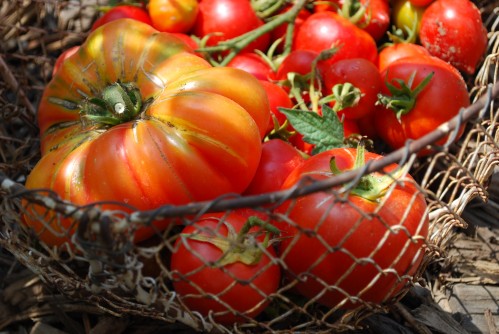
The Character of Heirloom Tomatoes

Beautiful Just-Picked Tomatoes For me, the prize out of our kitchen garden each summer is always heirloom tomatoes. In the spring I plant as many different types as I can, and baby them along through August. I seek out tomato plants I have read about, tomato plants that have funny names, tomato plants that bear certain tomato colors, and even tomato plants with a story behind them.

Heirloom tomatoes have so much color and character. They have fun names like Mortgage Lifter, Green Zebra, Mr. Stripey, Purple Cherokee, Pineapple, and Abe Lincoln, to name a few. Heirloom tomato names rival in stature the gifted quirky race horses names we all love like Dolly Daggers, Platinum Stiletto, Wink and Nod, Bling Star Dream, and Six Pack Abs, (borrowing a few horse names running at the Del Mar Race Track this season).

Heirloom tomatoes have longevity, these seeds have been passed down from generation to another, and with their genetics intact. They come in a rainbow of colors, and at first glance, an heirloom tomato is usually never perfect, but characteristically funny with bumps, creases, and what some people might call blemishes. I call them perfect, and absolutely heaven to your taste buds.

Heirloom tomatoes are so perfect in taste, slicing and adding a pinch of sea salt is all you need. If you would like to go a step further, slice fresh heirloom tomatoes, place on top of sliced fresh mozzarella cheese, add a few leaves of your summer basil from your garden, and lightly drizzle fabulous fig vinegar on top. Delicious. Of course, heirloom tomatoes are a cook's bonus to summer pasta, pizza, salsas, sauces, as well

Some of my heirloom tomato plants do not always grow well for me. I am the first to admit, living close to the Pacific coast might make me tomato-challenged. But I have persevered, and now our heirloom tomato harvest is usually abundant.

The last two years I have tried growing the "Julia Child" heirloom tomato, and with no luck. The plant grows, but does not produce many tomatoes.  Yes, besides a rose, and probably many other unknown treasures to me, Julia Child has an heirloom tomato named after her. Wouldn't you know it, this tomato plant is unusually tall with potato-type leaves and with pink 4" fluted tomatoes at harvest. How appropriate for Julia. Guess I will try again next year, because I'm sure the tomatoes are "Bon Appetit" tasty.

I usually purchase my tomato seedlings locally, but I noticed on the web a nice heirloom tomato website, Tomato Fest, with a wonderful selection of heirloom tomato seeds, including "Julia Child".

What heirloom tomatoes do you grow and recommend? What do you think is the biggest difference between heirloom tomatoes and commercial hybrid tomatoes?
Honey Bees Are Great For Your Garden

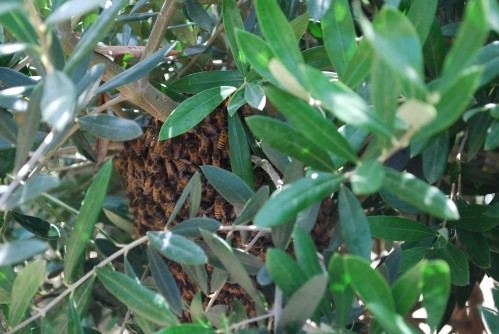
Swarm of Honey Bees Resting I know that nothing is a coincidence. Just last week I experienced my second honey bee swarming. The first one was in a friend's backyard a few years ago, and the second one was last week, close to our vineyard by the "Little Ollie" olive trees. At first I noticed a tiny dense dark cloud moving above our vineyard, with motion and fervor. Following this sight with my eyes for a while, it dawned on me that it was a swarm of honey bees. Upon further investigation and with the mission to water our "Little Ollie" olive trees, I spotted the swarm, quiet and resting under one of the branches. I wasn't afraid of them, and knew that they would be soon travelling on.
Swarming is an important part of the honey bee reproductive life cycle, and how they create new colonies for the new and old queen bees. Scouts from the swarm are sent out to find a new suitable spot for a permanent hive. In the mean time, the swarm rests, patiently protecting the queen bee, and is usually not aggressive. If you find a swarm, it is best to leave it alone. Do not spray the swarm with insecticide. Chances are the swarm will be there for only a day or two, and then move on. Contact a professional beekeeper, or your local Cooperative Extension office for questions and assistance.

We all have heard about the alarming diminishing honey bee populations in our country today. There is speculation that the bee populations might be experiencing repercussions from global warming, harmful effects from pesticides in our environment, and even experiencing some pest or fungus ravaging them. The truth is, we really don't know what is happening to our honey bee populations. This is devastating to our agricultural crops, especially almonds, and trickles down to our very own backyards, with our flower and vegetable gardens. We need bees for pollination, and of course for the golden nectar, honey.

Coincidentally last week, a special garden friend recently told me about Gretchen LeBuhn, and The Great Sunflower Project. Gretchen LeBuhn is a Bay Area biologist, who started this "grass roots" project in 2008, with little money and realistic expectations. She created a website where people could sign up, receive the specific "Lemon Queen" sunflower seeds, and then count the number of bees that visit these blooming sunflowers in their yards. This projected has blossomed to the point where she now has bee-data feedback from people in all 50 states, plus Canada. Tens of thousands of volunteers, and growing, are very concerned about the plight of the honey bee, and want to help her cause. As Gretchen LeBuhn states on her website at the bottom, "Bees: Responsible for Every Third Bite of Food".

For more coincidence, Sunset magazine's current August 2009 issue features Gretchen LeBuhn in a two page article, called "Hive Minds", page 54.

I have signed up, and you hope you will , too. Are you already part of The Great Sunflower Project? What are you finding in your own backyard with bees? All of these coincidences are a wake-up call, to help with the plight of our honey bees.

7 Basic Steps of Successful Vegetable Gardening

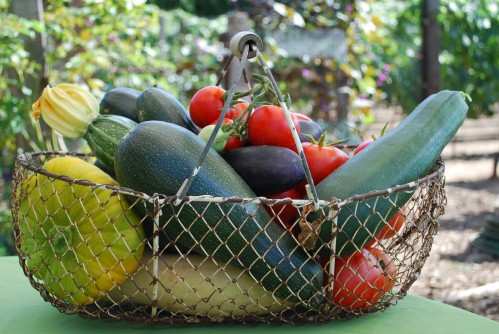
A Basket Of Satisfaction Imagine, it is August, and summer vegetables are at their peak. You are reaping all the benefits of your time invested, and steps taken to ensure a bountiful vegetable harvest. It gives me so much satisfaction to harvest these beautiful and flavorful vegetables.
If you have never had a vegetable garden before, or would like to review what it takes to have a successful vegetable garden, please follow these simple basic steps.

1) Make your plan first on paper, what you are going to plant, where your vegetables will be planted in your garden plot, and when to expect harvest for each. Read and follow seed packet directions or seedling instructions, for planting, spacing, and thinning.

2) Plant the vegetables that you and your loved ones like to eat the most. If you're not interested in a certain type of vegetable, than don't grow it. I always plant an assortment of heirloom tomatoes and squash each year. For fun, I always try and plant one or two new vegetables that I have never grown before. Don't be afraid to experiment with some of the exciting heirloom vegetable seeds available.

3) Pick a nice sunny, level, location away from trees and shrubs that might shade, and compete for water and nutrients. Make sure this location has a convenient water source. Starting out, don't make your garden too big. A 10' x 10" plot will feed a family easily, with lots of vegetables to share. Plant your tallest vegetables to the north, so they don't shade the shorter ones, and continue on down your plot with your shortest plants on your south side. Generally, it is wise to surround your vegetable plot with a fence to keep out critters like Peter Rabbit.

4) Work your soil first before planting. Ideally, you want loose, rich, well-drained soil for a vegetable garden. If you have finished compost, or the ability to add nutrient-rich amendments, add to your soil, turn over well, and mix in. Level your ready-soil before planting.

5) Mark off your vegetable plot in "one foot segments" using two stakes tied with string the width of your desired vegetable plot, to provide a straight line for planting. Some of your seeds might require rounded mounds, allow room for them. Adhere to the types of vegetables that are planted in the spring, summer, fall, and even winter.

6) Regular weeding and hoeing is a must. This keeps your soil loose for water penetration and air. Weeds if left unchecked, can rob nutrients from your growing vegetables. Water requirements vary according to your particular soil type and zone. Plants generally need 2" of water per week. Some plants have specific deep watering requirements, like tomatoes.  If possible, water your vegetable garden in the morning.

7) Know when and how to harvest your vegetables for optimum flavor and harvest. This will help your vegetables retain their maximum vitamin content and flavor. Mark it on your calendar beforehand, the approximate time frame your specific vegetables should be harvested, and observe your vegetables closely approaching this time.

Add your thoughts, do you have other tips you have used for successful vegetable gardening. Do you plan on continuing your vegetable gardening into the fall, and throughout the year. Do you have a favorite heirloom vegetable you planted this year to share.

Latest Scoop From The Coop

J.Lo Giving Us The Scoop From the Coop Chickens and backyard chicken coops have got to be one of the hottest trends happening today in the garden, right up there with growing your own vegetables. In case you missed it this week, there was an interesting article in the New York Times about backyard chickens, http://www.nytimes.com/2009/08/04/business/04chickens.html? emc=eta1.
Last month, the fab daily e-newsletter out of Southern California, "dirt du jour", spoke about the upcoming trend of chicken coop tours alongside garden tours in various parts of the country, http://www.dirtdujour.com/item/tour_de_coop/

Recently, dear friend, Debra Prinzing, author of Stylish Sheds and Elegant Hideaways wrote on her blog, Shedstyle, "Chicken Coop Sightings" and how utterly charming, beautiful, and creative chicken coops can be. Thank you for including "Coop de Manion" in your sightings.

Check out the latest scoop.

VintageGardenGal Gardenin' Survey

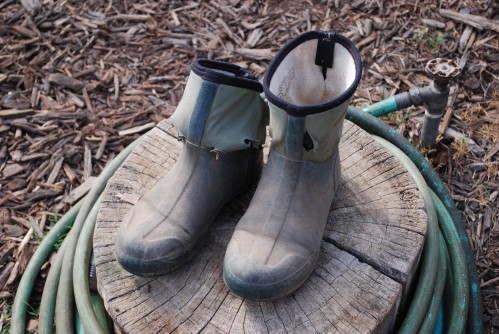
These Boots Are Made For Gardenin' I've been looking for a new pair of garden clogs, shoes, or boots, for sometime now. I haven't really found a desirable new replacement pair, as of yet. So, I thought I would simply ask all of you. This has been the impetus for VintageGardenGal's Gardenin' Survey today. I want to hear from you, your feedback. Please answer and comment on any, or all of these questions.
What is your favorite shoe, clog, or boot to garden in? Why? How long do you usually keep your garden boots?

What is your favorite garden tool, you can't garden without?

What are your favorite garden websites and or garden blogs you follow? Can you list your top five to ten?

What kind of a gardener are you?  Sporadic?   Weekend?  Passionate everyday gardener?   When the mood hits me gardener?  Since you were a child?

What motivates you to garden?  How did you get started gardening?

Where do you look for help with your garden? Magazines? Blogs? Websites? Workshops? Nurseries? Friends? Professionals?

What garden trends are you seeing in your community? Your garden clubs? Your neighborhood?

In what ways do you think gardening today is different, from even five years ago?

VintageGardenGal is a garden lifestyle blog covering many categories. What is your lifestyle? What draws your attention to VintageGardenGal? What would you like to see more of?  Do you prefer "How To's"?  The Unusual?  Garden tips?  More of the same?   Other categories?  Please feel free to comment, and please suggest your favorite footwear you garden in!

VintageGardenGal Reviews Ethel Gloves

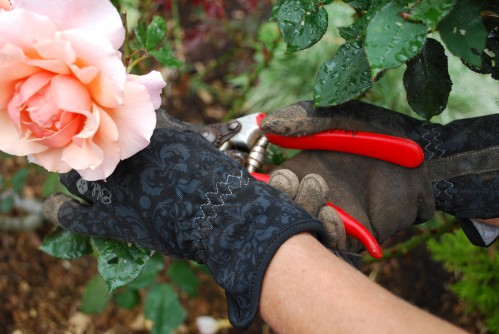
Gardening With Ethel Gloves The creative folks at Ethel Gloves approached me, and asked if I might want to review their gloves, and ultimately share my thoughts with you. Upon accepting their offer, I was sent a complimentary pair of Ethel Gloves. It is my intention to present a fair, unbiased, and informative review for you.
I had never heard of Ethel Gloves before, but in researching their website, they are widely distributed. I like their philosophy of gloves created for women gardeners, which focus on fashion, function, and protection. Their product packaging alone was enough to woo one over, clever and beautifully designed.

My initial reaction when I put my new Ethel Gloves on was similar to wearing my winter leather car-driving gloves...classy. Instantly I felt fashionable in my garden gloves, something I've never experienced before. I have a small hand, and received a size small, which fit my hand nicely. The gloves come in S, M, and L. The glove conforms to your hand easily and has reinforced finger tips and palm surface for protection. An elasticized cuff, keeps your gloves comfortably in place. So fashion was good, nice fit, and many styles to choose from.

Putting on my Ethel Gloves, I started my hands-on gardening practices. I was pleasantly surprised at the great hand dexterity in holding tools, clipping plants, and best of all, creating my vintage container designs. In my designs I'm working with chop sticks, tiny spaces, intricate placing of plants, and usually without the aid of my garden gloves, but Ethel Gloves are like a second comfortable skin and worked well throughout my designs. So function, was very good.

I consider myself a bit of a "guerrilla gardener". In one week I helped move a wood pile, trimmed and mulched over 30 rose bushes, and tended to my black berry bushes, wearing my new Ethel Gloves. For these heavy duty chores where thorns and splinters lurk, I could have used a little more protection from my Ethel Gloves. So protection was only fair. Please note, Ethel Gloves does have a specific "rose glove" available. However, we all have a wardrobe of clothes and shoes for specific activities and functions. If you are an avid gardener, why not have a wardrobe of garden gloves to choose from as well.

The Ethel Gloves shown above are the Gala model, priced at $20.00, black with contrasting grey fleur-de-lis pattern, and black palm. This glove is machine washable. For more information on Ethel Gloves, please go to Ethel Gloves.

Discovering The French Marans Chicken Breed

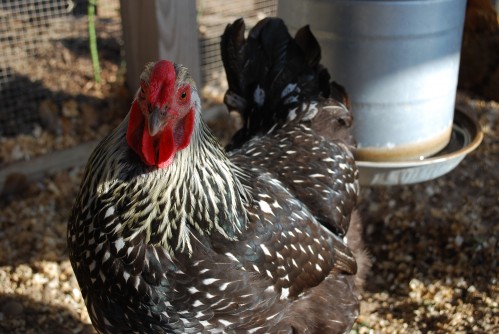
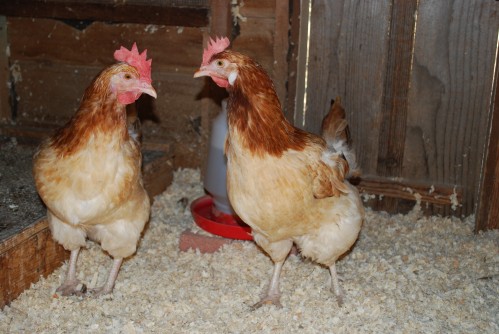
Meet Our New French Hens, Fanny and CoCo Originally, I found an advertisement for French Wheaten Marans chicks at my local feed store's bulletin board, and decided to order some chicks from the breeder. I was unfamiliar with this chicken breed, but was captivated by them. What makes this breed so unique is their dark chocolate colored eggs. By unusual circumstances, and many twists and turns, I was actually given the breeder's two "1-year old" hens last week. I promptly and appropriately named our new two French Wheaten Marans hens, Fanny and CoCo.
The Marans chicken breed originates from western France, around the actual town of Marans, and near La Rochelle. The Marans rooster is very striking, multi-colored, and is often depicted in French paintings and farm scenes. The hens look totally different from the rooster. Within this Marans breed there are actually eight or more colors or varieties. Our Wheaten Marans hens are one of the varieties, being light buff in body, with darker buff feathers around their neck, shoulder, and tail feathers. For a little drama, their tail feathers have a striking black tip on the ends. The most well known varieties within the Marans breed are the Cuckoo and Black Copper.

Marans chickens are generally characterized as a large attractive hardy breed. They are very active chickens, and do well in a homestead setting. They have a friendly docile temperament. They have a single red comb. and can come in feathered or clean-leg varieties. They were originally bred for their very dark brown egg production, and meat value.

It is the dark chocolate colored laid egg, which attracts most people to the bred, and which sets them apart from all other chicken breeds. The Marans egg receives its deep brown color right before laying. A deep chocolate brown pigment is deposited and tinted over the finished egg by way of mucus glands within the last 10 centimeters of the hen's oviduct before laying. Immediately after laying, this layer of tint dries quickly and the shell retains its beautiful dark chocolate color. Remember, the egg's flavor is determined by what the hen eats, therefore these eggs will not taste like chocolate. It is all about the "wow factor" in the visual appeal of the egg.

This differs from your usual farm-fresh brown eggs, most generally laid by heavy-weight chicken breeds, where the tan pigment is built into the shell calcium as the egg travels down the hen's oviduct, and not tinted in the last moments of being laid. Similarly, the popular blue-green egg laid by the Ameraucana breed is tinted throughout the thickness of the shell. With your normal brown eggs, and blue-green eggs, the color cannot be removed. However, the deep chocolate brown color on a Marans egg can be washed off with water, if you attempt it.

All of you who have been following this blog by now know we have our other beloved chickens, our "Hollywood Girls". With the introduction of Fanny and CoCo, there is an adjustment period, a "get to know you" period, and a creation of a new pecking order. While I'm watching this all unfold, I'd love to hear from you. Especially if you are familiar with the Marans chicken breed. What do you like most about the breed? What do you like most about the eggs? Do you have a Maran rooster, too? What variety do you have?

Tips On Keeping A Clean Chicken Coop

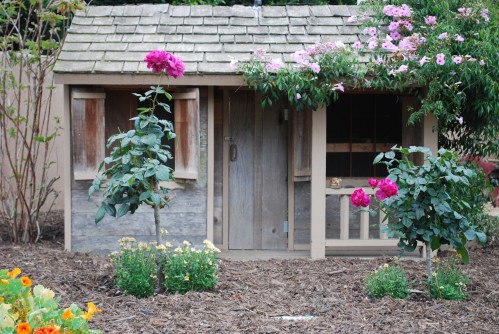
Coop de Manion If you have chickens, do yourself a favor as well as your chickens, by keeping their coop and outside pen clean. In a clean environment, your chickens will be healthy, happy, and flourish for many years. On the flip side, if your chicken coop and outside pen is always dirty, you are courting disease, stress, flies, rancid food, rodents, dirty eggs, and more. Your flock will not be able to live an optimum healthy happy life.

We all live in different parts of the country and the world with different climates, and most likely have some sort of unique chicken coop set up. So the formula is, what ever works for you, as long as your chickens are in a clean environment. Do you have tips for keeping your chicken coop clean, that you would like to share?

I have mentioned previously in the post, "Backyard Chicken Coop", Roosting Bar & Manure Box, I clean my manure box under my hen roosting bar every morning, skimming it and putting it into the compost. I rotate my chicken coop bedding on a regular basis, starting with fresh bedding in the nesting boxes, rotating the bedding to the chicken coop floor and then to the manure box, and finally to the compost bin. This method of cleaning has worked quite well for me.

My hens always have plenty of fresh water and quality laying mash. I supplement with greens, fruits, and vegetables every day for treats. Any uneaten treats also go into the compost bin. Chickens love their protein, as much as their grain. Do not be alarmed if your chickens eat a mouse, small lizard, grasshopper, snail, worm...these are also perfectly natural foods for chickens.

Every month, or more frequently if needed, I thoroughly clean my chicken waterers by soaking them in a tub of "food safe dish soap" and and a few tablespoons of bleach for a half an hour or so. The bleach acts as a sterilizing agent. There are "environmentally safe" bleaches available on the market now. Never mix any soaps or cleaners with your chicken waterers that may be toxic, and leave a residue. With a toothbrush, I scrub the chicken waterer lip and basin. Here in Southern California, in the summer heat, sometimes I get a green scum build up, so I clean my chicken waterers more frequently. Make sure to rinse your waterers well before filling with water and returning them to your chickens. When cleaning your waterers, make sure your chickens have an alternative source of water to drink from.

Protect your feed from rodents, mice, squirrels, moths, moisture, etc. by keeping it in a dry, air-tight container like a new plastic or metal garbage can with a tight lid on it. Ideally, you should have a special place to keep your feed safe in a shed, garage, or enclosed area protected from weather elements. Rodents can transfer mites, and diseases to your chickens if left unchecked. Please note that rodents are pretty determined, and can chew through plastic garbage cans and wood feed bins, too. If you have rodent evidence, take steps to eradicate them.

Incorporating a daily maintenance routine for your chickens will keep your chicken coop, and outside pen clean on a daily basis. Once a quarter, or about every three months, I also do a thorough chicken coop and outside pen cleaning. First, I move my chickens to another area, or let them out in our yard with a watchful eye. I open up all the doors and windows, remove all of the bedding and check for dry rot, termites, rodent holes, etc. With a broom, I brush off my protective wire screens for dust and any cobwebs. I take my manure box out of the chicken coop, empty, hose down, and brush the wire top clean. I then let it dry in the sun throughly. I level the soil in my outside pen with a rake, and add a layer of fresh new sand or soil. I add new walking mulch around my chicken coop. I do a thorough "tending to" of my plants, vines, roses, and vegetation I have planted around my chicken coop. I never let weeds grow or trash of any kind, linger near my chicken coop.

In other words, I do a thorough quarterly cleaning of my chicken coop, and outside pen. I have a small flock of hens, if you have a large flock you might have to do extensive cleaning more often. When it comes to chickens, I can not stress enough that preventive cleaning and daily maintenance is your best philosophy to follow.