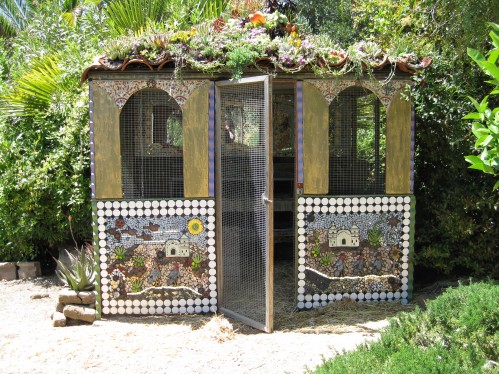
 My dear friend, fellow gardener, and incredible ceramic and mosaic artist, Kathy LaFleur, would only have a chicken coop as befitting as the one in the above photo for her lucky chickens.
Kathy has transformed this aviary into a "palais de poulet" for her hens. On the top of her roof she added roof tiles, and planted beautiful thriving blooming succulents. On the front of her chicken coop she has painstakingly created two unique mosaics. There are more colorful mosaics and mirrors adorning the inside. Notice the two rows of vintage hen nesting boxes in the chicken coop background, and that she uses hay as her preferred bedding material. Hats off to you, Kathy, your creative chicken coop is so inspiring and amazing!
Here are a few FAQ questions from the previous "Backyard Chicken Coop" Series:
What are the best chicken breeds for a backyard chicken coop? It really is your preference, and what your purpose is for having chickens.
My preference for backyard "homesteaders" is the heavy-breed chickens that generally lay brown eggs. Some of my favorites are the Buff Orpingtons, Rhode Island Reds, Barred Rocks, Silver-Laced Wyndottes, and the Black Australorps. The heavy-breed chickens are more docile, friendly, approachable, and are great layers. Ameraucanas lay a pretty blue-green egg, and are a nice choice, too.
If you are pinched for space overall, you might consider the Bantam chicken varieties. They are a smaller chicken that lay large eggs relative to their size. Their space requirements are 1 sq ft/bird inside coop and 4 sq ft/bird outside chicken coop, quite a bit less than the heavy breed chickens at 1.5-2 sq ft/bird inside chicken coop, and 8-10 sq ft/bird for outside pen. Silkies, with their head plumes, and Cochins with their heavily feathered legs are Bantams. I call them designer chickens, pretty and showy, but can be skittish and a bit aloof. You might want to get an assortment of breeds for your backyard flock for variety and fun, but preferably all about the same age.
What is the best floor for chicken coops? Chickens require dry, draft free housing with good ventilation. Ideally you want your chicken coop, raised off of the ground, with sunlight able to access underneath. However, this is not always possible, especially if you have a modified structure or building.
A concrete floor is acceptable, but you must provide ample bedding and make sure it is not damp. A dry, wood floor is acceptable, again with ample bedding. If you are using plywood or wood in general, make sure it is untreated, no chemicals used in manufacturing it. My preference for bedding is pine litter, available at feed stores, because it is manageable and easy to compost with. Hay is another nice choice of bedding. Sometimes your chicken coop design lends itself better to one kind of bedding over another.
An entire wire floor is not ideal, because it can be hard on hen's legs and feet, and manure is dropping where? Wire mesh over the top of your chicken manure box is fine, but not for an entire floor. It also leaves your hen house rather exposed to rodents and varmints.
Where do I position my chicken coop in my backyard? Ideally, you want a quiet corner or spot on your property that is away from your house. It needs to be preferably on a high, well-drained area. You want ample air movement without a draft. Fresh air means fresh oxygen and movement to remove excess moisture, ammonia, and carbon dioxide which hens naturally give off.
It should be an area where the south sun reaches the chicken coop, and the outside pen for a large portion of the day. We have our chicken coop nestled by our orchard, and generally close to our storage shed, and composting area. It is an area slightly removed, but accessible. Fun with landscaping helps muffle sounds from your chickens, and integrates your chicken coop with the rest of your garden.
Chickens are active, and can be remain in their outside pen all day. Remember, if they are laying hens, they will need access to their chicken coop and nesting boxes during the daytime, too. At night time, it is best to tuck your chickens in, by bringing their feed bucket inside the chicken coop, and closing up their outside pen, doors, and windows till morning. Make sure your chickens have adequate ventilation with their chicken coop closed for the night.
When I let my chickens out in my yard, they like to wallow in the dirt. What are they doing? I call it a "dirt bath". They enjoy creating a little basin and laying down in the dirt, flinging dirt over themselves and their feathers. It is a way of cleaning themselves, cooling themselves, and relaxing.
I have a hen who insists on sitting on a "clutch" of eggs for long periods of time. What is she doing? She is brooding, or sitting on her eggs to hatch them. If you have a rooster in your flock, most likely you want fertilized eggs and/or chicks. If your hens sit on fertilized eggs for 21 days, embryos will develop and eventually hatch as chicks.
Even if you don't have a rooster in your flock, some hens will naturally sit or "brood" on their eggs, usually in the spring time. You have a choice to let your hen brood, or collect your eggs as usual. I usually collect my eggs so I know they have recently been laid, and because a hen can actually become emaciated by not moving, eating, or following her regular routine for days and sometimes weeks. Just because you remove all the eggs a hen is sitting on, does not necessarily mean she will stop brooding, too.
I have a neighbor or friend who wants to give me one of her hens that is being picked on in her own flock. Is that okay to do? I have generally had good experience in adopting hens into my flock. I would encourage you to adopt a hen, if the circumstance is right for you, and the hen is generally healthy and in good condition. There is a difference in a hen being pecked at, and a hen that is sick. Introducing an older hen into a younger hen flock usually works well. The adopted hen, can become the "mother hen", and show the others "the ropes".
Why are certain hens being picked on in my flock, and how can I prevent it, stop it? Hens naturally have a pecking order they establish within a flock. Sometimes a hen is perceived as weak, or picked on for no reason at all. If you introduce younger hens into your flock this can be a problem because they are smaller and younger, and unable to defend themselves. Generally speaking, if your flock of hens are the same age, you will have less of a "pecking order" problem. This can be hard as your flock size shifts and you might want to add new hens. Hens like routine, and when new hens are frequently introduced, it shifts the flock dynamics. Also, make sure you are not overcrowding your hens, check your sq ft/bird to chicken coop and sq ft/bird to outdoor pen ratio.
Sometimes it takes just a few days for all of the hens to settle in, and adjust. Sometimes they never adjust, and you might have to separate them in another pen or coop, or isolate them for a period of time, or ask a friend about adopting your hen.
Do you have more questions, comments, stories to share about your chickens and chicken coop?

 There is nothing boring about Borage, Borago officinalis. It is the epitome of why herbs are so great, and how you can enjoy them in your garden as well as their many versatile uses.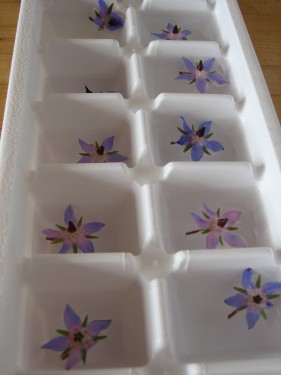
 Each morning I start my day in our gardens and opening up our chicken coop for the day. It's early morning, and I am scurrying around to see if any new seeds have sprouted in our kitchen garden, what needs water, what is about to bloom, how my new roses are doing, if what I transplanted recently is doing well, and what chore or project needs to be done. It is also a time I reflect on my gratitude, my blessings, and my bliss. I call these "coffee cup thoughts".
 Does your mom live a "stone's throw" away from you? Are you able to make her and all of your loved ones a delightful Mother's Day Brunch celebrating "her day" with your fresh eggs, delicately poached over heart-shaped polenta, melon-drizzled vinaigrette over arugula greens, blue cheese, and proscuitto, and gloriously ending with fresh berries and sour cream coffeecake? No, does she live out-of-state like my mom? Well, here is a great suggestion.
 This is another spring blooming delight, Orchid Rockrose, Cistus x purpureus. Although this is a native Mediterranean drought tolerant shrub, something about it reminds me of an English country garden.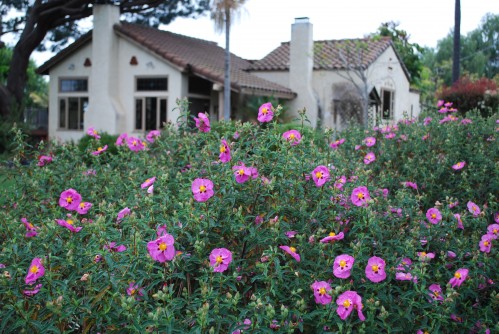
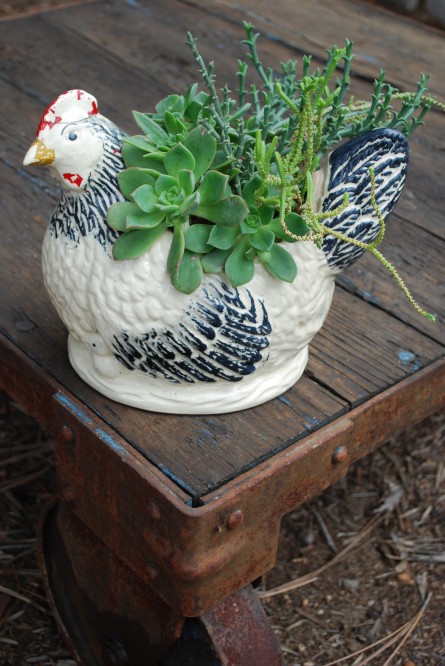 Vintage chicken planter cackles with character, and begs to be potted with succulent plumage. Round and rosette-like, I use my perennial favorite succulent, echeveria, planted at my hen's shoulder and back. Similiar to a perfectly shaped fleur-de-lis, is the handsome green, slightly uncommon ice plant relative, Smicrostigma viride. The chartreuse green notched strands, with a mind of their own, are Crassula mucosa, or Watch Chain succulent (formerly Crassula lycopoidioides). One couldn't ask for better plumage, that keeps on growing.
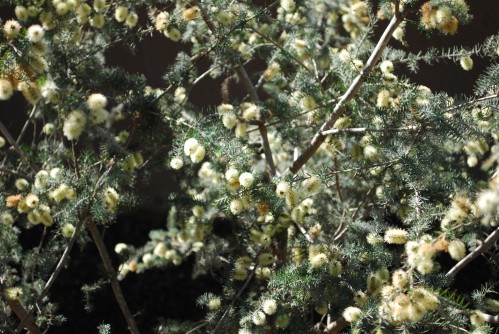 I wanted to write about the Grey Honey Myrtle tree, because it is one of my stellar nursery choices, of the last two years. You know the ones. They catch your eye in their generic container. You have an inkling they could look nice in your garden or yard. You take them home, plant them, and you all settle in. Presto, you wonder how you ever lived without them. They do something incredible and unknown to you, such as a totally unanticipated explosion of color. Yes, it is a big deal, because there are many more lackluster nursery choices that seem to fizzle, and all with good intentions. Has this happened to you?
 If you like spring greens, you will love to grow and cook with the asian mustard, Red Giant, Brassica juncea. Easily started by seed, it is a cool season annual which is slightly peppery in taste with magnificent green to dark purple textured leaves. Although it is "cold and bolt" tolerant, if allowed to flower, it has incredible yellow flowers that emerge as a tall spike out of its center, as a final encore.