Ornamental Oregano, Kent Beauty

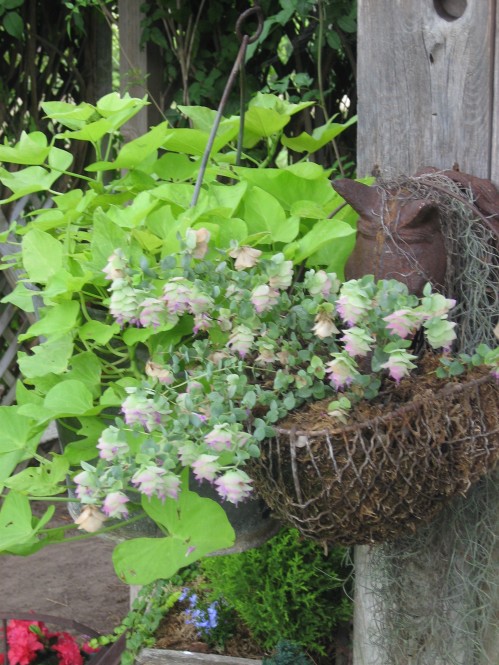
Kent Beauty, Potted in Vintage Horse Muzzle Planter If you are a gardener, chances are you like to grow herbs, too. One of the most beautiful herbs I have ever grown is the ornamental oregano, Kent Beauty, Origanum rotundifolium. While most oregano varieties are grown for their culinary use, Kent Beauty and a few other ornamental oregano varieties are not, and in fact, have no taste at all. Ornamental oregano are best used for their beauty in gardens, borders, and especially containers.

In the photo above, I created a tiny hanging basket out of a vintage horse muzzle, lined with moss, and planted with a 4" Kent Beauty plant. As the Kent Beauty grows, it spills gracefully over the sides of its re-purposed container. Its simplicity is enchanting.

Kent Beauty is a delightfully fragrant herb, attractive to bees, and has such a delicate "tossled" beauty about it. Its foliage is actually hard to describe. It has wiry stems that reach 4" in height, with beautiful blue-green stemless rounded leaves.

Off of these stem ends, bloom textured bracts, similar to hop, in a delicate mauve pale pink color throughout the summer. These delightful mauve pink bracts can be cut in full bloom, hung, and dried upside down for use in crafts.

Kent Beauty is native to Turkey, Armenia, and Republic of Georgia and is a hydrid ornamental oregano of Origanum rotundifolium x Origanum scabrum. I have seen multiple preferred climate zones for this herb, so check with your plant source for details for your area first, before purchasing.

Prune Kent Beauty closely back, after its summer bloom. It does best in well-drained soil. It prefers to be in dry soil, between thorough waterings. It is best to protect it from excessive winter moisture. It is available in local nurseries, and a good website I found for ornamental oregano varieties and purchasing is http://www.mountainvalleygrowers.com/index.html.

Prep Your Garden Tools For Spring

Last year my husband, John, and I were featured in an article called "Grow Greener" highlighting our flower/vegetable gardens, and organic practices in, Nature's Garden magazine, Spring 2008, http://www.debraprinzing.com/articles.php?article_id=40, written by friend, Debra Prinzing, an incredible garden and design features writer. See below, for more information on Debra. For this article, she asked me my "top ten healthy garden practices", and the last one I chose was "order before beauty", which Debra so aptly penned, "Chores Have Their Rewards".

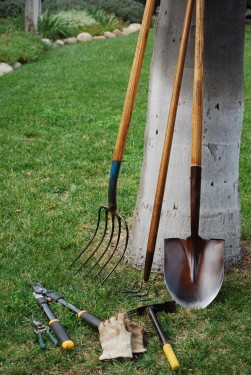
One of the chores I was particularly thinking about, was caring for your tools. Tools should always be cleaned, dried, and stored away in an orderly manner. If you have the due diligence, go one step further and wrap clean rags or towels around your tool heads before stowing away. Spring is especially a great time to prep your garden tools and have them ready, for all of your busy gardening needs, so you can "hit the dirt running".

Take a good look at your tool inventory and their condition. Do you know where your favorite tools are? Are your tools clean, or a bit rusty? If so, deep clean and lubricate them. Do they seem dull when using, or do they still have their sharp edge? Make sure your tools are sharp, it will save you physically. Are your tool handles rough or soft to the touch? If rough, lightly sand your wood handle tools with fine sandpaper, and apply a generous amount of linseed oil with a soft cloth. If the oil absorbs quickly, reapply. Your tool handles will be as soft as velvet and a treat to work with. Properly cared for tools can last generations, and can be handed down from one generation to the next budding generation of gardeners.

It is all the same, whether it is your personal life, your home, or your garden. If you are organized and tidy, you will be much more effective, efficient, and accomplish more effortlessly. You will soon experience the rewards. There is a great quote that reinforces this message. "When you do the things you have to do when you have to do them, the day will come when you can do the things you want to do when you want to do them."--Zig Ziglar, Author.

Debra Prinzing is a Southern California-based writer and lecturer who specializes in interiors, architecture, and landscape design themes. For more information and articles, please visit her website, www.debraprinzing.com, and her blog, www.shedstyle.com. Her latest book, with William Wright, architectural and interior design photographer, is called "Stylish Sheds and Elegant Hideways".

Dazzling "Razzleberry" Shrub

Blooming Razzleberry Ruby Shrub

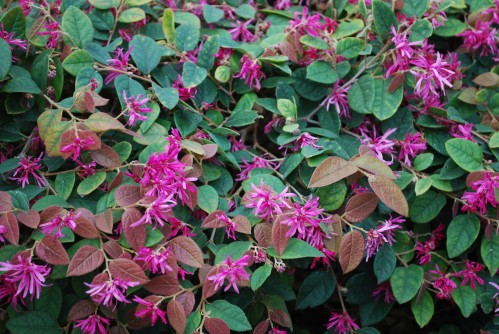
Another favorite early spring blooming shrub of mine is the showy "Razzleberry" evergreen shrub, also called Chinese Fringe Flower Loropetalum chinense, var. rubrum "Razzleberry". Its striking deep pink fringe-like flowers have a sort of "flopsy mopsy" show-off demeanor. In spring, its foliage is a verdant green, deepening to a beautiful bronze color later in the year.

Not only are its flowers and leaves showy, I love its mound-like structure, too. Although it can reach 4 feet high and wide in maturity, I keep mine compact at about 3 feet high by 3 feet wide, and off of the ground. Its layers of graceful arching branches add to Razzleberry's flowering drama which is best in the spring, but it can flower at other times throughout the year, too. It benefits from a shapely trim, now and then, and certainly before its spring bloom.

Originally from Japan and Southern China, this evergreen shrub is drought tolerant once established, and likes sun to partial shade. I planted mine under a mature avocado tree, so it has sun and partial shade. I also planted it along my boxwood pathway, surely to be noticed by passersby.

The Razzleberry shrub can be used in many different ways in the garden. Place it in an entrance to a sun-speckled woodlood garden. Plant it next to a wonderful gurgling water feature. Espalier it against your courtyard wall. With young plants, you can pot it in a patio container with other color, or in your favorite moss-covered hanging basket.

Loropetalum chinense, or Chinese Fringed Flower, comprises a large variety of cultivars, with pink, red, or white flowers and various other size and structural characteristics. Besides, the Razzleberry, other popular varieties are Ruby, Sizzling Pink, and Burgundy. They grow best in zones 7-9. These shrubs are easily found in local nurseries, and by mail order via the internet.

For an eye-catching addition to your spring garden, plant a dazzling Razzleberry shrub. Do you have a Chinese Fringed Flower shrub in your garden, you'd like to share comments on?

Miracle in the Chicken Coop

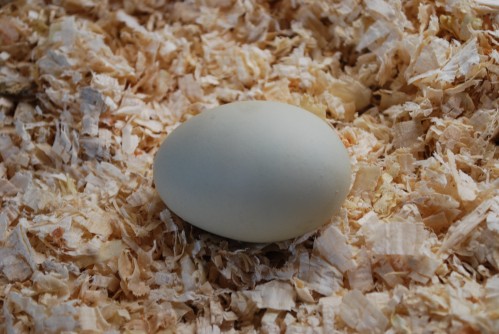
Miracle in the Chicken Coop Yesterday morning, I was opening up the shutters and door of the chicken coop for my hens to start their day, and I spotted a "miracle egg" in one of their nesting boxes. Miracle, because it was simply perfect in shape, size, and shell. Miracle, because it was a beautiful pastel blue-green colored egg, laid by Julia, my honey-colored Ameraucana hen. Miracle, because eggs are more of a rarity than the norm in our flock these days. Miracle, because Julia is a six-year old hen, hopelessly past her egg-laying prime, and please don't tell her. Miracle, because it is yet another sign of spring approaching, with increasing daylight lengths stimulating Julia to lay a perfect egg.

Fresh laid eggs are an incredible joy. One of the last things a hen does before she lays her egg is put a thin protective transparent coating over the egg. This locks in freshness, and you should never wash fresh eggs, except if they have gotten dirty with a manure dropping, mud, or something. This is nature's organic way of keeping the egg fresh. Once you gather your fresh laid eggs, you will want to put them in your refrigerator.

Fresh laid eggs, can still be warm from a hen's body, and warm in your hand. This is surely one of life's simple pleasures to experience, and reinforces my bliss in raising and growing your own food.

Some hens cackle a bit when laying an egg, confirming it is an in depth process for them. Hens laying eggs regularly, usually lay their eggs in the morning to early afternoon. When you provide nesting boxes for your hens, with fresh pine shavings or straw, hens instinctively know where to lay their eggs. Sometimes hens will lay all their eggs together in one nesting box, as if it were a party. More often, they use separate nesting boxes. Your eggs will keep fresh, and unharmed, until you collect and gather them.

Each chicken breed lays an egg of a particular eggshell color, that remains constant to that breed. For instance, a Rhode Island Red hen will only lay brown eggs. What a hen eats is the big difference in eggs, and determines the amazing color of their egg yolks and taste of their eggs.

There is such a dramatic difference in cooking, baking, and eating with fresh eggs, I am astounded. I have to smile at friends and family reactions when I cook them breakfast for the first time with our fresh eggs, or give a friend a dozen fresh eggs as a hostess gift.

Happy backyard hens who eat a protein laying mash*, enjoy fresh fruit and vegetable treats, as well as the pickings of a yard or garden for bugs and worms, will lay truly incredible "golden" eggs for you, your family, and friends to enjoy.

-Glossary-

*Laying Mash, complete diet for laying chickens, usually made up of cracked corn, soybean meal, oyster shell pieces, and other nutrients.

Pink Breath of Heaven

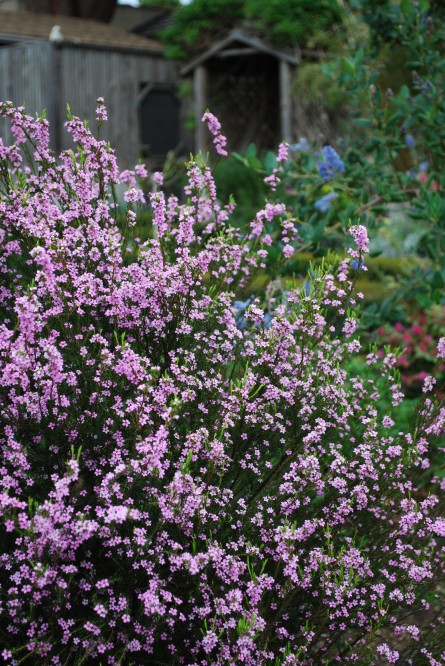
First Sign of Spring, Pink Breath of Heaven Blooming How can you not love a plant called "Pink Breath of Heaven". This shrub originally from South Africa, explodes into bloom winter to spring, with showy pink delicate tiny flowers on wispy feather-like branches. I feel like it is my own personal "trumpeter" in the garden, announcing the beginning of spring.

Pink Breath of Heaven, Coleonema pulchrum, can sometimes be found in nurseries under the name, Pink Diosma. There is also a white-flowered species, called White Breath of Heaven, Coleonema album, which is equally as beautiful in bloom and size. Pink Breath of Heaven likes full sun or partial shade, and moderate water. At maturity, it can easily become one of your largest evergreen shrubs in the garden reaching 5 feet high by 5 feet wide. It benefits by trimming it back, or lacing it if you prefer, after its spring bloom, to shape it and keep it compact. It does well in zones 7-9, and 14-24. Pink Breath of Heaven has a slight bit of fragrance when touched lightly, or brushed up against it.

Introducing this showy shrub into your garden, requires some thought on where to best place it for ample room to grow and thrive, and yet blend in with the rest of the garden. Pink Breath of Heaven look nice as a background shrub, as a focal point, or even along a pathway. For its size, it has a light and airy feeling to it, and it moves beautifully in a breeze.

Its delicate pink flowers are such a feminine and romantic pink, I like to use a visually complementary plant color palette such as dark pinks, purples, lavenders, and green colors surrounding it in the garden.

It is about this time of year, the end of February, in my zone 9 garden, my Pink Breath of Heaven bursts alive with its stunning first bloom and lets me know that spring is just around the corner.

The Joy of Chickens

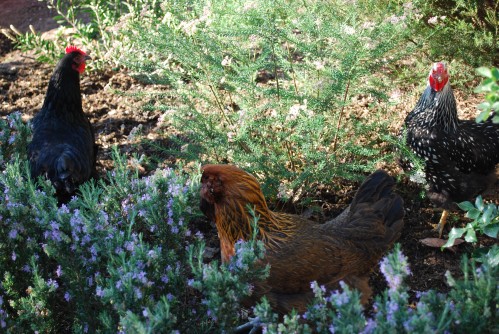
My Hollywood Girls, Louise, Julia, and J.Lo in the Garden In the photo above are my beloved hens, Louise, Julia, and J.Lo, named after the posh Hollywood crowd. Believe me, besides being pretty, they have attitude, too.

If you have the space, and are properly zoned to have chickens in your backyard or property, I would highly recommend jumping into the world of chickens. Chickens are so much fun, and relatively easy to take care of, and require just a few basics.

Chickens need protection.  They need a protection in the form of a building, pen, or coop, from extreme temperatures, winds, and drafts. They also need protection from elements that might harm them such as neighbor's dogs, hawks, coyotes, etc. Place straw or pine shavings on the floor, and keep clean. Ideally, it is nice to have a place of protection at night time and for extreme weather conditions, as well as an outdoor protected pen where they can be active.

Chickens need a source of water and feed at all times. Chickens need to eat constantly, and require "laying mash" in their egg-laying years. In fact, when I open up my chickens in the morning, and stir up their feed bucket, every morning is like Thanksgiving to them...they can't wait to get to the feed bucket after a night's sleep.  Every day I give my chickens a fresh treat consisting of greens, fresh fruit, or some type of vegetable. A fresh, clean water source is important for chickens to have at all times. I have two for mine, one that is inside their house, and one for their outside pen.

Chickens like a nesting box for laying eggs.  Chickens start laying their first egg at about six months old. Their egg production can be described like a "bell-shaped curve". Initially, once they start laying, they will lay an egg every 24 hours, or an egg a day. They will lay at that rate for their first 1-2 years, and they will gradually taper off, to the point where they do not lay any eggs. You can build a row of nesting boxes inside their chicken coop. It is an open square shape box, where straw or pine shavings is placed for bedding, and where the hen can go and quietly lay her egg. It is really quite an incredible process. Chickens naturally molt about once a year. Call it a vacation, or time of rest in sync usually with the decreasing day length. Do not be alarmed, they will lose their feathers, stop laying for a few weeks time, and then begin to grow back beautiful new feathers, and commence with the business of laying eggs once again. Fresh eggs are so beautiful and taste incredible. They are literally golden eggs.

Chickens like a roosting bar, 24-30 inches off of the ground to sleep at night. This bar assimilates a tree branch. They feel protected, and want to be off of the ground to sleep. I have a manure box with quarter inch wiring directly under the roosting bar, which catches most of their manure from the night before. Some people clean it once a week or less, but I collect their manure every morning, and put it in my compost pile. I like to avoid any problems like excess flies and odor that a build up of manure might cause.

A hen does not need a rooster to lay eggs. A hen does need a rooster if you are planning on having fertilized eggs, and eventually chicks for your flock. Baby chicks especially need to be kept warm and protected. Roosters introduce a whole different element to your flock, noise, and often they exhibit aggressive behavior protecting their hens. You might do yourself, and your neighbors a favor, and start with a flock of hens only.

Chickens are fun, social, and with individual personalities. Don't get just one chicken. They are social, so start off with at least 2-3 chickens. You can bet there will be a pecking order established within your flock, which is not necessarily a bad thing. Chickens love to explore, and are curious about everything. They love gardens, and will be a faithful garden companion. They respond to kindness, a routine, and familiarity of people feeding and caring for them. If you plan on going on vacation, etc., make sure you have someone reliable to watch and care for your chickens, just like you would do for your other pets.

If you have been thinking of getting chickens, spring into summer is your best time. Your local feed stores might carry a nice variety of "pullets", young laying hens, for you to choose from. There are certainly a wide variety of breeds available for the chicken enthusiast. I like brown eggs, and have found the heavy breed chickens, such as the Buff Orpingtons, and the Australian Black Australorps to be great egg producers, and "people" chickens. A fabulous website and place for information on different breeds and mail order of "specialized fowl" is www.mcmurrayhatchery.com.

I can not say enough about the "joy of chickens", you must experience them for yourself.

"Rainy Day" Green Tips

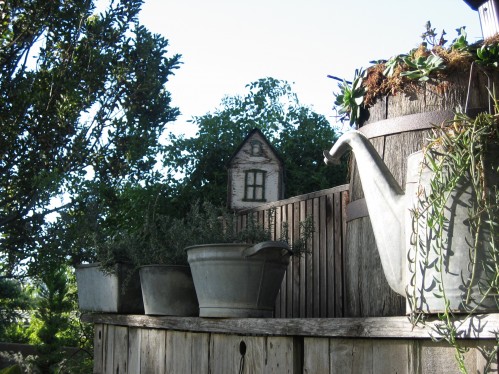
Can You Spot the Rain Barrel? Here in Southern California our average rainfall is twelve inches. With the looming cloud over of us whispering "water rationing" it is wise to take advantage of our precious rains. Why not try to collect, contain, and utilize your precious rain water for your garden. Here are six easy tips I use, that I would like to share with you.
1)  If you hear on the news of an incoming rainstorm or showers, turn off your irrigation water. The news has gotten quite accurate reporting on all the details of rain coming, enough to give you advance warning to prepare.    

2)  I have a compost bin, actually three to be exact, that I add to everyday and make fabulous "worm worthy" compost for my garden. That is another post subject on its own. They are stackable and have a removable lid. When I hear it is going to rain, I remove the lids from all of my compost bins to catch all of the rain and moisture. Compost needs to be kept moist, and what better way then a fresh rain. After the storm, I put the lids back on.

3)  Install an actual rain barrel or large urn under one of your convenient downspouts to collect water. In the photo, there is actually a plastic 33 gallon barrel within the beautiful wooden barrel, adorned with succulents on its top. My dear neighbor gave me this vintage barrel, that I slipped over a new plastic barrel. If you look closely you can see the downspout which is coming off of a storage shed rain gutter. I went one step further, and connected a hose at the bottom of the barrel with an on/off valve. The lath structure by the rain barrel is actually my potting shed. I have the ability to fill a watering can from my collected rain water barrel, inside my potting shed. It does not take much rain to fill a barrel. You will be surprised.

4) If you can not install an actual rain barrel of some type, put your watering cans, or something similiar under your rain spouts or gutters.

5) Place your easily moveable pots and containers out in the open air to receive the rain. Rain water has a lot of nutrients in it, that our irrigation water does not. Give your plants that extra boost.

6) Once again, when you hear rain. Prepare. Clean your bird baths, and empty them. The rains will fill them with fresh rain water and your wild birds will enjoy the treat.

I would love to hear your green tips for rainy days...in comments.

"Much Ado" in the Winter Vineyard

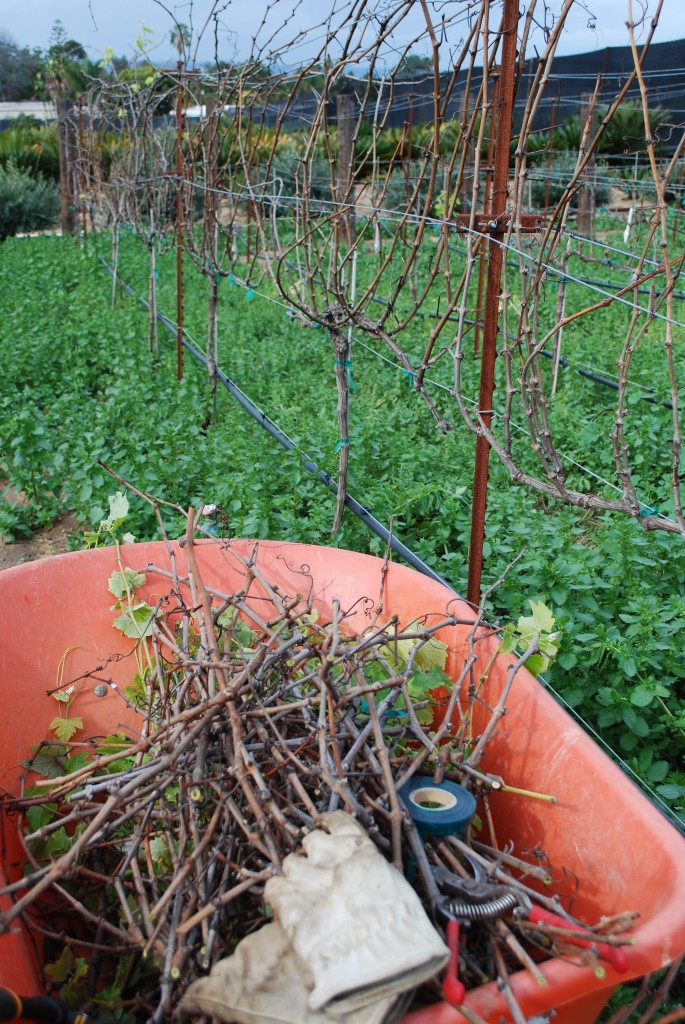
Backyard Vineyard in Winter A few months ago, I wrote a post called "Rest, Repose, and Replenish", the dormancy time in a garden during winter. This time of year has a different kind of beauty, and a peaceful mood beckoning everything to slow down and replenish. The same beautiful dormancy happens with a vineyard, too.

After the culmination of the grape harvest, the vines begin to slowly shut down. Their leaves turn a rainbow of autumn hues and eventually drop off the vine. The skeleton of the grapevine or "bones" is exposed, showing their trunk, cordons (horizontal stem-like arms), and their canes that have grown upright and been tucked carefully into the upper wire trellis.

There is "much ado" in the winter vineyard. For every vineyard, whether backyard or commercial, there are certain tasks within certain timetables over the calendar year which must faithfully be done to ensure a healthy vine and optimum grape growing.

We have a backyard vineyard which my husband, John, and I have named, Domaine de Manion or (DDM). We have about 300 syrah grapevines on 1/3 acre that are spaced 6 feet between grapevines and 5 feet between rows. Our rows are planted east to west to catch the natural cleansing of the Pacific Ocean's breeze one mile away. DDM is on a sunny western slope in sandy soil, on the 33rd Parallel. In 2009, our vineyard is beginning its fourth year.

The winter months of January and February begin the calendar year of tasks. The grapevines are dormant now, and show off their structure left from the previous year's growth. Winter pruning of each grapevine is done during dormancy and before bud break, the initial new leafing of the plant's beginning leaf and vegetative growth. Here in Southern California, pruning is usually done the beginning of February through mid-February, depending on the grape varietal you are growing and weather.

Pruning is a task that is done by hand, and rather carefully. There are different types of pruning methods used in vineyard management. At DDM, we use the "spur" pruning method, which keeps the established horizontal cordons or arms in place, off of the grapevine's trunk. Each cordon is further trimmed to approximately six spurs on each side. Each spur will renew itself, beginning at bud break, and grow a new fruiting shoot for this coming year's grape formation.

Pruning is an extremely beneficial tool in a vineyard for managing the growth and shape of your grapevines, managing your optimum grape production, creating a healthy balance between your vegetative growth to fruit production ratio, even delaying bud break if you are in a frost prone area, and physically removing any disease, if needed. Using a wheelbarrow we walk the rows, pruning and removing the grapevine clippings. The clippings are then bundled and recycled with our green waste.

This is also a time of close inspection for the health of the vines, cordons, trellis wires, end posts, and drip irrigation for anything a miss. It is important to to take the time now for close inspection as you can see everything so easily, and ensure the year ahead is smooth.

Weeds from our winter rains can quickly get out of hand fast, and need to be knocked down and away from the grapevines. Weeds can hold moisture and humidity close to the grapevines, which is not a good thing. In some vineyards, a cover crop is planted between the rows to keep the weeds down, and provide nutrients back in to the soil.

Each task now, and throughout the coming year will affect the growth and health of the grapevine, and the grape harvest this coming fall. Mother Nature will play a huge part with the amount of rainfall, daytime and nighttime temperatures, and overall weather. There might be unforeseeable events such as wildfires, winds, drought, and frost which will be a factor, too.

This is also a time of much anticipation, and optimism for the growing season ahead, and the rewarding harvest in the fall. It is a journey that the vineyard takes you through together, changing with each season.