"Early Amethyst" Beautyberry

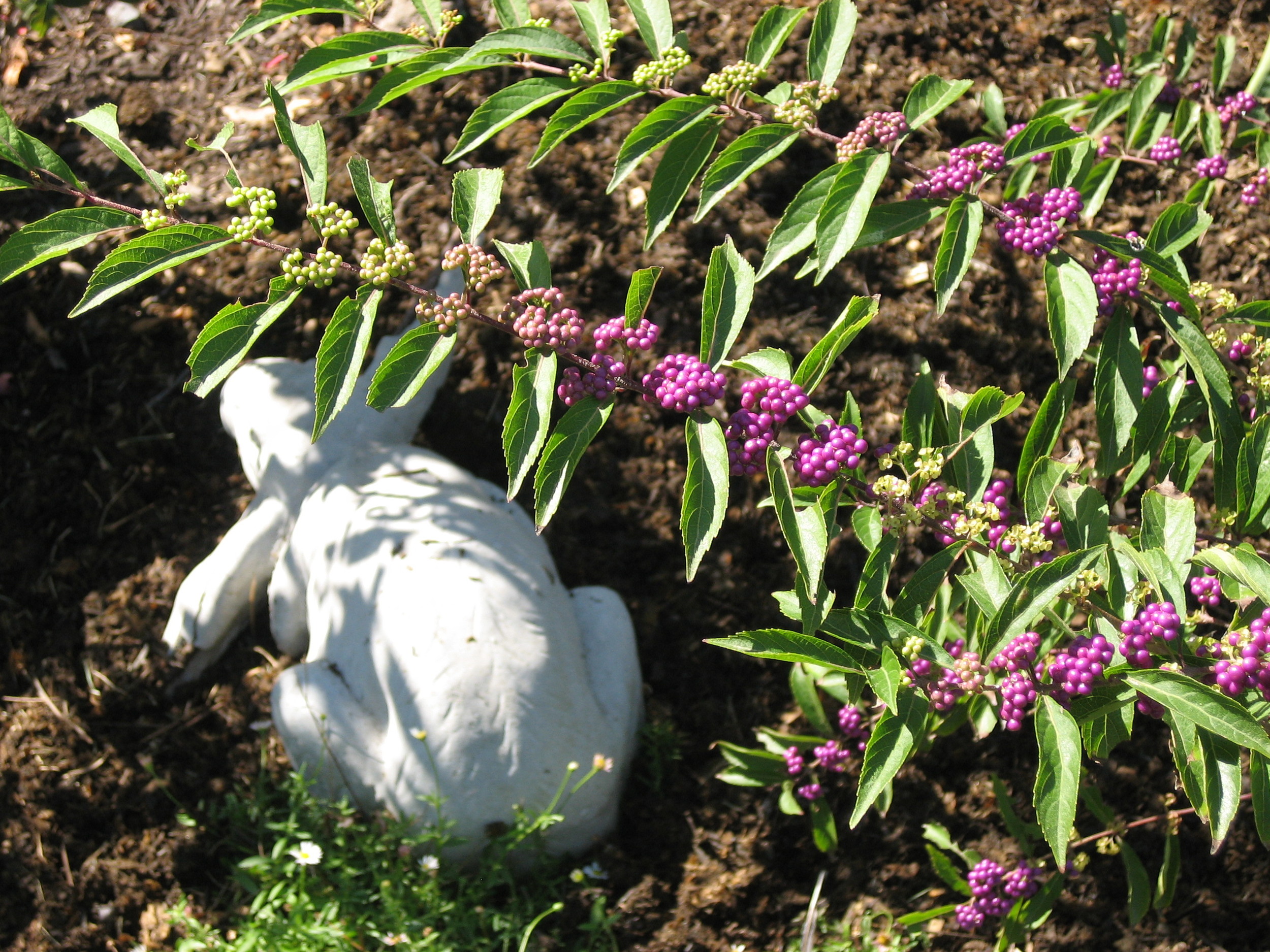
"Early Amethyst" Beautyberry Approaching winter, it is hard to find plants that are beautiful and blooming in your garden. If you live in zone 5-9, I would suggest planting an "Early Amethyst" Beautyberry, Callicarpa bodnieri giraldii. It is a stunning deciduous shrub, that blooms tiny pink flowers in the summer, and beautiful tight clusters of violet fruit along it's arching branches in the winter.

"Early Amethyst" Beautyberry usually grows in an upright fashion to 3-4', but can reach 6' high and 6' wide. It is a very graceful willowy plant which seems to dance in the light, and when coaxed by a subtle breeze. It prefers sun or light shade with regular watering. It's bloom and fruit occur in the current season's growth, so best to prune back by about 1/3 in late winter. It's violet-colored berries which appear in fall and winter can benefit from fertilizing this shrub monthly, during the spring and summer.

As seen in this photo, I have just placed fresh mulch down around the base of my "Early Amethyst" Beautyberry, but I intend to plant a companion ground cover or low flowering perennial to add to it's drama. "Early Amethyst" Beautyberry is excellent for cutting and in flower arrangements.

Callicarpa bodnieri, Beautyberry is a native of western and central China. The species is named after Emile Marie Bodinier (1842-1901), a French missionary in China who was first to collect this shrub for introduction to Europe.

In your quest for more information on this stunning shrub, you might notice there are other species listed, American, Purple, and Japanese which have slightly different characteristics and optimal growing zones.

Initially, I was unfamiliar with the "Early Amethyst" Beautyberry and bought only one shrub, now I wish I had bought several. It is a very easy shrub to care for and it is so stunning, it always catches my eye when I am in my garden. My local source, Tom Piergrossi, said he might have more "Early Amethyst" Beautyberry available this coming spring 2009, www.tompiergrossi.con

What is Your Garden Style?

Rustic Arch, Boxwood Hedge, Cottage Flowers Do you know your garden style? What are the elements that are repeated in your garden? What gives you joy to see? What do you gravitate towards? What is your vision with your garden? What do you like to do in your garden? Who do you spend time with in your garden? These are all great questions to ask yourself to help you define your style.

For instance, I like topiaries, espaliered trees, rustic arches, variegated plants, animal statuary, vintage gnome, boxwood, roses, fox gloves, hollyhocks, herbs, curving paths, olive trees, spiral shapes, cypress, juniper, roses, hydrangea, fruit trees, succulents, garden vignettes, hanging baskets, vintage containers, heirloom vegetables, and more.

All of these elements help define your garden style. When you are browsing or shopping at your favorite nurseries, garden shops, and flea markets, you will be more focused on what works in your garden, and what does not. It will save you money. You will be able to identify better what areas or items to spend your money on for your garden.

Color is also part of your style. Do you prefer soft, subtle tones? Do you prefer bright and dramatic color? Do you have a color scheme or palette to complement your garden style? If you enjoy your garden, you probably enjoy the joy of fresh cut flowers inside your home. Your garden colors should enhance the interior colors you have chosen in your home.

Do you have a modern home? Do you have a modern style? Perhaps you have a Cape Cod home, Spanish Hacienda, or an Arts & Crafts beauty. There is specific landscaping and plant selections that complement each style of home. Make sure that is in place, before you move on to refine your garden style.

A person can become quite well known and admired for their garden style. Go ahead, express yourself. What is your garden style?

Apple Gourds

    Apple Gourds

    One of my favorite gourds is the Apple Gourd. It's as if they have an "Alice in Wonderland" persona. They have a wonderful "apple" shape, and are just a great size, 5-9" tall, 15-20" in circumference for fall decorating. When they dry they are a beautiful toffee color. They fit easily into a table centerpiece or an outdoor cart, and blend well with other gourds and pumpkins of autumn hues. I first saw these gourds on my travels in the South, but occasionally see them dried for sale in California.

    This year I decided to grow Apple Gourds for the first time. I sacrificed one of my beautiful dried gourds, splitting it open hoping there would be many seeds. I was rewarded with an abundance of seeds. Apple Gourds need space to grow like pumpkins, and can even be coaxed up a trellis for a neat effect.

    In June, in a warm and sunny spot, I mulched and prepared several mounds or hills, and planted 5 to 6 seeds per hill, thinning to the 3 strongest once they started growing. I made sure they had adequate water. While the vines grew, beautiful dainty white flowers begin to appear and announced the beginning of the Apple Gourds. It took about 120 days for the Apple Gourds to mature. And guess what, they were a beautiful dappled green! They were also very heavy and full of water at this point. It will take them 5-6 months to dry and turn that beautiful toffee color. Be patient, and keep them in a dry place with air circulation. Once dried properly your Apple Gourds will last for years.

    For more information on Apple Gourds, and purchasing seeds go to, Burpee Seeds, Apple Gourds.

Apple Crumb Pie

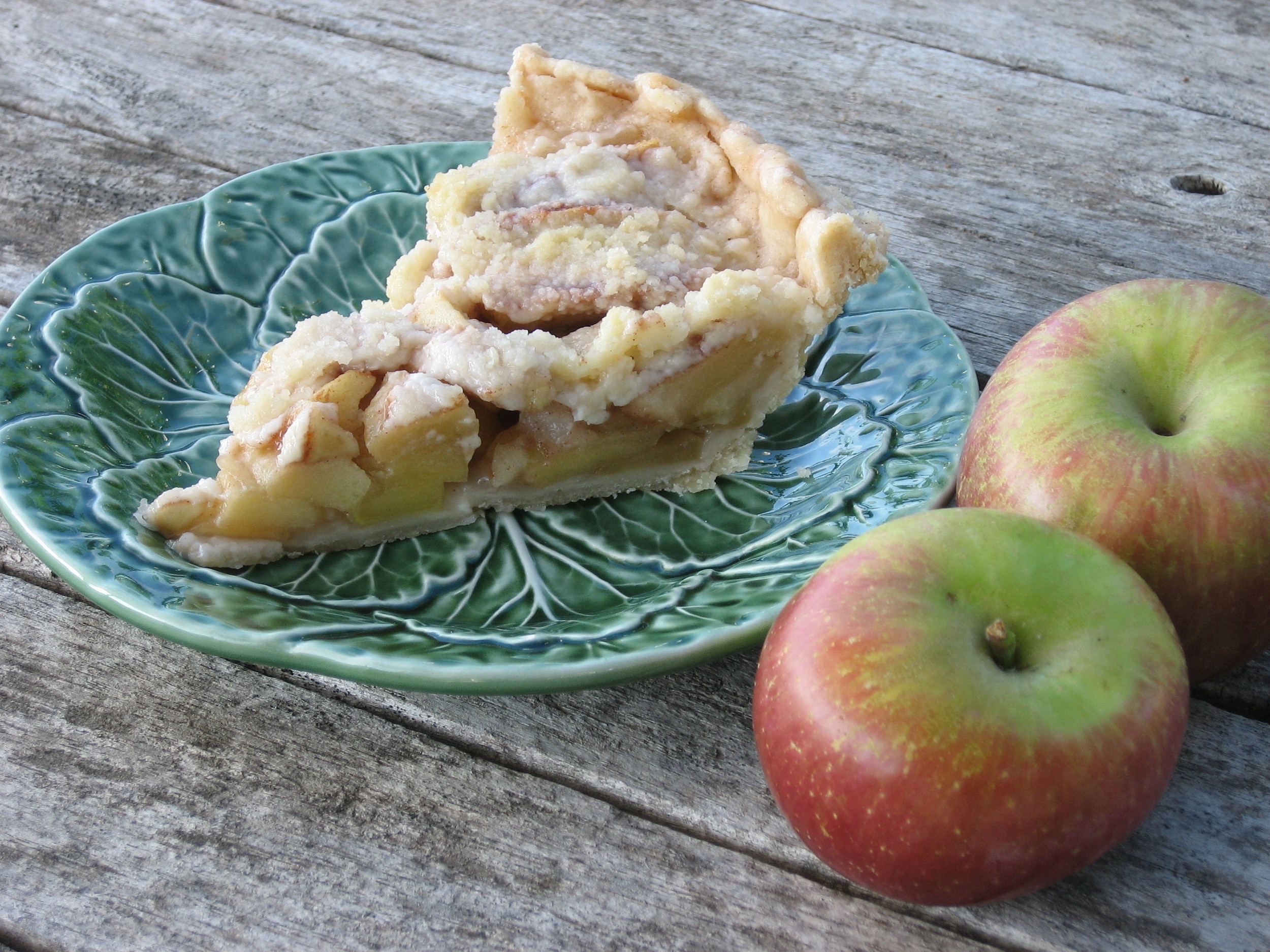
Slice of Apple Crumb Pie This is a great old-fashioned recipe out of the Midwest, which my Mom made for our family. You can use any apple which is in season, crisp, and good for baking. I am using my Fuji Apples from my garden that I recently wrote about.

I like to pile my thinly sliced apples fairly high in the pie pan, if you see you can use more apples than the recipe calls for, go ahead. Remember to save room for your crumb topping.

APPLE CRUMB PIE

5-6 Large Apples Plain Pastry Recipe (see below) 1 Cup Sugar, Divided 1 Teaspoon Cinnamon 3/4 Cup Flour 1/3 Cup Unsalted Refrigerated Butter

Peel apples. Cut in half, core and further cut into thin slices. Arrange the apple slices in slightly overlapping circles in a 9" pastry lined pie pan. Sprinkle apples with 1/2 cup sugar mixed with the cinnamon. Sift remaining 1/2 cup sugar with flour, cut in butter with two knives until crumbly. Sprinkle over apples. Bake in hot oven at 450 degrees for 10 minutes. Take pie out of oven, reduce oven temperature to 350 degrees, wait until oven temperature is constant at 350 degrees. Bake further for approximatley 40 minutes, or until apples are tender. Apple Crumb Pie is best served warm, and with a dollop of French Vanilla Ice Cream.

PLAIN PASTRY RECIPE

9 to 9 1/2" Pie Pan 1 1/2 Cups Flour 1/2 Teaspoon Salt 1/2 Cup Shortening 4 to 5 Tablespoons Cold Water

Mix all ingredients together in a ball. Using a floured surface, floured rolling pin and hands, knead just enough for dough to stay together and roll out in a round circle 3" to 4" larger than the diameter of your pie pan. Fold pastry circle in half and carefully lift and place in your pie pan. Adjust your pastry dough in pie pan and up sides. Cut off any excess dough with a knife. Crimp pie edge with your fingers to make a nice fluted edge.

Fab Fuji Apples

Just Picked Fuji Apples I have two espaliered* Fuji Apple trees along one side of my potager*. Although I have cared for them diligently for years, feeding annually in the Spring, pruning faithfully in Winter, watering, and observing them as I walk past them everyday (often several times a day), they always limped along for me. The apples were small, sparse, and unappealing. I always attributed it to our zone 11. Fuji Apple trees do best in zones 6-9, 14-16, and 18-22. Nonetheless, I love my espaliered Fuji Apple trees.

Something happened this year that I am still trying to figure out. This year I have an abundance of beautiful large sweet Fuji Apples! I understand now their popularity. You will truly experience one of life's little pleasures simply by eating a ripe Fuji Apple fresh off the tree.

Created in Japan in the 1930's, the Fuji Apple comes from American beginnings, a combination of the Red Delicious and Ralls Genet, an heirloom apple that dates back to Thomas Jefferson, 1793. Fuji Apples were first introduced into the United States in the 1960's. They are a late season apple, harvested in late September and October. They are distinctive in appearance with a yellow-green background color and red highlights. Excellent for eating fresh, and in autumn salads, they are also good to use in pies and sauce. Fuji Apples have a very firm, crisp flesh, and are very sweet and juicy to the taste. They store exceptionally well.

Putting on my detective hat, and delving into the habits of Fuji Apples trees, I have since learned that it can take several years for them to get established and bear reasonable fruit, they have a tendency to bear heavy crops in alternate years, and it is best to plant another Fuji Apple tree within 20 feet of each other, or another mid to late-blooming apple tree for pollination. They do best in zones with a mild winter, and have a long growing season with apples that take 160 days to ripen. Their fruit needs 100 to 400 winter chill* hours to establish dormancy. So it seems there are a number of factors that can affect Fuji Apple fruit from year to year.

Every year there is at least one thing in the garden that really surprises me. This year it is the fabulous Fuji Apples. With these "just picked" Fuji Apples, I am going to make my "Apple Crumb Pie", see recipes.

Glossary

    *Espalier--French term for training a tree or plant to grow in a specific shape or form, usually on a flat surface such as a wall or a building. The shape is often architecturally appealing and space saving.

    *Potager--French term for kitchen garden which is usually gardened year-round, and is often laid out in a formal and ornamental style.

    *Winter Chill--As it pertains to apple trees, is the number of hours in a climate zone where temperatures are at or below 45 degrees F, 7 degrees C.

Anticipating One's First Grape Harvest

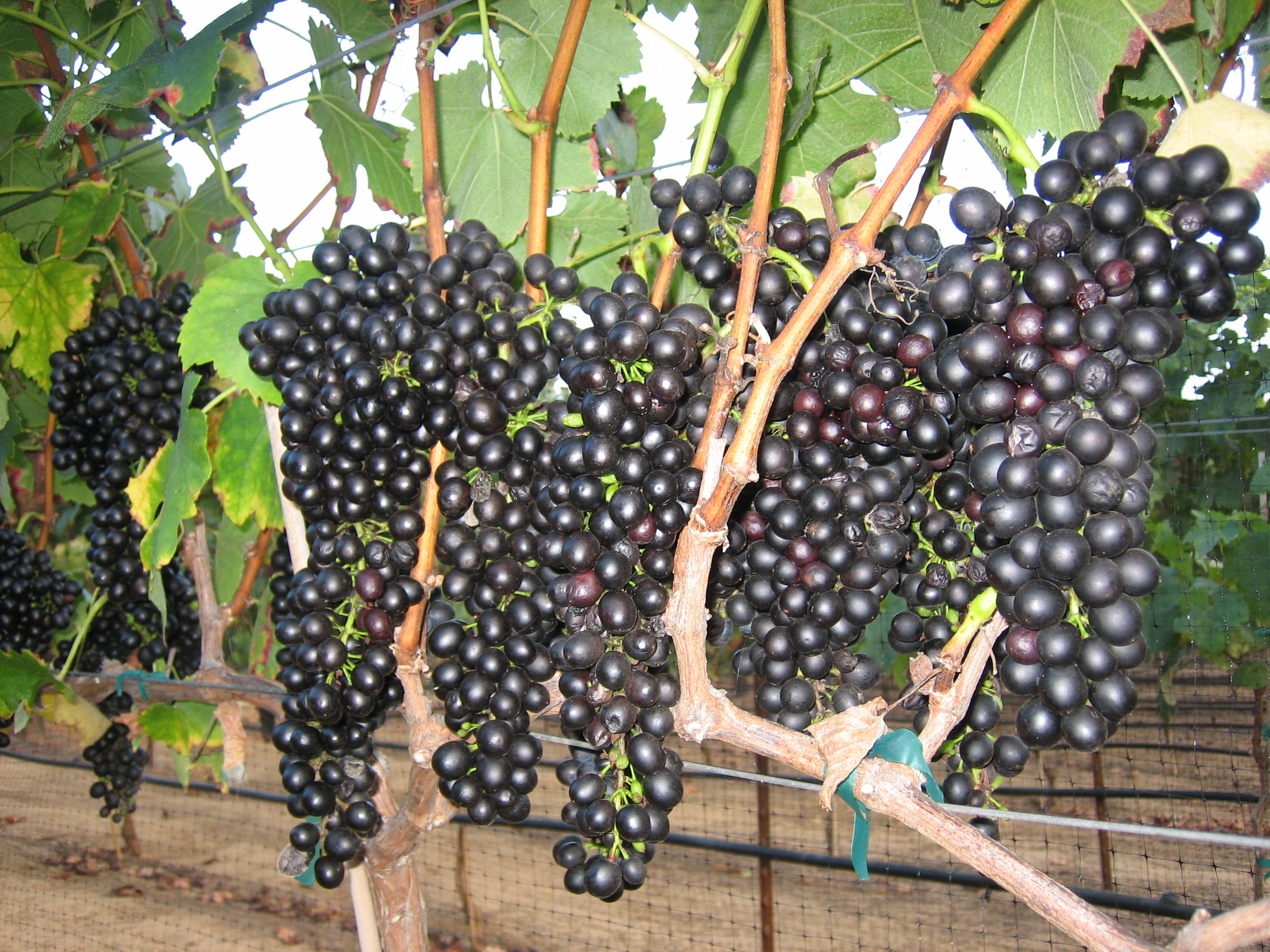
Syrah Grapes Waiting Harvest It seems just like yesterday, that my husband and I had this idea to put in a vineyard. We had about a third of an acre that was fairly flat, sunny, and western sloping toward the ocean. We overlooked this area from our home, so I wanted it to be pleasing to the eye. I had enough garden vignettes to be content. It was important to us to reap from our land, a sort of "thank you" for being able to live here and enjoy daily all that it gives us. That was nearly six years ago.

Holding that vision of a vineyard, we sought help from professionals to install one. We contacted people in Temecula and Sonoma County, to no avail. Then, on Sunday, October 9, 2005, I opened the Homescape of The San Diego Union-Tribune, in it an article called "Vine Street" highlighting successful backyard vineyards in Point Loma, Clairemont, La Jolla, and Mount Helix, including a listing of professionals locally who install vineyards. We were ecstatic!

Everything clicked from there. We sought professional advice for the best grape varietal to grow for our location, if indeed this was a good location for a vineyard, ballpark costs, and where to buy the bareroot vine plants for Spring planting. Ironically the next Spring, our local community college offered their "Vineyard Management and Production" class, www.miracosta.cc.ca.us/ for the first time. We enrolled in the class, met other fellow wine and vineyard enthusiasts, and started getting vineyard knowledge under our belt. It was a real coup when our class came, as part of the Saturday lab, and helped measure and stake out our vineyard, plant, and construct trellis for a few rows, over a three month period. It had been worth the wait!

Around the third year (or harvest) of a vineyard's life, one can make wine from the grapes. The first couple of years all of the fruit is dropped early in the year, to focus on establishing the grapevines and their roots.  During this time we continued to take classes on winemaking, wines of the world, and even joined a group called San Diego County Amateur Winemaking Society, www.sdaws.org.  There are a number of basic books such as From Vines to Wines by Jeff Cox, Vineyard Simple by Tom Powers, A Wine-Growers Guide by Philip M. Wagner to get you started.  We felt that growing a vineyard is a hands-on experience, rather then something learned by theory, and taking practical classes was very beneficial.

We made some misstakes and had some pitfuls, such as underwatering our vines their second year, losing three vines to gophers, and not taking into consideration the competition of our young vines with mature macadamia nut trees. A vineyard is a huge time investment, and it has it's own timetable for maintaining it throughout the year.

With all that said, it is with great satisfaction as we walk our rows of Syrah vines, with their magnificent black conical-shaped clusters, soaking up their final sunny autumn days. I'm reminded of the adage, "It is not so much the destination that matters, but the journey".

Butter Leaves

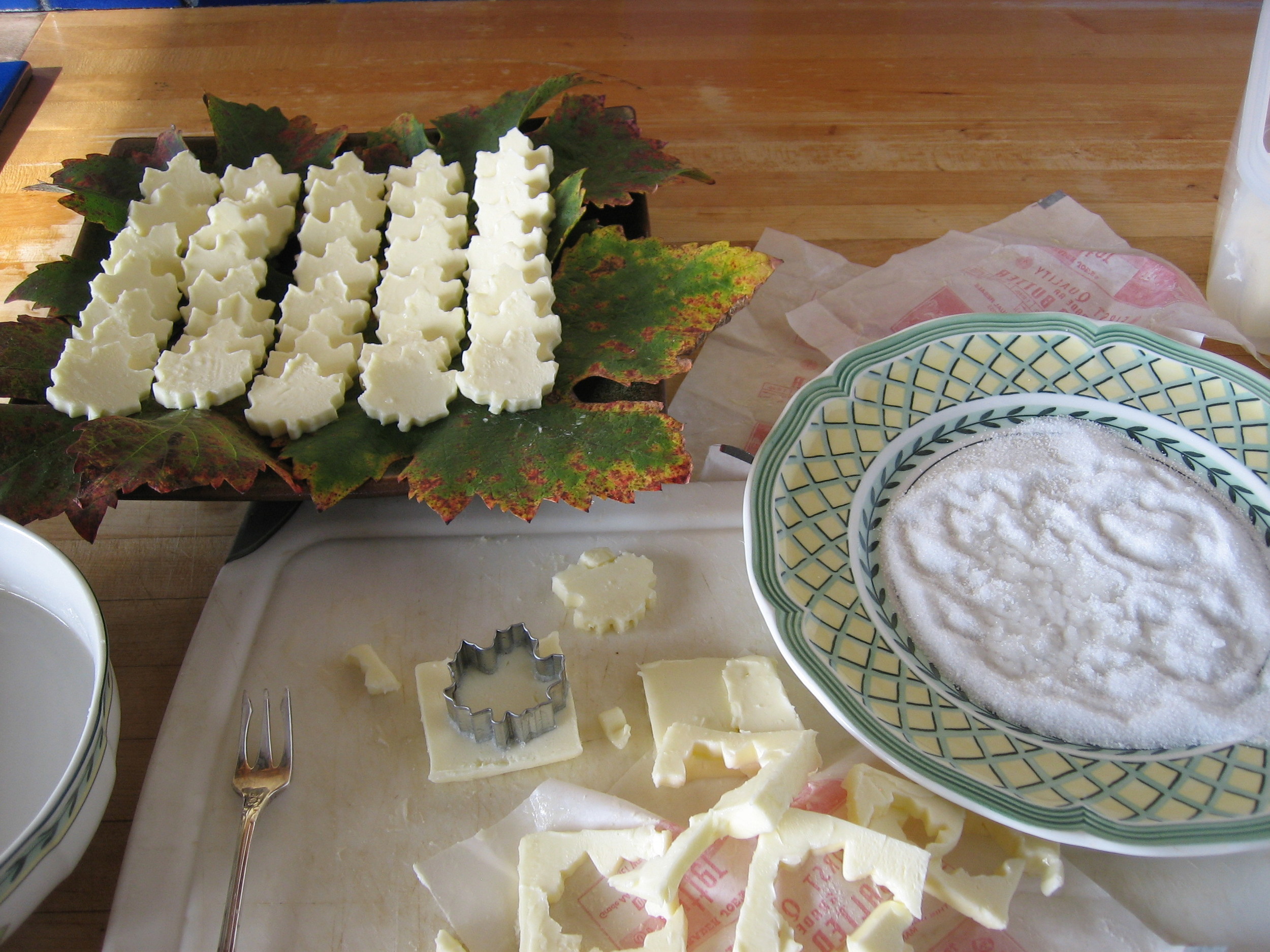
Butter Leaves Add a little flair to your special holiday meals with maple leaf-shaped butter. I found a wonderful "maple leaf" cookie cutter set by Fox Run Craftsmen. The smallest size in the set is a perfect size for a butter pat, 1.25". www.foxruncraftsmen.com.

Take a stick of butter which has been cooled in the refrigerator. Remove paper. Cut 3 or 4 butter pats at a time on a cutting board. Take your cookie cutter and place it in a bowl of warm water, dap excess water on a paper towel or kitchen towel, dab same cookie cutter in a plate of shallow table sugar, and then press your cookie cutter face down into an individual pat of butter. The warmth of your cookie cutter will make an easy outline of a leaf in your butter pat. Remove excess butter around cookie cutter, and remove your finished leaf-shaped butter pat from the cookie cutter. Repeat process till you finish stick(s) of butter. Arrange finished butter leaves on a table-ready dish for serving. Cover and refrigerate until you are ready to serve.

Interesting butter shapes are not limited to leaves. Look for any charming cookie cutter shape that is within the size of a butter pat. One can flavor butter with honey, herbs, or spices beforehand. If you did not want to dip your cookie cutter in sugar, you could use salt.

Tomato Stars

 Collage of Colors I have just about eaten all of my tomatoes grown on the vine for this season. It is a short season, but "oh so tasty" a season. Being in Zone 11, tomato growing can be something of a challenge. Each year I seem to get a little better at growing and harvesting the rewards. Every spring I search out new tomato seedlings to try and experiment growing. This year had several stars.

There are tomatoes in just about every rainbow color. I'm drawn to the black and purple, like Black Prince, Black Krim, and Cherokee Purple for their smoky, earthy flavors. I also lean towards the orange and yellow tomatoes...something that will pop out at you in a salad, pizza, or salsa.

One of the biggest surprises, and tomato stars for me this year was "Jubilee". It is a bright orange, fleshy textured fruit that is prolific on the vine. It was the All-American Bronze Medal winner in 1943.    Another star was "Fuzzy Peach", a 100 year old heirloom which actually looks like a lemon-colored peach, and has the fuzzy texture, to bout. When it ripens it has a slight blush pink color. It is a mild tasty tomato, which was delightful when I used it in my homemade salsa. It is about 2 ounces in size, and has outstanding storage ability, too. 

An enduring tomato star is the heirloom cherry tomato, "Sun Gold".  It is actually golden orange in color. It is so sweet and unforgettable in taste, it is hard not to eat them all right in the garden. The fruit grows in sprays of 6 to 8 together, so pretty, one can imagine using them as a subject in a painting. Sun Gold Tomato

I had never grown the fabulous hybrid tomato, "Celebrity" until this year.  I was so surprised at the colossal, beautiful red, firm, flavorful fruit it produced.  Colossal, meaning one slice will cover your entire hamburger, and then some. The vine as it grew was very strong and even sprawled up and over the rusted antique iron bed frame I provided for support. With this beauty, I felt that I was officially a successful tomato grower.

Some key tips to growing tomatoes successfully: 1)  mulch your soil well before planting, 2) plant in a warm sunny area, 8 hours of sun ideally, and when night temperatures are consistently above 50 degrees, 3) plant your tomato seedling deep-stems will root once planted, 4) water deeply and frequently in the beginning and less as the tomato plant matures, 5) fertilize your seedling plant when first planted, a month or so later, and then on an as needed basis, and 6) rotate your tomato spot in your garden each year if possible.

Finding tomato seedling sources is as much fun as growing them. There is always your favorite local nursery.  Other sources I have used in San Diego are: www.summerspastfarms.com, www.tomatomania.com and www.pearsonsgardens.com.

Garden, Kitchen GardenKaliComment