
 I was first introduced to climbing "America" rose in garden guru, Pat Welsh's garden years ago. I was drawn to its vibrant salmon-coral blooms, but it really is an ideal climbing rose for the home garden for many reasons. I now have a climbing "America" rose on the entrance gate to my kitchen garden.
First introduced in 1976, back in the year of our country's bicentennial, hence its name "America." It won the 1976 All-American Rose Selections award that year. Its parentage is Fragrant Cloud x Tradition.
"America" rose is considered a modern climber reaching 12-15' tall, and a repeat bloomer with a double bloom shape. It is well-adapted for climbing arbors, fences, and pillars. It has layers of petals to each bloom, and its bloom longevity is one of the things I love best about it. Climbing "America" rose has blooms that can range from deep coral to pink. It blooms on new wood, so prune early to promote new growth. Climbing "America" rose has a nice spicy fragrance. It is fairly disease-resistant to powdery mildew, black spot, and rust. It does best in zones 4-9. Be aware that climbing "America" rose does have thorny stems.
Please share if you have climbing "America" rose in your garden. Please comment on your favorite climbing rose.


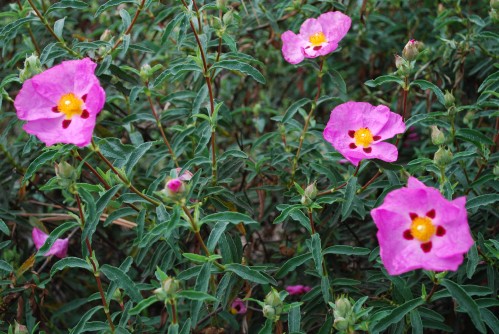 This is another spring blooming delight, Orchid Rockrose, Cistus x purpureus. Although this is a native Mediterranean drought tolerant shrub, something about it reminds me of an English country garden.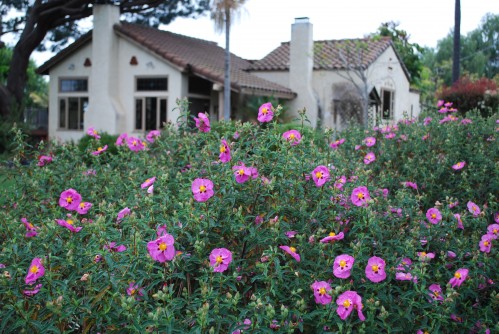
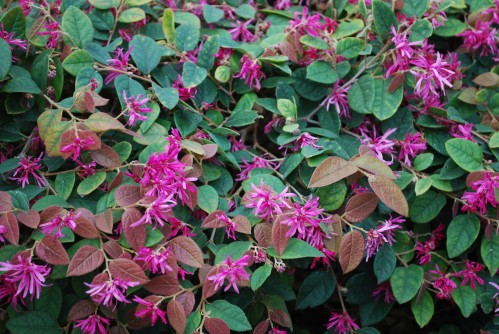
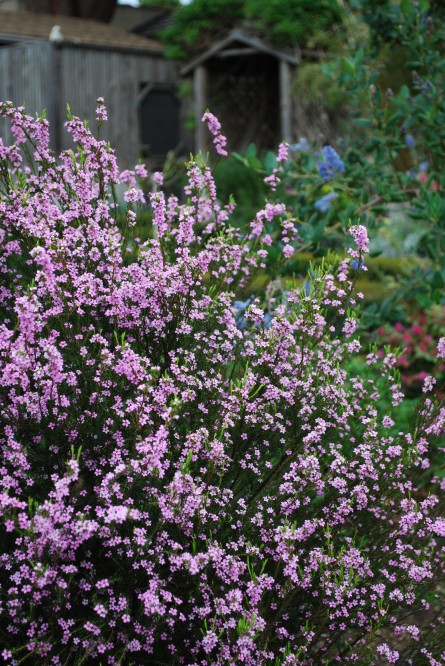 How can you not love a plant called "Pink Breath of Heaven". This shrub originally from South Africa, explodes into bloom winter to spring, with showy pink delicate tiny flowers on wispy feather-like branches. I feel like it is my own personal "trumpeter" in the garden, announcing the beginning of spring.
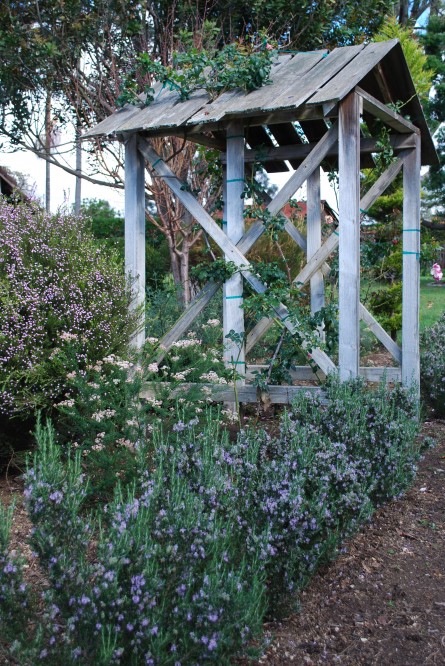 Let me introduce you to the "Majorca Pink" rosemary, Rosmarinus officinalis, "Majorca Pink", planted along the front edge of the arbor in the photo above . It is an upright rosemary which can grow 2-4 feet high, and 1-2 feet wide. It has pretty pink lilac flowers, with a hint of fragrance. Its flowers attract bees, birds, and butterflies. It blooms in the winter time here in Southern California, in my Mediterranean climate. Its flowers are edible, and can be used as a garnish. Its dark green, glossy, aromatic leaves are a great culinary herb.