Strawberry Savvy

Home-Grown Strawberry Comparison My first venture into growing my own strawberries, was purchasing by a fluke, two pony packs of Chandler strawberries.  That was the winter we received a record 25 inches of rain or so, here in Southern California. I don't want to scare you, but from those original two pony packs I gave away 17 full nursery flats of Chandler strawberry plants to my enthusiastic garden friends that following spring.  Needless to say, conditions must have been optimum.

Picking my own sun-ripened strawberries for morning breakfast is always a delectable treat. My strawberries are so sweet and juicy, and incredibly flavorful. Once you have had your own strawberries, you will be spoiled, and never want anything but your home-grown. Here are some tips I have found growing strawberries in my kitchen garden:

1) Pick a sunny sloping spot with rich, well-draining, preferably acidic soil in your kitchen garden. Strawberry plants are perennials, but should be rotated out after three years, because the plants start to decline. Either replace "your strawberry patch" with new plants, or start cultivating a "new strawberry patch" with your young runner plants. If you don't have space in your garden, a planted strawberry pot or container works well, and is very attractive.

2) Mulch your strawberries with straw, or in my case, I use my compost mixture. This will keep your strawberries off of the soil, discourage bugs, and allow pristine berries to grow and ripen.

3) Provide adequate water. Strawberries need regular moderate watering.

4) If you have the room, I urge you to experiment with different strawberry varieties. Bear in mind there are three types of market strawberries, June-bearing, everbearing, and day-neutral varieties. June-bearing produce one crop of strawberries in early spring or early June. Generally speaking, these are the best quality strawberries you can grow in your garden. Everbearing varieties produce two crops one in June and one late summer. Day-neutral varieties can produce a continuous crop from June to frost. There are also alpine and musk strawberries which are not to be confused, and are a different species.

5) Pick your ripe strawberries regularly, and often. This also discourages bugs from enjoying your strawberries first.

6) After harvest, or in the winter, I prune back my strawberry plants. Be careful not to damage the crown of the plant for the following year. Some gardeners actually lightly mow the tops of their strawberry plants, but I prefer gentle pruning.

There are so many different strawberry varieties available to grow, buy regional strawberry varieties adapted to your particular area. This spring, I got "Strawberry Mania" and planted four different strawberry varieties, one type in each corner of my potager or kitchen garden. I thought it would be fun to experiment in taste, size, texture, and yield.

My point is, a "strawberry" is not just a strawberry. In the above photo, I planted and tasted my favorite, Chandler strawberry, and  a new-to-me variety, Camarossa strawberry, both June-bearing varieties. I planted in two other corners, Eversweet and Sweetheart everbearing strawberries, which are also new-to-me varieties this year. Time will tell how they all will fare in my home-grown taste comparison.

Strawberries are so versatile in baking, cooking, preserves, summer desserts, salads, and simply fresh straight out of the garden. If you love strawberries, try planting your own strawberry patch. For more in depth information on growing strawberries, please refer to some of the amazing new books on edibles, Sunset's Western Garden Book of Edibles and Grocery Gardening, I have reviewed recently.

Please share tips from your strawberry patch. Please comment on the varieties of  strawberries you grow.

Circle of Sweet Peas Revisited

Sweet Peas, Two Months Later Fast forward two months later, and my "Garden Circle of Sweet Peas" have grown tall and are starting to bloom. There wasn't a label on my sweet peas, so I had no idea what color they would be. The mystery is over. Red, white, and purple is the answer.

When your sweet peas bloom, remember the more you clip your sweet peas for a small hand-tied bouquet or vase, the more it encourages them to bloom. I put my first bouquet of these fragrant beauties in a vase next to my kitchen sink, and the fragrance is intoxicating.

We Want Your Vote! You Can Make A Difference! Announcing the return of the prestigious "Mouse and Trowel" Awards, garden bloggers equivalent to the Oscars. If you love your gardening blogs, including VintageGardenGal, please support us by voting. Nominations started April 1, 2010 and are open through midnight on April 30, 2010. Simply click on the banner below, and type in your nominations.

Mouse and Trowel Awards are the brain child of Colleen Vanderlinden who blogs at In The Garden Online She initiated these awards in 2007, and then took a break in 2009. We thank her for bringing them back in 2010, with even more verve.

There are several different categories to vote for such as Best Writing, Best Photography, as well as several "Niche Garden Categories" to vote for, such as Best Urban Garden Blog, Best Container Gardening Blog. We want to hear from you. It is fun, and a benefit to all of us. Please tell garden bloggers they make a difference in your lives, by casting your vote today.

Color My Eggs Beautiful

What Was In My Easter Basket On Easter, my hens laid four beautiful eggs for me, one egg from each breed I have.  They were so beautiful, I had to put them in a pastel Easter basket, and share them with you. There is something so special, and perfect about freshly laid eggs from your backyard flock. It is like Easter every day.

I currently have five hens in my flock, from four different chicken breeds. Each hen lays an egg, color and size specify to her breed. I knew, by looking at my hen's eggs, who had laid an egg. Please bear in mind, that my hens range in age from nearly 8 years old to six months.

If you recall, Julia, my  wonderful honey-feathered Ameraucana hen, surprised me last spring by laying a miracle pastel blue-green colored egg at nearly 7 years old. This spring at nearly 8 years old (in May), she once again started laying. It is a surprise, since she hasn't laid an egg in about a year. Julia laid a small "pullet" size egg the day before Easter, and then on Easter day laid this incredible full-size perfect pastel-blue egg. What a gift. Really, it is incredible for a hen to be laying at nearly 8 years old. She is such a sweetheart. She will lay a few eggs more this spring, and then drop off for the rest of the year.

Coco, my French Wheaten Maran hen is just two years old, and laid the massive "chocolate-colored" egg on Easter. French Marans, typically are a very large hen. Coco weighs nearly 7 pounds. Her eggs are very desirable for their size, and tinting of dark chocolate color.

It is hard to tell the difference in the photo, but Charley, my White-Crested Blue Polish hen laid the slightly "bone colored" egg in the foreground. She lays a smaller egg, in ratio to her smaller body size. She is just six months old, and laying well. Needless to say, she is the "clown" in the flock with her "tossled" plume of feathers and personality.

The "cream-colored" egg behind Charley's is an egg laid from one of my Silver Spangled Hamburgs, Dolly and Dahlia. Silver Spangled Hamburgs are elegant faithful layers, with smaller eggs, and a smaller body type. An old breed, originating in Europe, they were at one time called "the Dutch every day layer."

What a wonderful Easter gift from my hens. These eggs are so fresh and tasty, it is hard really to describe them. They are so beautiful visually, it is hard to think of eating them. Yet, that is the best part. There is no comparison for cooking and baking with fresh eggs, making perhaps a spring frittata, and the delight in raising your own hens.

Please share if you have multiple chicken breeds in your flock. Please comment on your experience using fresh eggs from your own flock.

In case you missed it last week, Martha Stewart did a show on chickens, and offered quite a few interesting links and information on chickens on her website, Martha Stewart Show.

Sun Sets On "Le Vin de Garage"

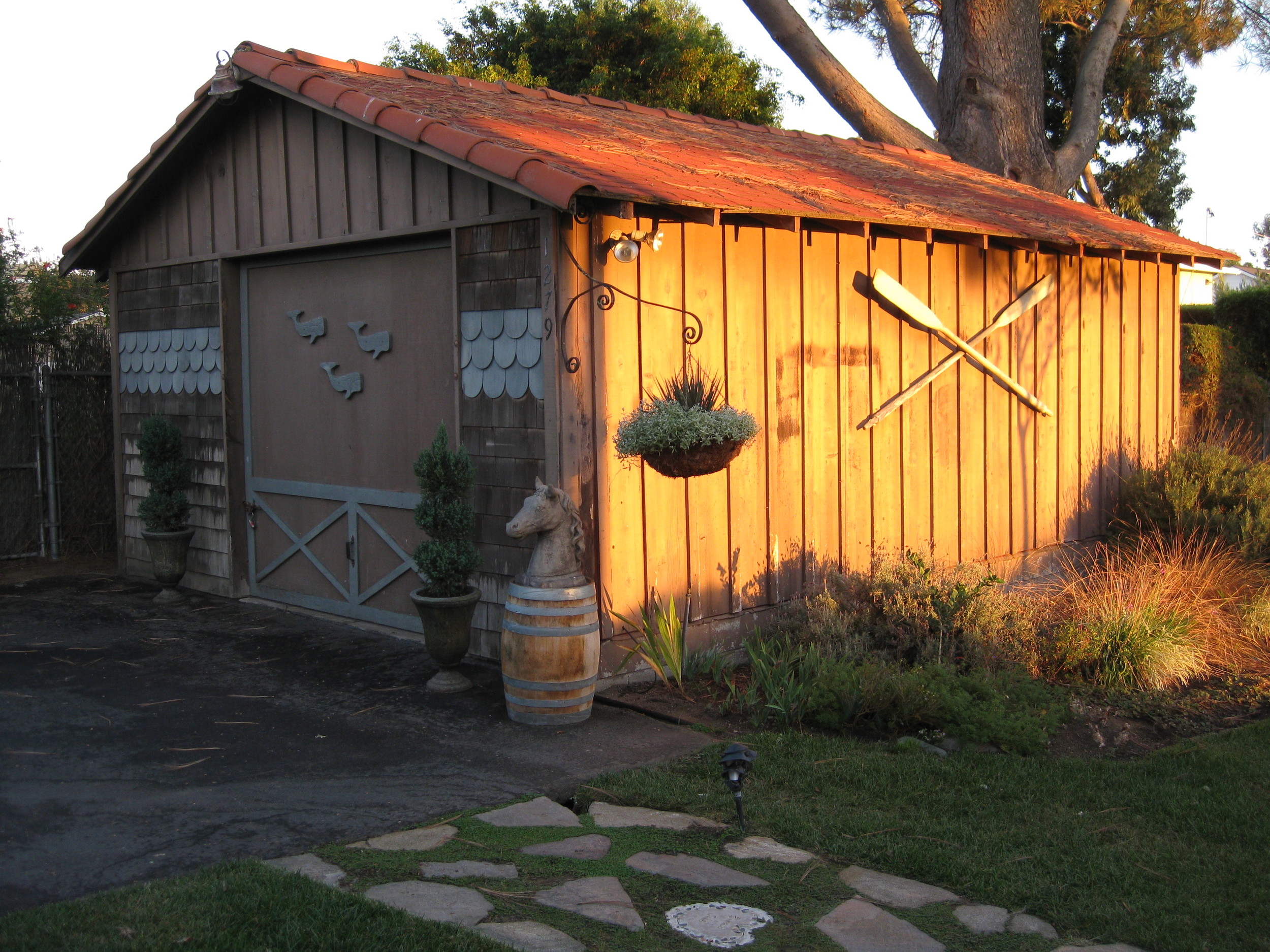
Sun Sets On "Le Vin de Garage" Sometimes the hardest part of a home remodel, is letting go of the old. Soon, it will be out with the old, and in with the new. It really is not that cut and dry. We have carefully thought this through, and tipped the scale in favor of our new barn.

In the above photo, is our revered garage named  "Le Vin de Garage," where until recently we made and stored our Domaine de Manion vintages. My husband, John, cleverly tweaked a photo of our "Le Vin de Garage" for our first label. It placed "Fourth Place" in "wine label category" at the San Diego County Fair a few years ago.

John got the "garage idea," one night, when we were watching the movie, A Good Year (Full-Screen Edition), based in Provence, directed by Ridley Scott, and starring Russell Crowe in one of his only comedy roles. Based on the book, A Good Year, one of the many books written by Peter Mayle, the endearing plot revolves around a tasty mysterious boutique cult wine. These tasty cult wines called "garage wines" as mentioned in the movie, were from small vineyards, small productions, and often commanding super premium prices.
Our home was originally built in 1930, and we believe this stand alone garage was built a little later in the 1960's. It has to be close to 50 years old. A previous unknown owner took the time to enhance its character, with whales, waves, and crossed oars. If only our "Le Vin de Garage" could tell us some of its colorful stories of the past.

Alas, our garage has served us well over the last ten years, and it is sad to see it go. It does have termite damage from past neglect. When we have a heavy rain it does leak a bit. Now with our remodel plans, it is not in the best location.

Actually our "Le Vin de Garage," is not totally going away. We've decided to re-purpose its best materials in the form of a shed, close to our vineyard. In a way, it will live on, and continue to help us with our vineyard maintenance and vintages.

Our new barn is nearly finished. It has our new wine-making room on its ground floor, with a work counter for testing the wines, storage area for our equipment, and a harvest table. We really have come a long way, from the day we got the idea to plant a vineyard.

Please share if you make home-made wine? Please share how you got started making wine. Please comment on what kind of area or space you devote to making wine.

Thank You for Supporting VGG Sponsors!

Design With Edibles

Crown of Strawberries I'm sure you have heard of a strawberry patch and a strawberry pot, but have you heard of a "crown of strawberries."  I have had this pair of cherub planters potted with bacopa and a few other trailing plants, but they really took on another look and life when I potted ornamental strawberry edibles in them. Imagine these planters placed on a table for a Sunday brunch.

There is something about using edibles in design, that transcends many styles such as cottage, country, eclectic, European, primitive, and even modern. It just works well. There is a bit of an element of surprise, that also pleases.

Decorative styling with edibles, is borrowing from the European potager kitchen garden concept, using flowers and vegetables intermingled, delivering function and beauty. Flowers and edibles are sensational together for floral designs, tabletop topiary, in the  garden, unusual containers, and where ever your imagination leads you.

Use live plants or  harvested fruit and vegetables to embrace this concept. Think of apples, asparagus, artichokes, green bananas, broccoli, cabbage, cranberries, gourds, lemons, kale, kumquats, oranges, pomegranates, strawberries, squash, and more.

First, your design starts with your container or location. What is it calling for. What form would look best. Is there a color combination that would be nice. Is there a plant combination that would surprise. Is there a function involved. What kind of creative ideas come to mind.

In the example of my two sweet cherub planters, I chose an ornamental strawberry plant, beautiful by itself. Deep green glossy leaves, bright pink flowers, emerging rouge-red ripening strawberries dangling like a crown, all add to its design drama and zeal. It has beauty. It is appealing.  It is growing edible fruit.

Please share if you design with edibles now. Please share some of your fun design combinations.

Our Great Room Takes Shape

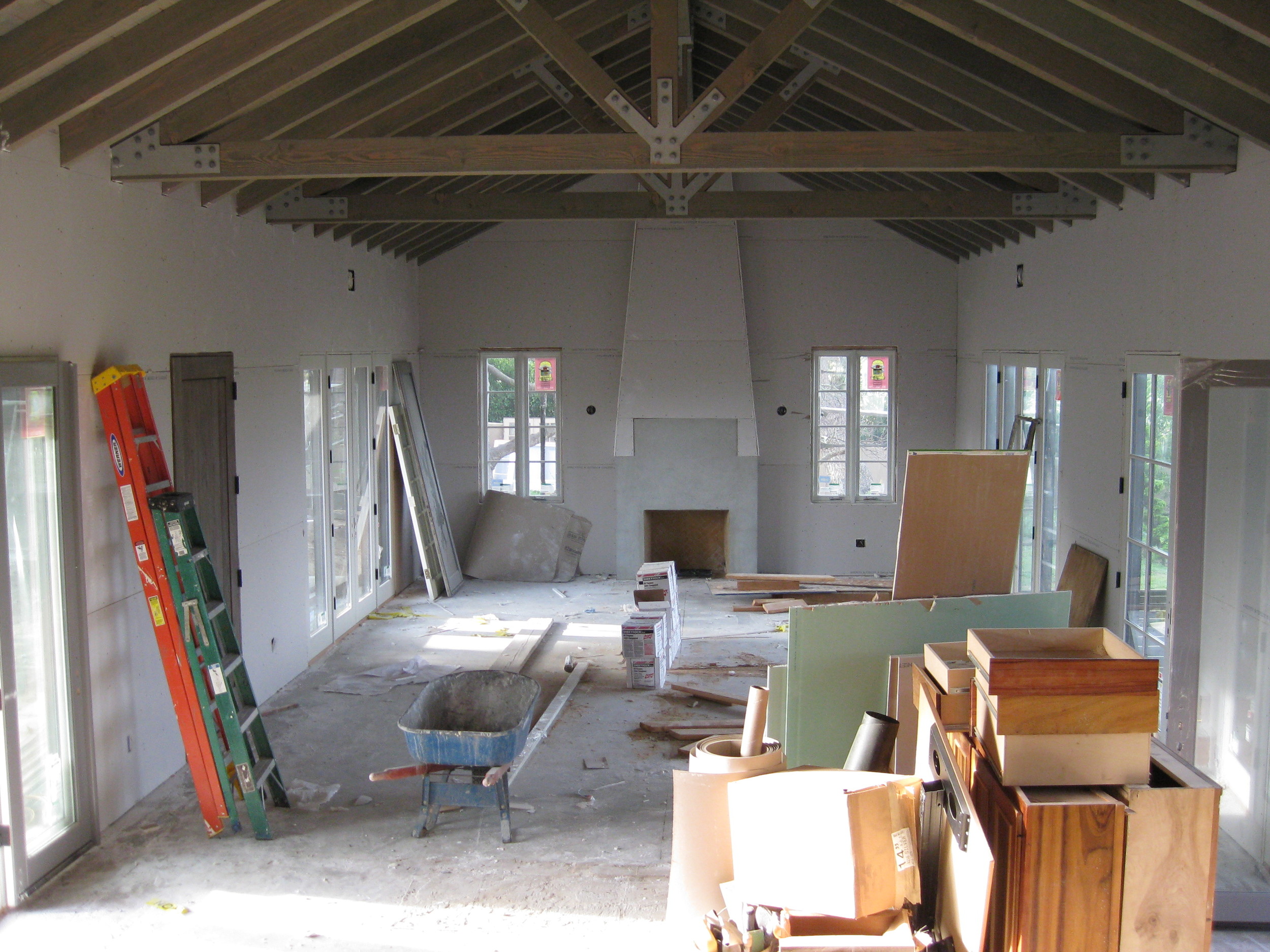
A Great Room Takes Shape It might look like a cathedral but in reality, it is our new dining room and living room, seen from our new elevated kitchen vantage point. One of our goals in our remodel, was to integrate more of our home with our garden. Essentially we pushed out our old living room to the south, doubling the size. This great room is close to ground level, yet surprisingly has enough elevation to easily see into our  garden, vineyard, and the ocean horizon.

The single wood door on the left hand side, in the above photo is our front door. There are massive French doors on either side of this room for light and views. A stucco fireplace at the very end of the room serves as a focal point, and an exclamation point. The area near the fireplace will be our new living room.

On the west side of this great room will be a long low outside deck running the entire length of the room. Our house was designed to hug our massive and beautiful Italian Stone Pine tree, embracing its beauty. From our intended dining room spot in the foreground, we will be able to dine looking westward to the vineyard, and enjoy the gnarly impressive trunk of this great tree that oversees our property.

Our ceiling is custom tongue and groove crafted lumber, with massive support beams. It is stained a warm gray color, called Drift Gray by Behr. The floor will be  an 8' x 8' Spanish tile, made out of durable concrete by Arto Brick, Artillo style, in Spanish Coto. It is a lovely blend of warm honey terra cotta and slightly darker hues.

We are about half-way through our remodel now, five months into it. Our home and barn is in place, and the last five months will be the finish work. Our decisions we need to make now come fast and furious.

Our syrah vineyard is pruned, weeded, and chartreuse buds are bursting with new shoots. I feel like it is a race to harvest. Will our home be done in time. I think so.

Please share your remodel experience.  Did it happen within your anticipated time frame? As it emerged in reality, was it your same vision as on paper?

Thank You for Supporting VGG Sponsors!

New Hens at "Coop de Manion"

Dolly, Dahlia, and a Tail of Charley My dear friend, Poultry Princess Kathy Lafleur, so aptly penned by panache garden writer Debra Prinzing, gave me three young hens a few months ago from her billowing flock. All three young hens, Kathy raised from day-old chicks, from a baker's dozen purchased from My Pet Chicken, five months earlier.  All of the chicks turned out to be hens, to My Pet Chicken's credit. It is not easy to sex day-old chicks. It is an art. With that said, Kathy's coop "runneth" over as the chicks matured into young pullets (hens) and I was happy to adopt three of her beauties.

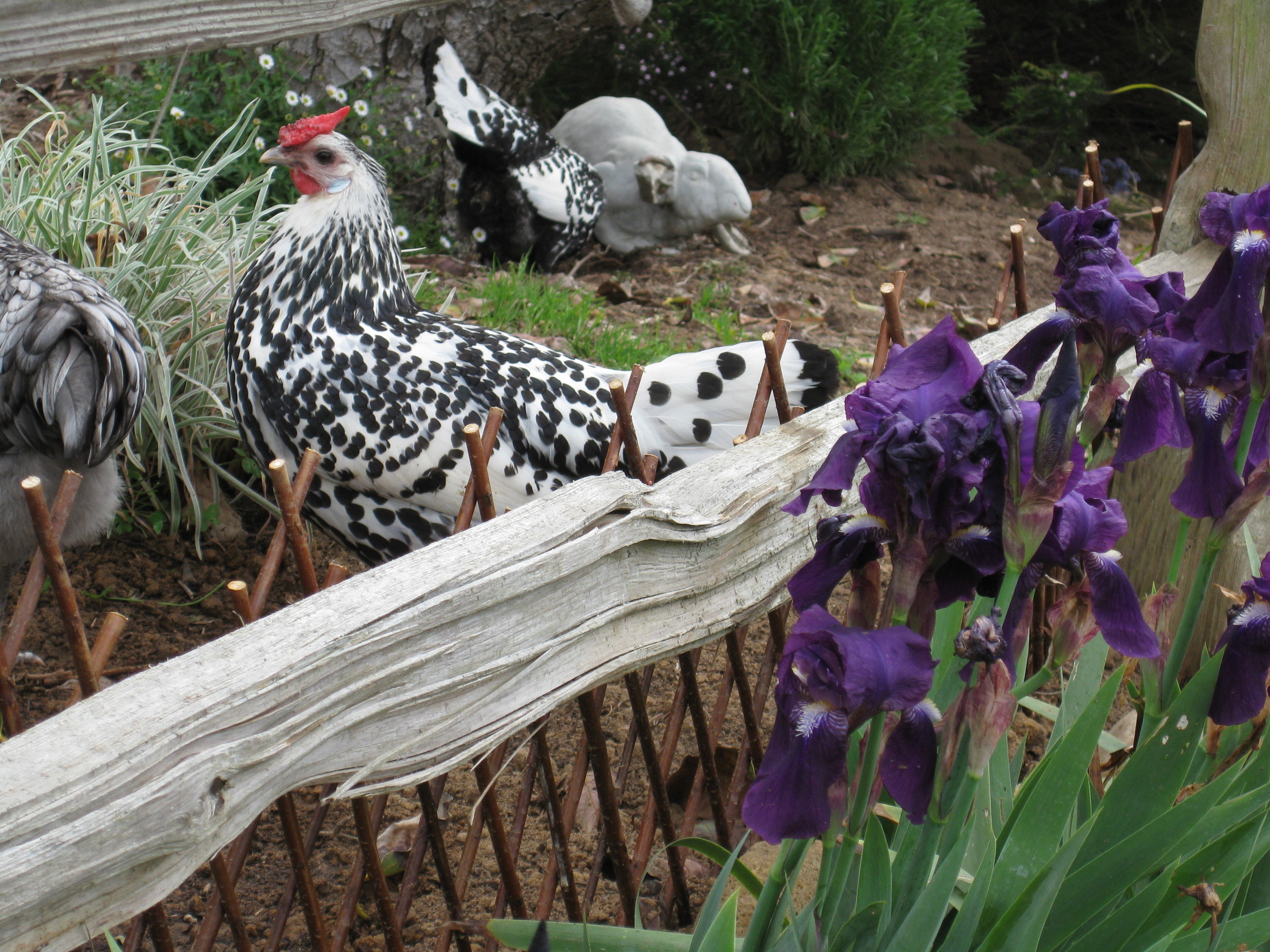
Two of my new hens are Silver Spangled Hamburgs, gorgeous, elegant black and white hens, that I named Dolly and Dahlia. The third is Charley, a White-Crested Blue Polish hen, whom you might have seen in her debut appearance, Chickens Dig Dirt Baths.

I was a little reluctant to blend these beautiful young hens in with my existing flock, for fear of not knowing the outcome.  I must confess, all went well, and introducing these young hens proved to be easy, nary a peck or a drawing of blood ocurred. Thank goodness, my elder hens, were on their best behavior.

Silver Spangled Hamburgs are small, almost bantam size, and very lively. In fact, after three months, I'm still trying to capture them together in a photo-worthy moment to no avail. I have noticed that when Silver Spangled Hamburgs are excited, they tend to fan their tail feathers, somewhat resembling a peacock.

Silver Spangled Hamburgs are an old traditional breed, whose origins date back hundreds of years to England and Holland. These hens exude elegance with their striking white feathers against black polka dot markings. Other stand-out features include a beautiful red rose-shaped comb, white ear lobes, and bluish legs. They are very quick, somewhat flighty, and not your "cuddly-lap" chickens for children. This breed is known for laying abundant ivory-colored dainty eggs, and a nice choice for "show competition."

Thank you, Kathy, for your lovely young hens. They are a joy, and a wonderful addition to our "Coop de Manion" flock.

Please share what factors have determined your personal chicken breed choices? Please share your motive for having, or wanting backyard chickens?

Thank You for Supporting VGG Sponsors!

Five Space-Saving Fruit Tree Techniques

Ein Shemer Apple Tree At the risk of going out on a limb, no pun intended, general trends today indicate that we have smaller spaces to garden in, converging with more desire to grow our own food. It is also the age- old adage, "less is more." Here are five space-saving fruit tree techniques to help you maximize growing your own desired fruit.

1) Espalier Fruit Trees on a two-dimensional plane in a pattern on a supporting wall, side of building, or fence. South and west facing direction are best for this. Espaliered fruit trees is one of my favorite styles as well as shapes for my fruit trees. You can either espalier them yourself, or buy them already pattern-established from a nursery or on online.

2) Multi-Variety Fruit Trees are available also from your favorite nursery.  Meaning these fruit trees are already grafted and established with different varieties on one tree. I have a pear tree that has  comice pear, d'anjou pear, and red bartlett pear harmoniously growing together in one tree. This winter, I got  a "4 in 1", which has two types of nectarines and two types of  peach. You  have one tree, but multiple varieties in one tree.

3) High-Density Planting of Fruit Trees. Planting of similar or dissimilar varieties of fruit trees closely together.  For instance, planting four fruit trees 18" to 24" apart in a square shape, in a 10' x 10' area. Requires summer pruning, but gives you the advantage of a possible long and varied fruit season, easy cross-pollination, natural restriction of fruit tree size, and a great appearance. With high-density planting you can create free-form shapes such as gazebos, circles, or as a hedge in a straight line.  Dave Wilson Nursery calls it Backyard Orchard Culture.

4) Limit Your Fruit Tree Size. After purchasing your bare root tree and planting it in your chosen location, cut the top 1/3 of your tree off at a 45 degree angle above a bud. Further trim any side branches or shoots to 6" to encourage new growth. Limiting your fruit tree size initially when planted, will keep your fruit tree small and manageable for maintenance and harvest size.

5) Plant Fruit Trees In Containers. Fruit trees in containers are beautiful, space-saving, and practical for small areas. Use on patios, entrances, and where ever you want to make a statement. Research what fruit trees do best in containers. Citrus trees are a good choice, if you have the climate.

Please share what is your favorite fruit tree in your yard or garden? Please comment if you think about space to harvest ratio in your yard and garden?

Thank you for supporting VGG sponsors!