
Posts in Kitchen Garden
The Rewards of Growing Your Own Food

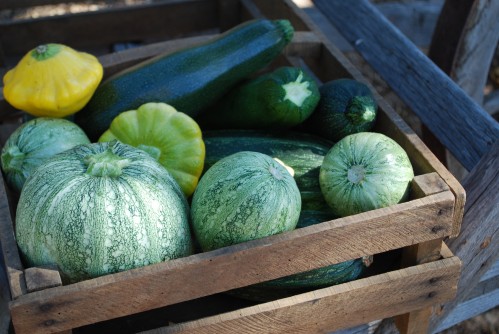
Squash Bonanza From The Garden It's a national phenomenon happening from the White House to local schools to your own backyard. It's one of the hottest food trends happening now in our country. I'm speaking of the "interest spike" in growing your own vegetables. There are several reasons for this mass appeal of vegetable gardening and growing your own food:

One, the current economic landscape has many people with extra time on their hands and looking for ways to save money.

Two, we are looking for green ways to improve our lives and environment.

Three, it is very rewarding to be outside, in touch with mother nature growing something great.

Four, you have control over how your food is grown, picked, and raised before you ever take a single bite.

Five, food from your backyard is simply as fresh as you can get it. You can pick it at its optimum ripeness, when you like. It doesn't have to travel by states and countries to reach you.

Six, home-grown food, cultivated and tended by you tastes like no other. Flavors are incredible, and scream "delicious".

Seven, chances are you will be eating and cooking healthier.

Eight, growing your own food sets you up for eating seasonally, which further creates many other wonderful ripple effects.

Nine, growing your own food will enhance your entertaining, cooking, baking, and dining experiences-- taking them all to another level.

Ten, did I forget to mention it is just "plain fun".

If you have children, gardening and vegetable gardening in particular, is an especially great way to teach them many of life's lessons. You must first "plant the seeds", be patient, and watch your dedicated efforts grow into fruition. Sometimes "less is more" when it comes to thinning your seedlings. Never be surprised if your best efforts far exceed your wildest imagination. Even your best efforts may be a failure sometimes, but look for the "something positive" that will come from it. Some of the best things in life are "free". Many hands lighten a load. Sharing with others is a beautiful thing. Mother Nature is awe-inspiring and incredibly unpredictable. Want to engage your children with enthusiasm. Instead of buying pumpkins this October, why not plant pumpkin seeds now of several different varieties and watch them evolve.

The rewards of growing your own food are many. It is certainly an important part of my life and lifestyle. Many of you are probably veteran vegetable gardeners, if so, what got you started? What was your motivation? If you have space constraints, don't let that stop you, think containers. This mass appeal of vegetable growing is fueling wonderful and very creative ways of vegetable gardening, like going vertical, hanging tomato containers, use of buildings and their accoutrements. The sky is the limit.
Meet A Magnificent Mustard

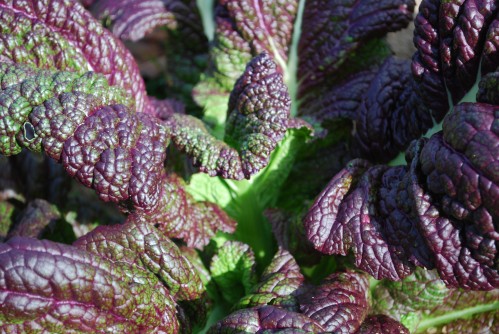
Close Up of Asian Mustard, Red Giant If you like spring greens, you will love to grow and cook with the asian mustard, Red Giant, Brassica juncea. Easily started by seed, it is a cool season annual which is slightly peppery in taste with magnificent green to dark purple textured leaves. Although it is "cold and bolt" tolerant, if allowed to flower, it has incredible yellow flowers that emerge as a tall spike out of its center, as a final encore.

I have to admit I was first drawn to Red Giant mustard for its magnificent beauty. At different times of the day, it even appears to have a copper glow about it. I bought seeds to make a winter to spring border in my kitchen garden, or potager. It is equally striking in a landscape planting, or even paired with the wonderful ornamental cabbage and kale in a cool-weather container design.

A part of the Mustard family, and thought to be originally from India, the asian mustard, Red Giant, is one of the most popular asian mustards. It is quite different in taste and texture from American mustards, you might have grown. It is extremely versatile, when it is harvested, how it is harvested, and how it is prepared. Do you like spring greens, harvest the young whole plants early, at 20 days for your spring lettuce and mesclun mix. Do you like Asian stir fry, take one or two mature leaves at a time for your recipe, and the plant will continue to grow. Try it as a replacement for chard in your bean soups, julienned, or a substitute for spinach in your quiche. It is nutritionally packed with abundant amounts of vitamin A, C, B vitamins, calcium, and more.

Depending on your climate, you can plant it in the fall, spring, or late winter. It prefers full sun, and light moist fertile-mulched soils. Seeds germinate in 1-2 weeks, young plants can be harvested at 20 days, mature plants at 40 days. For a continuous crop, you might want to sow seeds every three weeks in the spring. I find that it "volunteers" easily for me, and my chickens reap those tasty benefits.

At nurseries, I often see asian mustard, Red Giant, in mesclun mixes, rather than sold by itself. There are many seed companies who have it available online. I first purchased my asian mustard, Red Giant, from the fabulous seed company, Botanical Interests, located in Broomfield, Colorado. Their website is www.botanicalinterests.com.

Do you normally grow mustard in your vegetable garden? What is your favorite way of preparing it? Please share your comments.

Fab Fuji Apples

Just Picked Fuji Apples I have two espaliered* Fuji Apple trees along one side of my potager*. Although I have cared for them diligently for years, feeding annually in the Spring, pruning faithfully in Winter, watering, and observing them as I walk past them everyday (often several times a day), they always limped along for me. The apples were small, sparse, and unappealing. I always attributed it to our zone 11. Fuji Apple trees do best in zones 6-9, 14-16, and 18-22. Nonetheless, I love my espaliered Fuji Apple trees.

Something happened this year that I am still trying to figure out. This year I have an abundance of beautiful large sweet Fuji Apples! I understand now their popularity. You will truly experience one of life's little pleasures simply by eating a ripe Fuji Apple fresh off the tree.

Created in Japan in the 1930's, the Fuji Apple comes from American beginnings, a combination of the Red Delicious and Ralls Genet, an heirloom apple that dates back to Thomas Jefferson, 1793. Fuji Apples were first introduced into the United States in the 1960's. They are a late season apple, harvested in late September and October. They are distinctive in appearance with a yellow-green background color and red highlights. Excellent for eating fresh, and in autumn salads, they are also good to use in pies and sauce. Fuji Apples have a very firm, crisp flesh, and are very sweet and juicy to the taste. They store exceptionally well.

Putting on my detective hat, and delving into the habits of Fuji Apples trees, I have since learned that it can take several years for them to get established and bear reasonable fruit, they have a tendency to bear heavy crops in alternate years, and it is best to plant another Fuji Apple tree within 20 feet of each other, or another mid to late-blooming apple tree for pollination. They do best in zones with a mild winter, and have a long growing season with apples that take 160 days to ripen. Their fruit needs 100 to 400 winter chill* hours to establish dormancy. So it seems there are a number of factors that can affect Fuji Apple fruit from year to year.

Every year there is at least one thing in the garden that really surprises me. This year it is the fabulous Fuji Apples. With these "just picked" Fuji Apples, I am going to make my "Apple Crumb Pie", see recipes.

Glossary

    *Espalier--French term for training a tree or plant to grow in a specific shape or form, usually on a flat surface such as a wall or a building. The shape is often architecturally appealing and space saving.

    *Potager--French term for kitchen garden which is usually gardened year-round, and is often laid out in a formal and ornamental style.

    *Winter Chill--As it pertains to apple trees, is the number of hours in a climate zone where temperatures are at or below 45 degrees F, 7 degrees C.

Tomato Stars

 Collage of Colors I have just about eaten all of my tomatoes grown on the vine for this season. It is a short season, but "oh so tasty" a season. Being in Zone 11, tomato growing can be something of a challenge. Each year I seem to get a little better at growing and harvesting the rewards. Every spring I search out new tomato seedlings to try and experiment growing. This year had several stars.

There are tomatoes in just about every rainbow color. I'm drawn to the black and purple, like Black Prince, Black Krim, and Cherokee Purple for their smoky, earthy flavors. I also lean towards the orange and yellow tomatoes...something that will pop out at you in a salad, pizza, or salsa.

One of the biggest surprises, and tomato stars for me this year was "Jubilee". It is a bright orange, fleshy textured fruit that is prolific on the vine. It was the All-American Bronze Medal winner in 1943.    Another star was "Fuzzy Peach", a 100 year old heirloom which actually looks like a lemon-colored peach, and has the fuzzy texture, to bout. When it ripens it has a slight blush pink color. It is a mild tasty tomato, which was delightful when I used it in my homemade salsa. It is about 2 ounces in size, and has outstanding storage ability, too. 

An enduring tomato star is the heirloom cherry tomato, "Sun Gold".  It is actually golden orange in color. It is so sweet and unforgettable in taste, it is hard not to eat them all right in the garden. The fruit grows in sprays of 6 to 8 together, so pretty, one can imagine using them as a subject in a painting. Sun Gold Tomato

I had never grown the fabulous hybrid tomato, "Celebrity" until this year.  I was so surprised at the colossal, beautiful red, firm, flavorful fruit it produced.  Colossal, meaning one slice will cover your entire hamburger, and then some. The vine as it grew was very strong and even sprawled up and over the rusted antique iron bed frame I provided for support. With this beauty, I felt that I was officially a successful tomato grower.

Some key tips to growing tomatoes successfully: 1)  mulch your soil well before planting, 2) plant in a warm sunny area, 8 hours of sun ideally, and when night temperatures are consistently above 50 degrees, 3) plant your tomato seedling deep-stems will root once planted, 4) water deeply and frequently in the beginning and less as the tomato plant matures, 5) fertilize your seedling plant when first planted, a month or so later, and then on an as needed basis, and 6) rotate your tomato spot in your garden each year if possible.

Finding tomato seedling sources is as much fun as growing them. There is always your favorite local nursery.  Other sources I have used in San Diego are: www.summerspastfarms.com, www.tomatomania.com and www.pearsonsgardens.com.