
 Ceanothus are California's wild lilac. A native evergreen shrub which is drought tolerant and spring time showy with lavender-blue 6" spikes. Belonging to the Rhamnaceae (Buckhorns) family, Ceanothus shrubs, in general are drought tolerant once established and are found frequently growing in California's native chaparral. There are many different varieties of Ceanothus in form and blooming lavender-blue colors. Ceanothus bloom winter to spring and are simply stunning. Three of my favorite Ceanothus are Ceanothus concha, Ceanothus dark star, and Ceanothus Ray Hartman.
Officially a shrub, Ceanothus Ray Harman variety has an upright tendency. It is one of the Ceanothus varieties that can be trained into a mature small tree, sometimes reaching up to 15' high and 10'-15" across. It does best in Zones 8-9.
In the above photo, my Ceanothus Ray Hartman is planted close to my soft-hued brown stucco wall for a pleasing backdrop. I planted four Ceanothus Ray Hartman in my garden a few years ago, and they grow quickly.
A few tips to share with you in creating a Ceanothus Ray Hartman tree in your garden. I purchased one-gallon size plants from the extraordinary California native nursery, Tree of Life Nursery. Tree of Life Nursery is located about 7 miles east of San Juan Capistrano on Ortega Highway. If you are serious about introducing more California natives in your yard and garden, Tree of Life Nursery is the place to go. Tree of Life Nursery offers over 20 varieties of ceanothus, as well as many other popular natives, and lesser known natives.
If your intention is to shape your Ceanothus Ray Hartman upright into a small tree, purchase Ceanothus Ray Hartman plants that have a nice single stem. Plant in a sunny spot with ample room. Water regularly to give it a good start, and then taper off once established. Prepare to support your Ceanothus Ray Hartman with stakes as it begins to grow and fill out.
Let your Ceanothus Ray Hartman grow and establish itself for a few years. After the second year, begin to trim bottom branches off of its main trunk slowly, at three month intervals. Nip or prune 6' off of the tips of some of your top branches and start shaping your tree. Trim as necessary to shape your tree into a nice upright tree form. This type of pruning encourages your Ceanothus Ray Hartman to grow upward and fill out into a beautiful wild lilac tree.
Please share if you are familar with the beauty of the Ceanothus varieties. Please comment if you have started introducing native plants into your garden.
Thank You for Visiting VGG Sponsors!
San Diego Horticultural Society announces its Spring Garden Tour, Saturday March 13, 2010. Tickets are $15/members, $20/non-members. To purchase tickets and more detailed information, please go to www.SanDiegoHorticulturalSociety.org


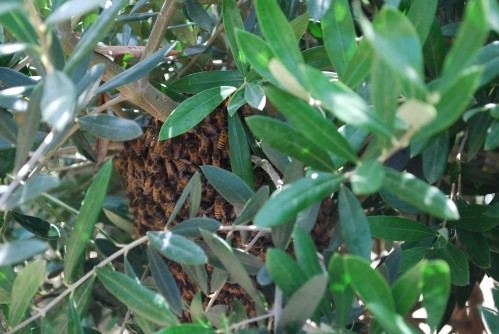 I know that nothing is a coincidence. Just last week I experienced my second honey bee swarming. The first one was in a friend's backyard a few years ago, and the second one was last week, close to our vineyard by the "Little Ollie" olive trees. At first I noticed a tiny dense dark cloud moving above our vineyard, with motion and fervor. Following this sight with my eyes for a while, it dawned on me that it was a swarm of honey bees. Upon further investigation and with the mission to water our "Little Ollie" olive trees, I spotted the swarm, quiet and resting under one of the branches. I wasn't afraid of them, and knew that they would be soon travelling on.
 Does your mom live a "stone's throw" away from you? Are you able to make her and all of your loved ones a delightful Mother's Day Brunch celebrating "her day" with your fresh eggs, delicately poached over heart-shaped polenta, melon-drizzled vinaigrette over arugula greens, blue cheese, and proscuitto, and gloriously ending with fresh berries and sour cream coffeecake? No, does she live out-of-state like my mom? Well, here is a great suggestion.
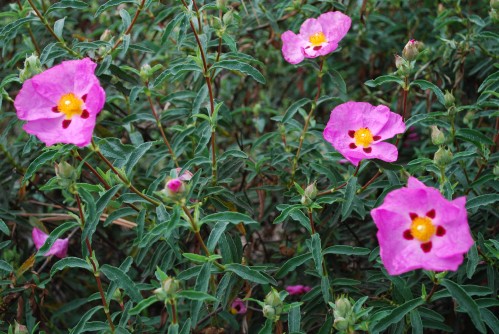 This is another spring blooming delight, Orchid Rockrose, Cistus x purpureus. Although this is a native Mediterranean drought tolerant shrub, something about it reminds me of an English country garden.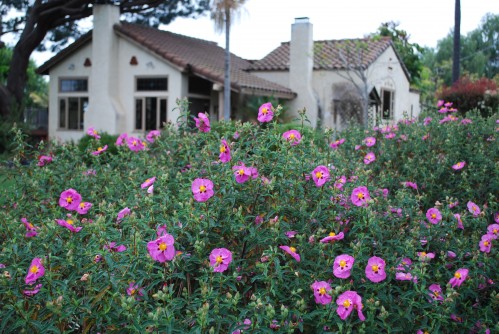
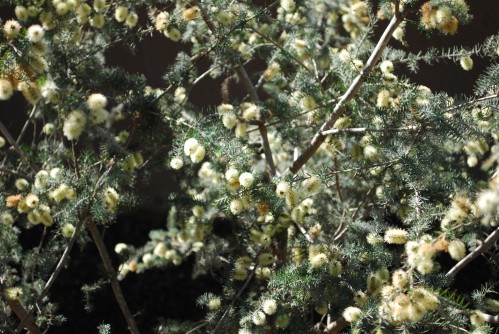 I wanted to write about the Grey Honey Myrtle tree, because it is one of my stellar nursery choices, of the last two years. You know the ones. They catch your eye in their generic container. You have an inkling they could look nice in your garden or yard. You take them home, plant them, and you all settle in. Presto, you wonder how you ever lived without them. They do something incredible and unknown to you, such as a totally unanticipated explosion of color. Yes, it is a big deal, because there are many more lackluster nursery choices that seem to fizzle, and all with good intentions. Has this happened to you?