Posts in Garden
Garden Circle of Sweet Peas

Garden Circle of Sweet Peas Nothing says "spring" like a dainty bouquet of fragrant ruffled sweet peas. There are so many colors to choose from like elegant whites, soft pastels, and even vibrant reds to purples. You might just have to grow several varieties.

Many types of sweet peas are the old-fashion kind, which need a fence or some type of support to encourage them upward. There are some new types of "bush" sweet peas which don't require any support and are equally attractive planted as a border in your garden, or in a circle around the base of a birdbath. There are also new "container" sweet pea varieties available for another very different effect. Place them on an outdoor table or on your patio for a splash of color.

If you are planting sweet peas which need a support to climb, why not get a little creative with your support fencing. Try a "garden circle of sweet peas" in your garden. Plant your sweet peas in some form like a circle, maze, square, or in parallel rows before an arbor. In other words, try some non-traditional form plantings. In the above photo, I used a perfect circle of wire reinforced with chicken wire and open at the bottom, from a load of river rock I bought last summer.

Renee Shepard of, Renee's Garden seeds, has a true love for sweet peas, and might just be responsible for a "modern day one-woman renaissance of sweet peas." She offers over 20 different delightful sweet pea seed varieties, and several articles on ensuring "sweet peas success" in your garden, Renee's Garden Sweet Pea Seeds and information.

If you love sweet peas, and can't get enough of them in your own garden, it is worth a visit to Summers Past Farms Sweet Pea Day, east of San Diego, for a life-size sweet pea maze at their annual "Sweet Pea Day" each April. Proprietors Marshall and Sheryl Lozier, encourage you to pack a picnic and bring the kids, or make it a special "garden gal" day with friends. Mark your calendar.

Welcome "spring into your garden" with romantic sweet peas, in your favorite colors, and grown in your favorite way. Please share if you grow sweet peas every year. Please comment on how you grow, and like to use your sweet peas.
Bay Laurel Tree

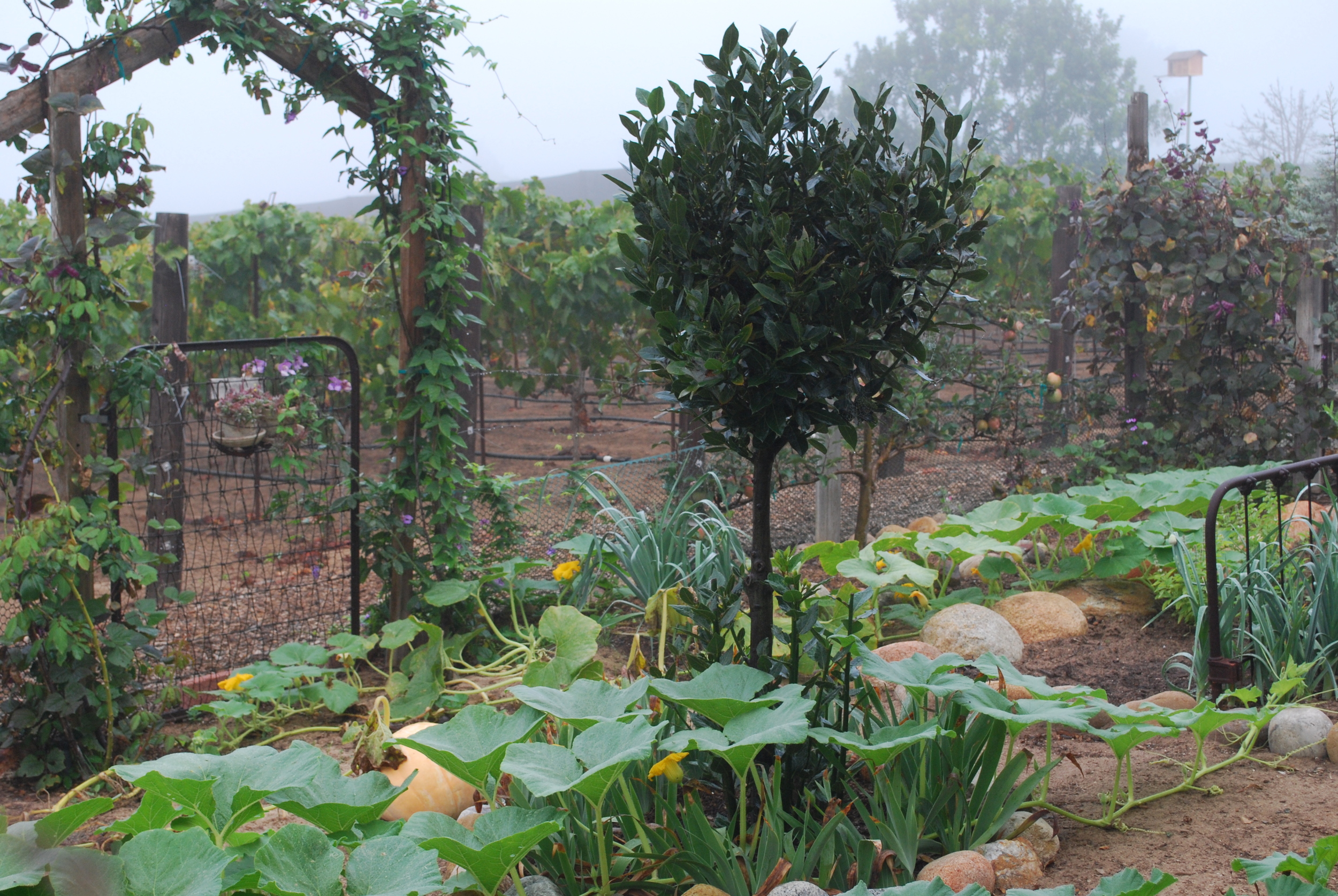
Early Morning In Potager, Bay Laurel Tree Centerpiece Everyone should have a Bay Laurel Tree in your garden, if you are in zones 5-9, and 12-24. There are as many uses for this tree and its green glossy aromatic leaves, as its many names. The names Bay/Sweet Bay/Laurel, Laurus nobilis are all the same tree. Sweet Bay is currently enjoying recognition as the 2009 Herb of the Year, as chosen by, The International Herb Association.

The Bay Laurel Tree is a Mediterranean evergreen shrub or tree. It is a slow grower but eventually can reach 12-40 feet in height. Fortunately, it responds well to trimming and can be shaped into a desirable topiary form. A few years ago in my potager, or kitchen garden I planted a Bay Laurel Tree in the center and as a focal point. I have shaped it into a sphere on top, and am presently shaping a smaller lower sphere closer to the ground. Bay Laurel trees take full sun or partial shade and appreciate moderate water.

Bay Laurel leaves are really desirable for decorative use in a wreath or crown, and as a culinary use in many types of recipes, and the well-known "bouquet garni". It also has household, cosmetic, aromatic, and medicinal uses.

"Bouquet Garni" is a french term for a bouquet of fresh herbs, tied together with kitchen string, and generally allowed to dry before steeping in stews, soups, sauces, stock, marinades, and the like. Typically, fresh herbs are rolled together using parsley, thyme, and flanked by bay leaves.

Karen England, Edgehill Herb Farm, is a recognized herb expert, garden speaker, and teacher of herb-related cooking classes in the San Diego area. She spoke to The San Diego Horticulture Society this past summer on Bay Laurel, and in a hand-out shared these adapted instructions for creating a bay wreath.

Make Your Own Laurel Bay Wreath Supplies Needed: Fresh bay branches, wreath form, paddle wire (available at craft stores), clippers, and optional ribbon.

Directions: With clippers, cut bay branches into lots of approximately of 3-4" sprigs. Using the wire, attach securely the sprigs to the wreath form. How much bay you will need depends on the type and size of the form you have chosen. Hanging Tip: Dry the finished wreath flat on a table for a week or so before hanging. This will prevent your wreath from drooping and drying lopsided.

Use: These completed wreaths can be hung as a decoration in a room or on a door, used for culinary purposes dried, or even as a fresh "laurel crown" on your head, just in time for Halloween. You could also make a garland swag of Bay Laurel using a length of stiff straight wire.

Please note, all laurels except the Bay/Sweet Bay/Laurel are poisonous. Make sure you identify the correct Bay Laurel Tree.

Please add your thoughts on Bay Laurel? Do you have a tree in your garden? What are your favorite uses? Have you ever seen a freshly made verdant bay wreath?

Highlighting Pelargonium "Limelight"

Springtime Pelargonium Limelight We are well into our wonderful fall splendor with its warm glowing autumn hues, so why am I mentioning the springtime Pelargonium "Limelight"? Because it is a must-have perennial in your garden. I thought if I highlighted it in the fall, it might afford you some time to find it, plant it, and enjoy it this upcoming spring.

Please forgive me as I really don't have a source for you either. You will have to diligently search the Internet for possible mail-order nurseries who might carry it or maybe request it at your favorite local nursery. My Pelargonium "Limelight" was a gift from a friend, in the form of a dainty small cutting. Aren't those the best kind of gifts? So put this one on your plant "wish list", and keep your eye out for it.

Pelargonium "Limelight" is a perennial which absolutely glows in the spring with its beautiful chartreuse foliage and dainty pink flowers. It is a pelargonium that is well-suited for zones 8, 9-11, and will grow in partial shade to sunny spots with moderate watering. I really think it thrives best in shady spots. If you are looking for the chartreuse foliage color in a very sunny spot, I suggest you look at the wonderful Euphorbia plant varieties. Pelargonium "Limelight" does have a tendency to want to climb slightly 1' to 3', as it grows and matures. I have it growing at the base of one of my arbors which is in a shaded, supported, and protected spot. Pelargonium "Limelight" gets the attention it deserves, as you pass through my arbor.

A few springs ago, I had the pleasure of a visiting local garden club, and everyone wanted to know the name of this perennial, Pelargonium "Limelight". Are you familiar with Pelargonium "Limelight", and have it growing in your garden now? Do you have trouble finding showy plants for your shady areas? Do you share with your friends "garden cutting" gifts?

Honey Bees Are Great For Your Garden

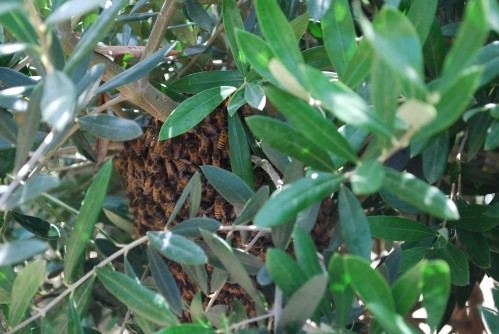
Swarm of Honey Bees Resting I know that nothing is a coincidence. Just last week I experienced my second honey bee swarming. The first one was in a friend's backyard a few years ago, and the second one was last week, close to our vineyard by the "Little Ollie" olive trees. At first I noticed a tiny dense dark cloud moving above our vineyard, with motion and fervor. Following this sight with my eyes for a while, it dawned on me that it was a swarm of honey bees. Upon further investigation and with the mission to water our "Little Ollie" olive trees, I spotted the swarm, quiet and resting under one of the branches. I wasn't afraid of them, and knew that they would be soon travelling on.

Swarming is an important part of the honey bee reproductive life cycle, and how they create new colonies for the new and old queen bees. Scouts from the swarm are sent out to find a new suitable spot for a permanent hive. In the mean time, the swarm rests, patiently protecting the queen bee, and is usually not aggressive. If you find a swarm, it is best to leave it alone. Do not spray the swarm with insecticide. Chances are the swarm will be there for only a day or two, and then move on. Contact a professional beekeeper, or your local Cooperative Extension office for questions and assistance.

We all have heard about the alarming diminishing honey bee populations in our country today. There is speculation that the bee populations might be experiencing repercussions from global warming, harmful effects from pesticides in our environment, and even experiencing some pest or fungus ravaging them. The truth is, we really don't know what is happening to our honey bee populations. This is devastating to our agricultural crops, especially almonds, and trickles down to our very own backyards, with our flower and vegetable gardens. We need bees for pollination, and of course for the golden nectar, honey.

Coincidentally last week, a special garden friend recently told me about Gretchen LeBuhn, and The Great Sunflower Project. Gretchen LeBuhn is a Bay Area biologist, who started this "grass roots" project in 2008, with little money and realistic expectations. She created a website where people could sign up, receive the specific "Lemon Queen" sunflower seeds, and then count the number of bees that visit these blooming sunflowers in their yards. This projected has blossomed to the point where she now has bee-data feedback from people in all 50 states, plus Canada. Tens of thousands of volunteers, and growing, are very concerned about the plight of the honey bee, and want to help her cause. As Gretchen LeBuhn states on her website at the bottom, "Bees: Responsible for Every Third Bite of Food".

For more coincidence, Sunset magazine's current August 2009 issue features Gretchen LeBuhn in a two page article, called "Hive Minds", page 54.

I have signed up, and you hope you will , too. Are you already part of The Great Sunflower Project? What are you finding in your own backyard with bees? All of these coincidences are a wake-up call, to help with the plight of our honey bees.

Make Mom Happy With A Rose Plant

Double Delight's First Spring Bloom Does your mom live a "stone's throw" away from you? Are you able to make her and all of your loved ones a delightful Mother's Day Brunch celebrating "her day" with your fresh eggs, delicately poached over heart-shaped polenta, melon-drizzled vinaigrette over arugula greens, blue cheese, and proscuitto, and gloriously ending with fresh berries and sour cream coffeecake? No, does she live out-of-state like my mom? Well, here is a great suggestion.
Stumped what to get your mom for Mother's Day? Say you "love her" with a symbol of love, a beautiful new rose plant for her garden. If you're a gardener, chances are you got your love of "digging in the dirt" from her.

If you haven't heard of Edmund's Roses before, you are in for a treat. Edmunds' Roses has an extensive selection of all kinds of bareroot roses, such as antique roses, floribundas, climbers, tree roses, hybrid tea roses and more. Once ordered, Edmunds' Roses sends out bare root roses, time-appropriate according to your plant zone you live in, so you receive your roses at their optimal time for planting. Prices and shipping are reasonable.

Edmunds' Roses is open year round for orders, and customer service, but actually ship their bare root roses from December through May each year. With Mother's Day less than a week away, you might consider sending your mom a gift certificate from Edmunds' Roses. Your mom can choose what type of rose she would like, what color, and when she would like it to redeem it. Gift certificates never expire and are available by phone only at, Edmunds' Roses, 1-888-481-7673, Monday-Friday, 8am-4:30pm CST.

A rose plant is something living, and keeps on giving year after year. It is a plant of beauty and emotion. Your mom will enjoy her rose and think of you, in her garden for many years.

Edmunds' Roses is a wonderful idea for other occasions besides "Mother's Day", such as the holidays, birthdays, anniversaries, new home, new baby, and thank you.

Please go to Edmunds' Roses for more information and online ordering.

Orchid Rockrose Shrub

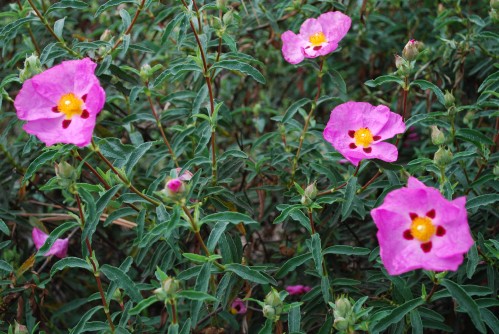
Close Up of Blooming Orchid Rockrose This is another spring blooming delight, Orchid Rockrose, Cistus x purpureus. Although this is a native Mediterranean drought tolerant shrub, something about it reminds me of an English country garden.
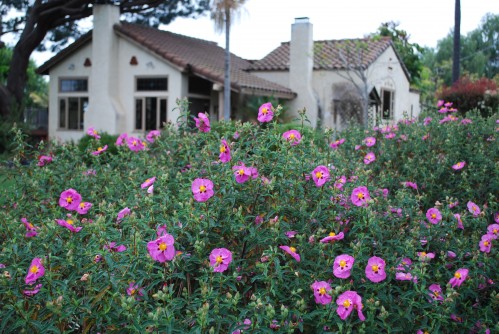
Former neighbors of mine had several one gallon Orchid Rockrose shrubs left over from a landscape installation, and asked me if I would like them. Not familiar with the Orchid Rockrose at the time, I boldly mass planted them in an informal hedge, in a sunny dry spot on our property. Besides a beautiful informal hedge, this shrub is suitable for rock gardens, fire-prone areas, erosion-control, and natural settings.

The hedge has grown to about 4' high x 4' wide. It blooms in the spring for about a month with 3" deep pink "happy face" flowers. Each flower has a deep burgundy spot at the base of each petal, with a yellow-orange yolk center. Their flower is very distinctive, and friends always ask me the name of this shrub.

When Orchid Rockrose is not demonstrating its showy bloom, its dark green evergreen foliage continues to please. It is an easy shrub to care for, thrives in full sun, requires little water, and grows quickly in poor soil and adverse conditions such as high heat, winds, and ocean salt air. It does not like a lot of pruning as a mature shrub, but can be top-tipped for fullness, and pruned easily as a young shrub.

  Orchid Rockrose Hedge

It grows well in zones 6-9, and 14-24. There are a number of different species within the Cistus family, with different flower colors, and characteristics in appearance. You can find the Orchid Rockrose shrub in local Southern California nurseries, and online, too. Be sure and start with a small container size, and adequate spacing, as it grows quickly.

If you are looking for a low maintenance, drought tolerant shrub, you might consider the versatile and showy, Orchid Rockrose.

Grey Honey Myrtle Tree

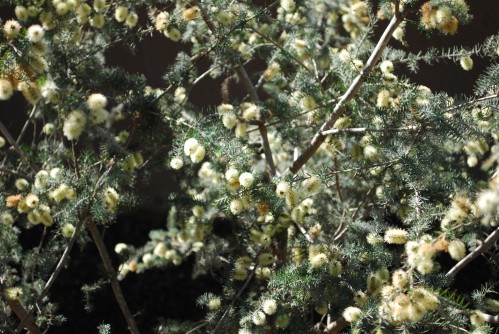
Close-Up of Blooming Grey Honey Myrtle Tree I wanted to write about the Grey Honey Myrtle tree, because it is one of my stellar nursery choices, of the last two years. You know the ones. They catch your eye in their generic container. You have an inkling they could look nice in your garden or yard. You take them home, plant them, and you all settle in. Presto, you wonder how you ever lived without them. They do something incredible and unknown to you, such as a totally unanticipated explosion of color. Yes, it is a big deal, because there are many more lackluster nursery choices that seem to fizzle, and all with good intentions. Has this happened to you?
One of my favorite trees, and stellar nursery choice, is the petite but ever so charming, Grey Honey Mrytle tree, Melaleuca incana. This little darling can actually be grown as a shrub up to 9' tall and wide, or shaped into a small graceful tree. It has a very appealing weeping and lacy branch structure with blue-slate needlelike foliage. In early spring, it blooms profusely in a plethora of tiny "cream puff" flowers that beckon birds and bees.

The Grey Honey Myrtle Tree is a native of Australia, and part of the mammoth melaleucas family which has over 140 species. Optimum climate zones vary by species. It is safe to say that this melaleuca does well in zones 8,9, and 12-24. It will thrive in full sun to partial shade, and is drought tolerant when established. It is an easy tree to care for, and can endure poor soil, wind, heat, and low moisture conditions. In my opinion, the Grey Honey Myrtle tree is a moderate to slow grower, although melaleucas are generally thought of as fast growers. Lace pruning is a good idea to enhance its weeping style, and keep it off of the ground.

My Grey Honey Myrtle tree was planted as a screen, close to my fawn-colored brown stucco fence. Its contrasting grey foliage against this backdrop, and backlit with southern sunlight is stunning. This is a beautiful, very striking ornamental tree for your yard or garden. It too, could be a stellar nursery choice for you.

If you live in a Mediterranean climate, these trees (shrubs) should be available at your local nurseries. In the San Diego area, I have seen them for sale at a few places, but most recently at Buena Creek Gardens. They are also available online through various websites.

Dazzling "Razzleberry" Shrub

Blooming Razzleberry Ruby Shrub

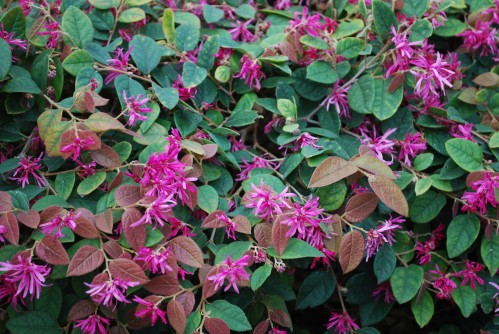
Another favorite early spring blooming shrub of mine is the showy "Razzleberry" evergreen shrub, also called Chinese Fringe Flower Loropetalum chinense, var. rubrum "Razzleberry". Its striking deep pink fringe-like flowers have a sort of "flopsy mopsy" show-off demeanor. In spring, its foliage is a verdant green, deepening to a beautiful bronze color later in the year.

Not only are its flowers and leaves showy, I love its mound-like structure, too. Although it can reach 4 feet high and wide in maturity, I keep mine compact at about 3 feet high by 3 feet wide, and off of the ground. Its layers of graceful arching branches add to Razzleberry's flowering drama which is best in the spring, but it can flower at other times throughout the year, too. It benefits from a shapely trim, now and then, and certainly before its spring bloom.

Originally from Japan and Southern China, this evergreen shrub is drought tolerant once established, and likes sun to partial shade. I planted mine under a mature avocado tree, so it has sun and partial shade. I also planted it along my boxwood pathway, surely to be noticed by passersby.

The Razzleberry shrub can be used in many different ways in the garden. Place it in an entrance to a sun-speckled woodlood garden. Plant it next to a wonderful gurgling water feature. Espalier it against your courtyard wall. With young plants, you can pot it in a patio container with other color, or in your favorite moss-covered hanging basket.

Loropetalum chinense, or Chinese Fringed Flower, comprises a large variety of cultivars, with pink, red, or white flowers and various other size and structural characteristics. Besides, the Razzleberry, other popular varieties are Ruby, Sizzling Pink, and Burgundy. They grow best in zones 7-9. These shrubs are easily found in local nurseries, and by mail order via the internet.

For an eye-catching addition to your spring garden, plant a dazzling Razzleberry shrub. Do you have a Chinese Fringed Flower shrub in your garden, you'd like to share comments on?