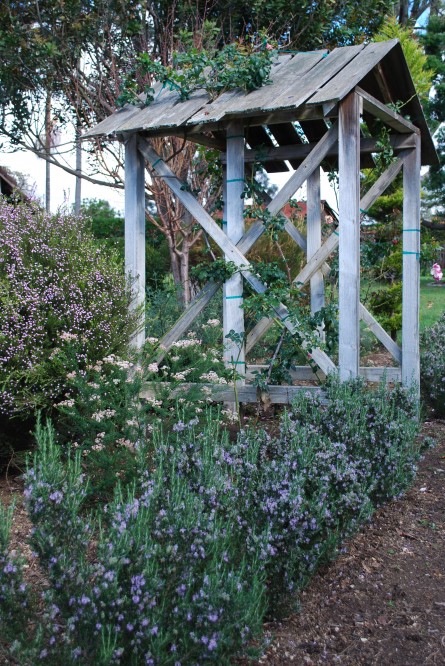
 Let me introduce you to the "Majorca Pink" rosemary, Rosmarinus officinalis, "Majorca Pink", planted along the front edge of the arbor in the photo above . It is an upright rosemary which can grow 2-4 feet high, and 1-2 feet wide. It has pretty pink lilac flowers, with a hint of fragrance. Its flowers attract bees, birds, and butterflies. It blooms in the winter time here in Southern California, in my Mediterranean climate. Its flowers are edible, and can be used as a garnish. Its dark green, glossy, aromatic leaves are a great culinary herb.
I stumbled across this "Majorca Pink" rosemary, quite by accident, unknown to me until last year. I thought it might work for a hedge or border on the south side of my middle garden. It is a location with wonderful sandy soil, and good drainage. This spot also receives a lot of sun, and is dry.
I planted this hedge, with several 1 gallon "Majorca Pink" rosemary plants spaced about one and half feet apart. The same method you would use to start a boxwood hedge. Let the plants establish themselves first for a year, and then you can trim their tops slightly if they reach the approximate height you are desiring. After tipping their tops, their sides will eventually reach for each other in the form of a hedge. The "Majorca Pink" is very easy to care for, and I have just let it go, liking the shape and the hedge it is forming. This type of rosemary is very pretty laced, as well.
I have several types of rosemary woven throughout my garden, besides the "Pink Majorca", such as the "Tuscan Blue", "Prostratus" and "Huntington Carpet". There are many, many other types to discover, too. Search the internet or your local nurseries for different ones. You just might surprise yourself, I had never thought of using "Pink Majorca" rosemary as a hedge.